You accept a job that starts Monday. In Phoenix, your new boss is legally bound to run your name and documents through a federal database before your first paycheck clears. In Los Angeles, that same boss can be fined for using the same tool the wrong way. In Dallas, it depends entirely on whether the company holds a state contract. Same federal system, three different answers, because the mandate is written by states, not Washington.
The question got louder this month. On November 19, 2026, the General Services Administration and the Department of Homeland Security announced they had flagged 1,579 federal contractors holding more than $50 billion in contracts as potentially out of compliance with E-Verify rules, giving them 30 days to respond. That crackdown is about federal contractors, who are already covered by a federal clause, FAR 52.222-54. For everyone else, whether E-Verify is mandatory at all is a state-by-state patchwork.
What E-Verify is, before the mandates
E-Verify is a free online system run by U.S. Citizenship and Immigration Services with the Social Security Administration. An employer enters the information from a new hire's Form I-9 and the system checks it against government records to confirm the person can legally work. It is available to employers in every state, and for most of the country it is voluntary. What changes at the state line is whether your employer has to use it, and which employers are swept in.
States where every hire gets checked
Arizona set the template. Under the Legal Arizona Workers Act, every employer in the state must verify each new hire through E-Verify, with no size exception. The statute, A.R.S. § 23-214, has required it since 2008, and a one-person shop is covered the same as a large company.
A handful of other states reach all or nearly all private employers, including Alabama, Mississippi and South Carolina. Tennessee is joining that group on a timer: today the mandate applies at 35 employees, but starting January 1, 2027 the Tennessee Lawful Employment Act reaches every private employer with at least one employee for hires made on or after that date.
States where a headcount flips the switch
Several states tie the mandate to how many people you employ. Florida is the one most workers have heard about. Under Florida Statutes § 448.095, a private employer with 25 or more employees must run E-Verify on every new hire, a rule in force since July 1, 2023. A 2026 bill to drop the threshold to all employers, House Bill 197, passed the Florida House but died before becoming law, so the number is still 25.
Georgia measures it differently. State law, O.C.G.A. § 36-60-6, requires private employers with more than 10 full-time employees to enroll in E-Verify as a condition of getting or renewing a local business license, and smaller firms must sign an affidavit claiming the exemption. North Carolina draws its line at 25 employees in the state; its labor department spells out the rule under N.C.G.S. § 64-26, with workers employed fewer than nine months in a year left out of the count.
The thresholds are not interchangeable, and they are not always counted the same way. Some states count only full-time staff, some count everyone on the federal tax ID including workers in other states, and some exclude seasonal help. If you are near a line, the definition matters as much as the number.
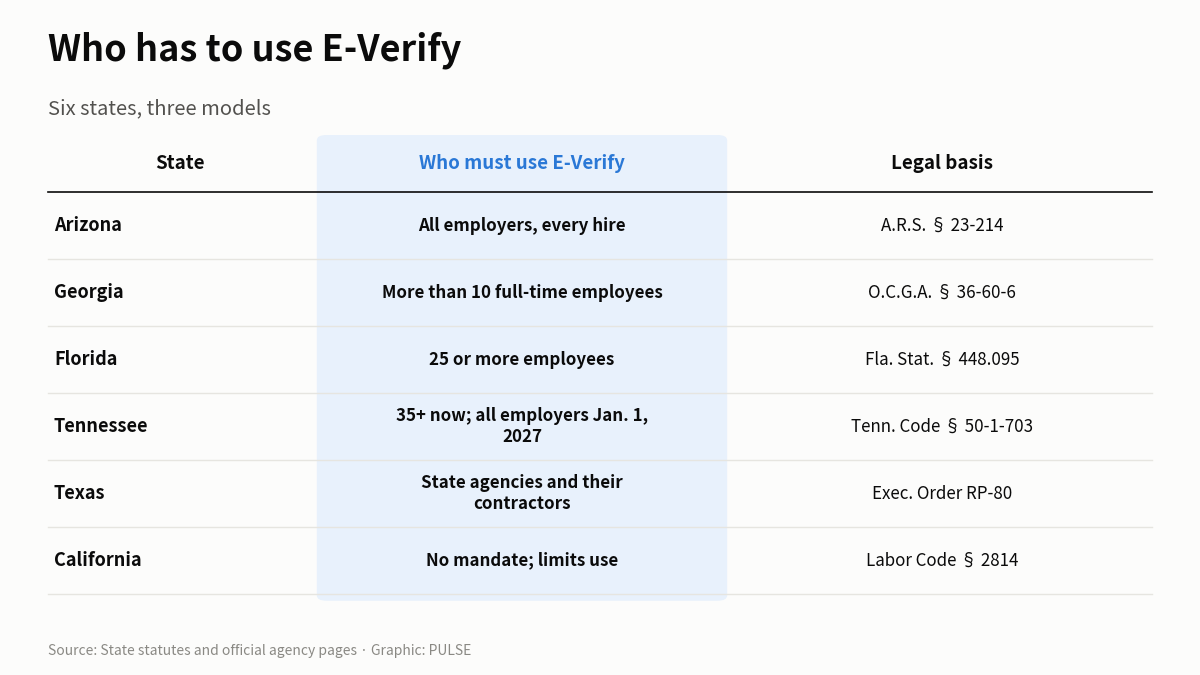
| State | Who must use E-Verify | Legal basis |
|---|---|---|
| Arizona | All employers, every new hire | A.R.S. § 23-214 |
| Georgia | Private employers with more than 10 full-time employees | O.C.G.A. § 36-60-6 |
| Florida | Private employers with 25 or more employees | Fla. Stat. § 448.095 |
| Tennessee | 35 or more now; all employers Jan. 1, 2027 | Tenn. Code § 50-1-703 |
| Texas | State agencies, universities and their contractors | Exec. Order RP-80 |
| California | No mandate; limits how E-Verify may be used | Labor Code § 2814 |
States where only government work triggers it
In much of the country the mandate stops at the public payroll. Texas is the clearest example. There is no general statute forcing a private Texas employer to use E-Verify; instead, a 2014 executive order, RP-80, requires state agencies, along with their contractors and subcontractors, to enroll. That account comes from a summary by the immigration firm Foster Global, which reproduces the order; we were not able to pull the executive order itself from an official Texas state page. A 2025 bill to extend the requirement to private employers, SB 324, did not pass. Many states follow this public-only pattern, covering their own hiring and public contracts while leaving private businesses free to choose.
A state that pushes the other way
Not every state is nudging employers toward E-Verify. California runs in the opposite direction. Under Labor Code § 2814, added by Assembly Bill 622, an employer generally may not use E-Verify to check the status of a current employee or of an applicant who has not been offered a job, unless federal law requires it. Violations carry a civil penalty of up to $10,000 each. Employers can still verify someone after a job offer, which is what E-Verify is designed for, but the law blocks using it to screen people who have not been hired.
How to find out what covers you, and what to watch
Start with two facts: the state where the job is physically located, and your employer's headcount under its federal tax ID. Those two things decide most cases. If you are an employee and E-Verify turns up a mismatch, you are entitled to notice and a chance to fix it before any action is taken; ask for the tentative nonconfirmation notice in writing. If you run a business, confirm your number against the exact statute for your state rather than a general chart, because the counting rules differ and a license renewal can hinge on an affidavit. Two dates are worth marking: Tennessee's expansion to all private employers on January 1, 2027, and any 2027 legislative sessions in states like Florida and Texas, where bills to widen coverage have come close. Federal contractors in the current sweep should note the 30-day clock in their notice, after which the government says contracts can be suspended or canceled.
How we checked this
We read the GSA and DHS announcement dated November 19, 2026; the federal contractor clause FAR 52.222-54; and the USCIS E-Verify site. For state rules we used primary or official sources where they existed: Florida Statutes § 448.095 on the Florida Senate site, the Arizona Attorney General's Legal Arizona Workers Act page and A.R.S. § 23-214, Georgia's O.C.G.A. § 36-60-6 as published in an official city compliance guide, the North Carolina Department of Labor's E-Verify FAQ, the University of Tennessee's Municipal Technical Advisory Service summary of the Tennessee Lawful Employment Act, and California's Labor Code § 2814 on the state legislature site. All figures were confirmed current as of November 23, 2026. Two limits: we could not load the Texas executive order RP-80 or the National Conference of State Legislatures tracker from their official pages, so Texas rests on a law firm's reproduction of the order, noted in the text, and the total count of states with mandates is not relied on here. Thresholds change by legislative session, and the way each state counts employees differs, so check your state's statute before acting. Spot an error? Write to connect@blinkhub.net.
Cover photo: DΛVΞ GΛRCIΛ / Pexels