Have a baby in Maine this year and the state has already set aside $500 for that child's education. You don't fill out a form. You don't open an account. It happens on its own, and the money waits.
Move that same family to Illinois and the deal flips. The amount drops to $50, nothing arrives automatically, and a parent has to open a 529 account and file a claim before the child turns 10 or the offer disappears. Same idea, wildly different terms.
A short list of states now puts public or philanthropic money into a savings account for children, a model often called a children's savings account or a "baby bond." The dollar figures are small next to a tuition bill. What varies most is not the amount but the fine print: who has to act, and by when.
The deposit is real, but the rules change at the state line
California runs the largest version. Through CalKIDS, the state deposits $100 for babies born on or after July 1, 2023 (or $25 for those born in the prior year), and it opens the account for them. School-age children can get far more: $500 for a low-income or English-learner public school student, plus another $500 if the child is in foster care and $500 more if the child is experiencing homelessness, stacking to as much as $1,500.
The scale is large. California's governor's office reported in August that more than 6 million CalKIDS accounts have been established with over $2.3 billion in deposits, and that one million families had claimed them. That claiming step matters: the account and the base deposit are created for you, but the cash sits unused until a parent or guardian registers it, and the extra bonuses only land if you act.
Where the money shows up on its own
Two of these programs ask nothing of a new parent. Maine's Alfond Grant awards $500 automatically to every Maine resident baby, funded by a private foundation rather than the state budget. The first children to receive it at birth are now old enough to spend it on college, and the foundation says the original $500 has grown to roughly $2,400 for the earliest recipients.
Nevada takes a different entry point. Its College Kick Start program opens a $50 account for every public and charter school kindergartner, built from student data the state Department of Education already holds. No taxpayer dollars fund it; the money comes from fees paid within the state's 529 plan. Families can't add to that specific account, only to a separate one they open themselves.
Where you have to claim it, and the clock that can run out
The other programs put the burden on the parent, and each sets its own deadline.
Pennsylvania's Keystone Scholars deposits $100 for every child born to a Pennsylvania resident since January 1, 2019. The state creates the account using birth records and mails claiming instructions about five months after a birth, but the funds stay in a holding account until a family opens a separate PA 529 account to reach them. Pennsylvania Treasury set a 2026 claiming window running from May through July, with a $25 bonus for Allegheny County families who also start their own savings account. Money left unclaimed by age 29 returns to the state treasury.
Illinois pairs its $50 with a hard cutoff. The First Steps seed deposit requires a parent to open a Bright Start or Bright Directions 529 account for a child born or adopted on or after January 1, 2023, and to file the claim before the child's 10th birthday. Connecticut's window is tighter still: its CHET Baby Scholars program adds $100, but only if a parent opens a CHET account before the child's first birthday, or within a year of an adoption.
How much is actually on the table
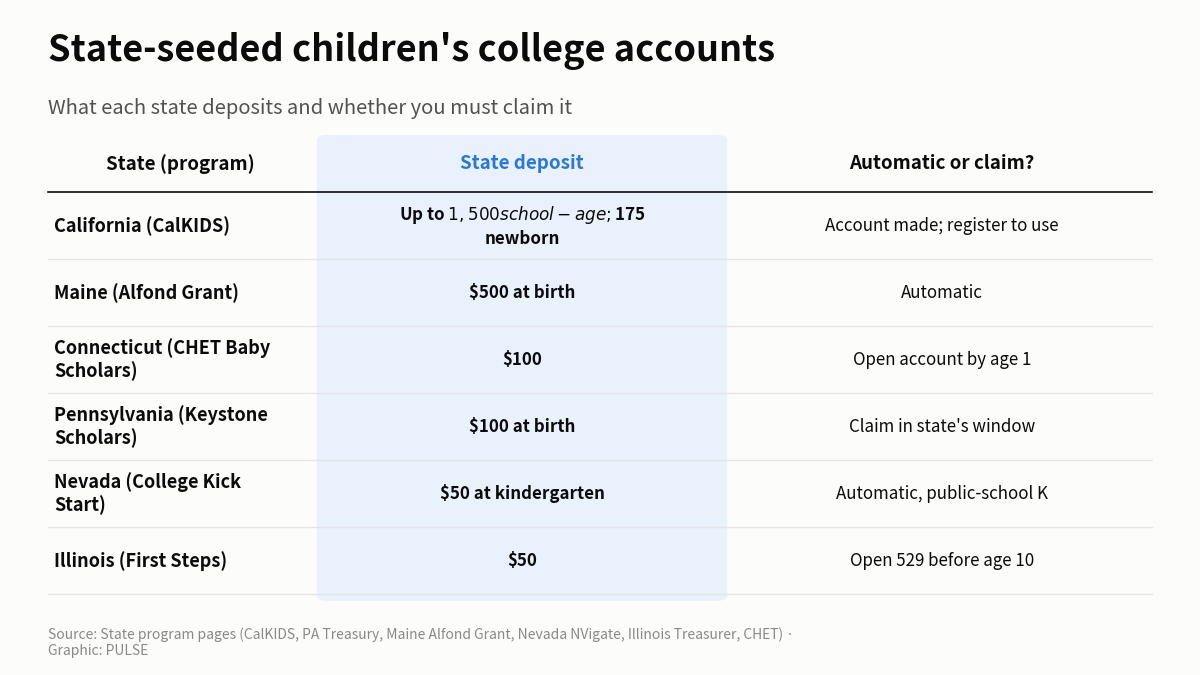
The headline numbers mislead unless you read them next to the strings attached.
| State (program) | What the state puts in | Automatic or claim? |
|---|---|---|
| California (CalKIDS) | Up to $1,500 (school-age); up to $175 (newborn) | Account made for you; register to use it |
| Maine (Alfond Grant) | $500 at birth | Automatic, no sign-up |
| Connecticut (CHET Baby Scholars) | $100 | Claim: open account by age 1 |
| Pennsylvania (Keystone Scholars) | $100 at birth | Claim during state's window |
| Nevada (College Kick Start) | $50 at kindergarten | Automatic for public-school K |
| Illinois (First Steps) | $50 | Claim: open 529 before age 10 |
California's $175 newborn figure is the full stack: the $100 base, plus a $25 bonus for registering the account online, plus $50 for linking a ScholarShare 529 plan. The $1,500 ceiling applies only to a school-age student who qualifies under all three categories at once.
What the account can and can't become
None of this money is cash a family can pocket. Every program restricts spending to education after high school: tuition, fees, books, and in some cases room and board at a college, trade school, or apprenticeship. Maine's grant must be used by age 28; Pennsylvania's reverts to the state near age 29.
The seeded deposit is also a floor, not a plan. State officials in every one of these programs frame the deposit as a prompt to open a 529 and keep adding to it, since the state money alone covers a sliver of any real bill. Connecticut, for its part, notes the $100 depends on available funding and can be reduced or stopped, a reminder that these amounts are set by budgets and board decisions, not guaranteed forever.
What to do before your window closes
Start by checking whether your state is on this list and which bucket you fall in. If you're in Maine or Nevada, confirm the account exists but expect no action is required. If you're in California, Connecticut, Illinois, or Pennsylvania, the deposit is contingent on you, so find your program's portal and note the deadline tied to your child's age. Connecticut's first-birthday cutoff is the easiest to miss. Illinois gives you until age 10, Pennsylvania runs an annual claiming season, and California lets school-age and newborn families register at any time but only pays the bonuses once you do. If your state isn't here, a handful of others, including Rhode Island, Massachusetts, and Colorado, run smaller versions worth a direct check with your state treasurer before you assume there's nothing to claim.
How we checked this
We read the official program pages and documents for each state: CalKIDS and the California governor's office; the Pennsylvania Treasury and PA 529; Maine's Alfond Grant materials through NextGen for ME and Maine Public reporting; Nevada's NVigate College Kick Start pages; the Illinois Treasurer and Bright Start; and Connecticut's CHET Baby Scholars page administered by Fidelity. Figures were confirmed current as of November 23, 2026. We could not retrieve Connecticut's state treasury (portal.ct.gov) page directly because the server did not resolve, so Connecticut details here come from the official plan-manager page; some program PDFs did not render cleanly and were cross-checked against the live program sites. We did not independently verify the exact totals cited in individual state press releases beyond the program pages. Spot an error? Write to connect@blinkhub.net.