Picture a hypothetical driver stopped on a Texas highway carrying $8,000 in cash to buy a used truck. No arrest, no charge, no conviction. Under most states' laws, the officer can still take the money, and the driver has to go to court and prove the cash is clean to get it back. That is civil asset forfeiture, and the rules that decide whether it can happen to you are written state by state.
One of those rules just changed in Texas, though in a narrow way. On November 19, 2026, Texas Comptroller Don Huffines announced that his office would stop seizing property through civil forfeiture. He called the practice "legalized theft" and said his agency would take forfeiture proceeds only from criminal cases that end in a conviction. He also directed the office to make any law enforcement agency that profits from civil forfeiture ineligible for its grant money.
One Texas agency stepped back, but the state law did not move
The announcement covers the Comptroller's own Law Enforcement Operations Division, which pursues tax and fraud cases. It does not change what a city police officer or county sheriff in Texas can do. Under Article 59.05 of the Texas Code of Criminal Procedure, the state can forfeit property by showing, by a preponderance of the evidence, that it is connected to crime. The statute says plainly that "a final conviction for an underlying offense is not a requirement for forfeiture."
Preponderance means more likely than not, the same weight used in a lawsuit over a fender bender. And the money has somewhere to go. Under Article 59.06, local law enforcement agencies in Texas can keep up to 100 percent of what they forfeit—70 percent in uncontested default cases—deposited in a fund for police use. That financial stake is exactly what reform groups point to when they argue the system rewards seizing.
The standard of proof is the dial that matters most
If you want to know how exposed your property is, look first at how hard the government has to work to keep it. The Institute for Justice, a libertarian law firm that grades every state's forfeiture laws, counts 17 states plus the federal government using the low preponderance standard. Twelve states and Washington, D.C., demand clear and convincing evidence, a meaningfully higher bar.
Two states sit at the extremes. Massachusetts uses mere probable cause, the lowest threshold in the country and the same level an officer needs to make an arrest. There, a third party trying to recover seized property generally has to prove their own innocence. At the other end, Florida requires the government to tie the property to a crime beyond a reasonable doubt, the criminal standard, which is rare for a civil proceeding.
A handful of states make a conviction the price of keeping your property
The strongest protection is a flat requirement that someone be convicted before the government can keep what it took. New Mexico rebuilt its law this way in 2015. Under Section 31-27-4, property is forfeited only after the owner is convicted and the state shows by clear and convincing evidence that the property is subject to forfeiture. New Mexico also routes proceeds to the state general fund rather than to the seizing agency, cutting the profit motive.
North Carolina has long leaned the same way. It generally allows only criminal forfeiture, and its constitution sends forfeiture proceeds to the public schools, not to police budgets, though a racketeering exception still permits civil forfeiture under a preponderance standard. California takes a middle path: under Health and Safety Code 11488.4, cash under $40,000 and most other property cannot be forfeited unless the owner is convicted, with limited exceptions such as a defendant who flees.
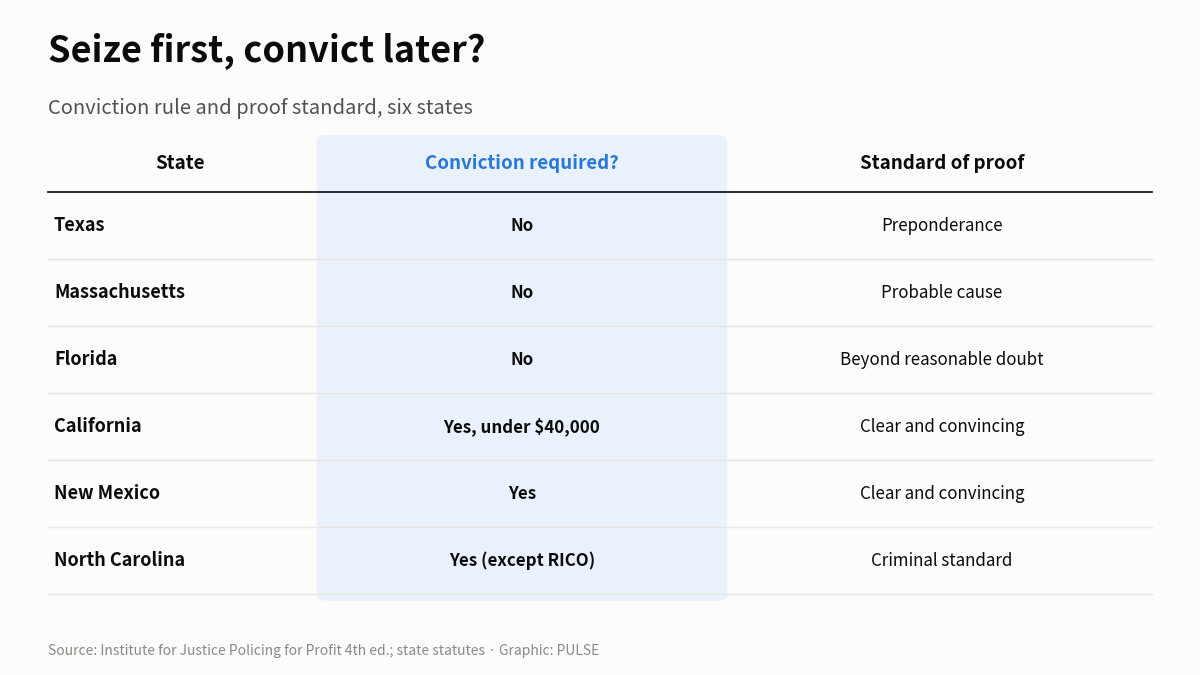
| State | Conviction required? | Government's standard of proof |
|---|---|---|
| Texas | No | Preponderance of evidence |
| Massachusetts | No | Probable cause |
| Florida | No | Beyond a reasonable doubt |
| California | Yes, under $40,000 | Clear and convincing |
| New Mexico | Yes | Clear and convincing |
| North Carolina | Yes (except racketeering) | Beyond reasonable doubt (criminal) |
The Institute for Justice reports that only four states, Maine, Montana, New Mexico, and North Carolina, have effectively abolished civil forfeiture in favor of criminal forfeiture. Even in states with conviction language, the group warns, loopholes remain when an owner misses a filing deadline or when the person convicted is not the owner.
The federal escape hatch your state cannot fully close
A strong state law has a leak. Through a federal program called equitable sharing, state and local police can hand a seizure to a federal agency, forfeit it under federal law, and get back up to 80 percent of the proceeds. That lets agencies sidestep tougher state rules. The Institute for Justice says the federal government has paid out more than $10 billion to state and local agencies through the program since 2000. About a dozen states and D.C. have passed laws limiting participation, but none has shut the door completely.
That is the piece the Texas Comptroller's move touches that most state reforms do not. Huffines said his office would participate in federal equitable sharing only for criminal forfeitures tied to a conviction, and would bar grant recipients from the civil version.
What to check before you carry cash or lend your car
Start with your own state's standard of proof and whether a conviction is required, because those two facts decide how much leverage you have if property is taken. Look up who keeps the money; if the seizing agency does, the incentive to seize runs higher. Keep records that show where cash came from, such as bank withdrawal slips or a bill of sale, since in many states the burden can fall on you. If your property is seized, watch the clock, because missing a short deadline to file a claim can forfeit property by default even under a conviction-required law.
Also watch your legislature. Forfeiture rules change often, and bills to require convictions or redirect proceeds move in several states each session. A reform announced at one agency, as in Texas, does not bind the police department in your town.
How we checked this
We read the Texas Comptroller's November 19, 2026 news release; Articles 59.05 and 59.06 of the Texas Code of Criminal Procedure; New Mexico Statutes Section 31-27-4; California Health and Safety Code 11488.4; and the Institute for Justice's Policing for Profit (4th edition, March 2026) state profiles and grading pages for standard of proof and overall grades. Statutory standards and conviction requirements were confirmed against those primary statutes and, where noted, the Institute for Justice, a policy organization whose analysis we attribute in the text. We could not independently extract figures from IJ's full PDF report, which did not render; we relied on its web state profiles instead. Letter grades differ slightly between IJ's summary pages and individual state profiles, so we report each state's substantive rule rather than lean on a single grade. Check date: November 22, 2026. Rules can change; confirm your state's current statute before acting. Spot an error? Write to connect@blinkhub.net.
Cover photo: Towfiqu barbhuiya / Pexels