
Picture two parents with identical salaries and the same job, each taking time off to care for a newborn. One lives in Oregon and can draw up to 100% of her weekly pay for 12 weeks. The other lives in Texas and is entitled to nothing beyond what her employer chooses to offer. Their work is the same. The state line between them is the only difference, and it decides whether the rent gets paid.
Whether your state guarantees paid family and medical leave, how much of your paycheck it replaces, and for how long is one of the widest state-by-state gaps in American benefits. Virginia just crossed from the no column to the yes column. But workers there will not feel it for two more years.
What Virginia signed, and why you will not feel it until 2028
Governor Abigail Spanberger signed Virginia's paid family and medical leave law, which lets workers take up to 12 weeks of paid leave at 80% of their average weekly wage, with the benefit capped at 100% of the statewide average weekly wage, according to the Office of the Governor of Virginia. Public radio station VPM reported that Virginia is the first state in the South to require the benefit, joining 13 other states and the District of Columbia.
The catch is timing. The program is funded by payroll contributions that begin April 1, 2028, with benefit payments starting December 1, 2028; the fiscal analysis estimated contributions of roughly 0.75% of wages, split between employers and employees, with small employers exempt from the employer share, per a summary from the National Law Review. So a Virginian expecting a baby next spring still has no state benefit to claim.
Same idea, very different numbers
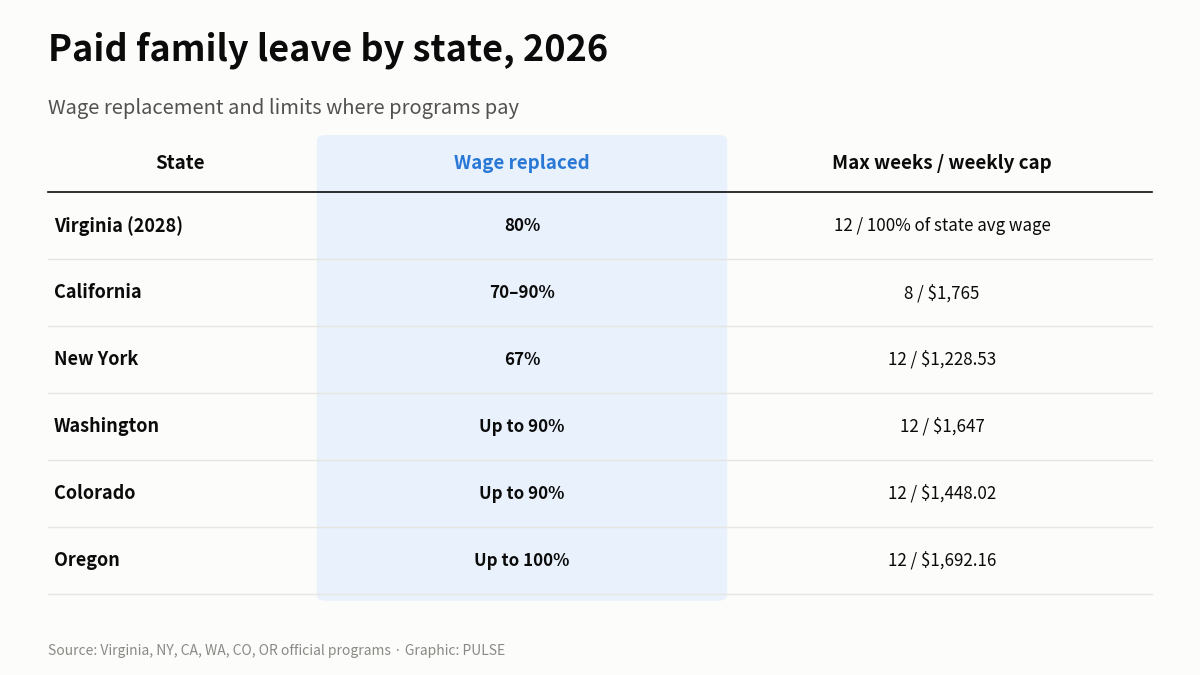
Look across the states already paying benefits and two things stand out. Most cap leave at 12 weeks, but California runs shorter at eight. And the share of your wage that comes back ranges from a flat 67% in New York to as much as 100% for lower earners in Oregon.
New York replaces 67% of your average weekly wage, up to a maximum of $1,228.53 a week in 2026, for up to 12 weeks, according to the state's Paid Family Leave program. California pays 70% to 90% depending on income, for up to eight weeks, with a maximum of $1,765 a week and a floor of $50, per the California Employment Development Department.
| State | Wage replaced | Max weeks / weekly cap |
|---|---|---|
| Virginia (2028) | 80% | 12 / 100% of state avg wage |
| California | 70–90% | 8 / $1,765 |
| New York | 67% | 12 / $1,228.53 |
| Washington | Up to 90% | 12 / $1,647 |
| Colorado | Up to 90% | 12 / $1,448.02 |
| Oregon | Up to 100% | 12 / $1,692.16 |
Why "up to 90%" rarely means 90% of your check
The high headline percentages apply to the first slice of your pay, not all of it. Washington replaces 90% of wages up to half the state average weekly wage, then 50% of the rest, with the benefit maxing out at $1,647 a week for new claims filed on or after January 1, 2026, the Washington Employment Security Department announced. Its standard leave runs to 12 weeks, with more available in some combined medical and family situations.
Oregon uses the same bend-point idea but at a higher rate: 100% of your wage up to 65% of the state average, then 50% above that, for up to 12 weeks, with the maximum weekly benefit rising to $1,692.16 for claims beginning on or after June 28, 2026, per Paid Leave Oregon. Colorado's FAMLI program follows a 90%/50% formula for up to 12 weeks and set its maximum at $1,448.02, effective July 1, 2026, according to the state's FAMLI division rate announcement. For a high earner, these caps matter more than the percentage: the dollar ceiling, not the rate, is what you actually receive.
Timing of the caps differs too. New York, California and Washington reset their maximums on January 1. Colorado's resets July 1 and Oregon's in late June, so the same program can pay two different amounts within one calendar year.
The states where the answer is still no
Thirteen states plus the District of Columbia guarantee paid family and medical leave, and most are already paying, VPM reported. Delaware and Minnesota began paying benefits on January 1, 2026, and Maine on May 1, 2026, according to the same reporting and state program materials. That leaves most of the South, the Plains and the Mountain West without any statewide program. In those states, paid leave exists only if your employer offers it or buys private coverage, and the unpaid federal Family and Medical Leave Act is the baseline for job protection.
Virginia's arrival shifts the count, but it also shows the gap is about more than a yes or no. A worker in a guarantee state may still get only 50% of wages above a threshold, and a worker in a new-program state like Virginia may have the law on the books years before the first check.
What to check before you count on leave
Confirm three things on your own state's official program page. First, is it paying now or only enacted for later; Virginia's benefit, for example, does not begin until December 2028. Second, find the current maximum weekly benefit and its effective date, because several states change the cap mid-year and the figure tied to your claim is the one in force when your leave starts. Third, check the wage-replacement formula, not just the top percentage, and whether your employer's size affects eligibility or cost.
Watch for annual adjustments. Most states peg the maximum benefit to a state average weekly wage that rises each year, so the number you see today is likely to move before you file. If you are in a state without a program, ask your employer whether it offers paid leave or short-term disability coverage, since that is the only route to wage replacement where no state guarantee exists.
How we checked this
We read the Office of the Governor of Virginia release and a National Law Review summary of the Virginia law for its rate, duration, funding and 2028 start dates; New York's Paid Family Leave 2026 page; the California Employment Development Department Paid Family Leave page; the Washington Employment Security Department news release stating the 2026 maximum; and Paid Leave Oregon for Oregon's figures. We verified all values as current on November 21, 2026. The official benefit pages for paidleave.wa.gov and famli.colorado.gov blocked our automated fetch tool; Washington's maximum was confirmed directly through the state Employment Security Department release, and Colorado's $1,448.02 maximum reflects the FAMLI division's published rate announcement, which we could not load directly and so could not independently confirm on the state page. California's 70% to 90% rate is EDD's published range; the EDD page we loaded confirmed the eight-week limit and the $1,765 maximum but did not display the percentage in our capture. Spot an error? Write to connect@blinkhub.net.
Cover photo: Sasha Kim / Pexels