Say you pull your child out of public school this fall and sign up for your state's education savings account to help pay private tuition. The deposit that lands in that account could be about $5,436 or it could top $10,000 — same idea, same school year, different state. And if you want to know what every family in the program is buying with those public dollars, one state will show you spending by vendor while another will not release itemized purchases at all.
That gap is the point of this piece. School-choice accounts have spread fast, and the headline "universal" label hides two numbers every parent actually cares about: how much money per child, and how much of the spending the public can see. We compared six states that run these programs and confirmed each figure against an official or state-authorized source as of November 21, 2026.
The deposit swings by thousands depending on your state line
Texas just launched the largest new program. A child attending an approved private school through a Texas Education Freedom Account receives $10,474 for 2026-27, with up to $30,000 for an awarded child with a disability and $2,000 for a homeschooled child. The amount is set by statute at 85 percent of the statewide average of state and local funding per public-school student, as described when lawmakers passed Senate Bill 2.
Iowa runs a fully universal account worth $8,148 for a full year in 2026-27, tied to the state's per-pupil cost. Utah's program pays $8,000 for a private-school student in 2026-27, and less for homeschoolers — $4,000 for ages 5 to 11 and $6,000 for ages 12 to 18. Florida's Family Empowerment Scholarship for Educational Options averages about $8,000 per student according to Step Up for Students, the nonprofit the state designated to run it, with the exact figure varying by grade and county.
West Virginia sits at the low end. Its Hope Scholarship pays $5,435.62 per student for 2026-27, and a family that applies later in the year collects only a fraction of that under a sliding quarterly schedule.
Arizona is the hardest to pin to one number, because its award is built from a formula rather than a flat figure. Each account equals 90 percent of what the state would pay a charter school for that child, starting from a base support level of $5,113.26 and multiplied by grade and disability weights. In practice that put most awards in the $7,000 to $10,000 range, with the statewide average around $9,600 in 2024-25 and far higher amounts — tens of thousands of dollars — for students with autism and other disabilities.
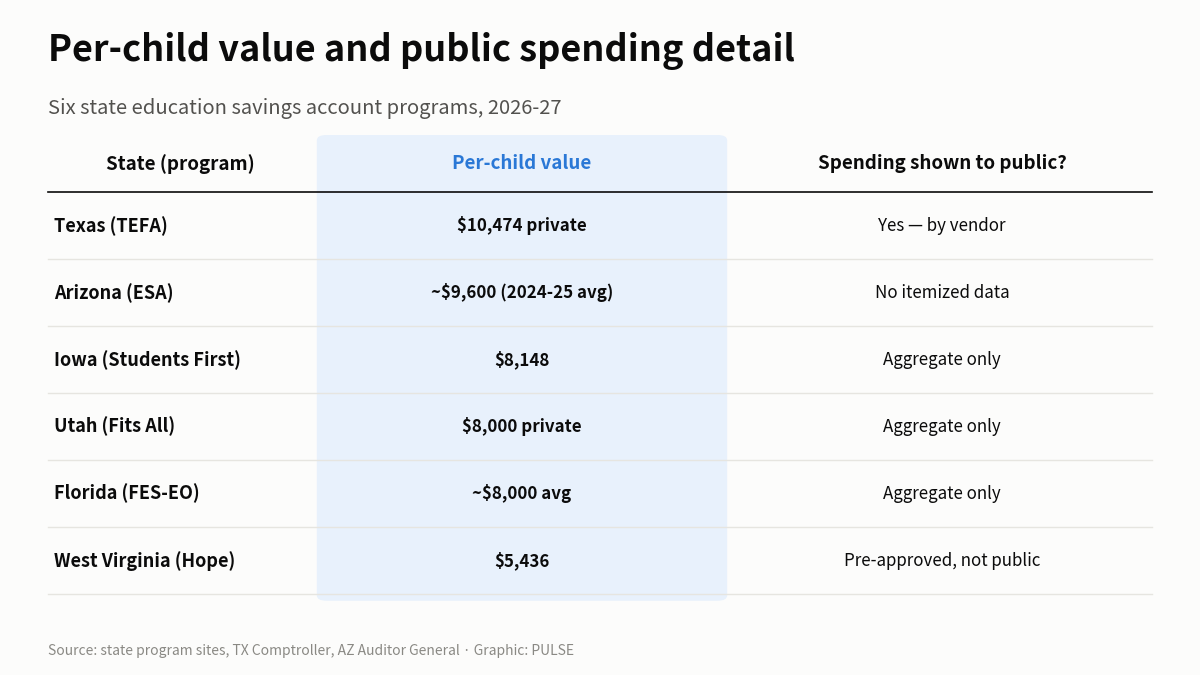
| State (program) | Per-child value | Spending shown to public? |
|---|---|---|
| Texas (TEFA) | $10,474 private | Yes — by vendor |
| Arizona (ESA) | ~$9,600 (2024-25 avg) | No itemized data |
| Iowa (Students First) | $8,148 | Aggregate only |
| Utah (Fits All) | $8,000 private | Aggregate only |
| Florida (FES-EO) | ~$8,000 avg | Aggregate only |
| West Virginia (Hope) | $5,436 | Pre-approved, not public |
What the money is allowed to buy
These are not tuition coupons alone. In most states the account can cover tutoring, therapies, testing fees, curriculum and technology, with one common string attached: tuition comes first. Iowa says funds must cover tuition and fees at an accredited nonpublic school before any balance can go to marketplace items, and those extras must be bought through approved vendors. West Virginia lists allowed categories — private-school tuition, tutoring, educational therapies, exam fees, technology and supplies — and runs every purchase through an ACH transaction pre-approved by the Treasurer's office, with a published list of non-qualifying expenses.
Texas routes spending through a program marketplace for approved education-related expenses. Utah and Florida work similarly, with families submitting purchases to the administrator for approval. The practical effect is the same across states: the money is real, but it is fenced, and a purchase your neighbor made in another state may be off-limits in yours.
Texas now posts spending by vendor; Arizona keeps the receipts private
The sharpest contrast is transparency. On November 20, 2026, the Texas Comptroller expanded its TEFA dashboard to show tuition and marketplace spending broken out by vendor, major category and subcategory, plus participation by state House and Senate district. To protect families, the office applies data-privacy safeguards, aggregating and masking certain information so individual participants cannot be identified.
Arizona has moved the other way. Its Department of Education does not publish itemized purchases or provider names, leaving the public without a line-item view. In May 2026 the Arizona Auditor General reported that the program lacked a comprehensive risk-based audit approach; reviewers sampled 63 transactions and found 25, or about 40 percent, had issues the program had not caught. The agency does publish aggregate quarterly reports showing total awards and enrollment, but not who sold what to whom.
The other four states fall between. Florida, Iowa, Utah and West Virginia each publish program-level totals or administrator reporting, but we found no public, searchable record of individual vendor spending comparable to the Texas dashboard. For those four, the "spending shown" answer is an aggregate, not a receipt.
Why two children in the same program can get very different checks
Even inside one state, the per-child figure is not one number. Arizona's weighting means a high-schooler draws more than an elementary student, and a child with a qualifying disability can draw many times the base — program materials describe autism awards running into the $30,000 to $47,000 range. Texas offers a disability track worth up to $30,000 for an awarded child. Utah splits homeschoolers by age. West Virginia cuts the award for late applicants.
So the table value is a starting point, not a promise. Your child's grade, disability status, enrollment type and application date can each move the real deposit up or down, sometimes by thousands.
What to confirm before you count on the money
Check three things on your state's official program page, not a tutoring blog, before you commit. First, the current-year award for your child's exact situation — grade band, disability status and whether the student is private-schooled or homeschooled. Second, the application deadline and any sliding scale; West Virginia's quarterly cut means missing the first window can halve or quarter your deposit. Third, the approved-expense and non-qualifying lists, because tuition-first rules and marketplace limits decide what the balance can actually buy.
If you want to see how public money in these programs is spent, Texas is the one state offering a vendor-level public dashboard today. Watch whether other states follow after the Arizona audit; several legislatures are weighing tighter oversight, and the reporting rules — not just the dollar amounts — are what is changing fastest.
How we checked this
We read primary and state-authorized sources on November 21, 2026: the Texas education-freedom program site and the Comptroller's November 20, 2026 dashboard release; the Iowa Department of Education's Students First ESA page; the West Virginia Hope Scholarship FAQ; the Utah Education Fits All FAQ; Florida's Step Up for Students, the nonprofit the state designated to administer its scholarship; and Arizona's base-support formula alongside the state Auditor General's May 2026 findings as reported by Arizona Public Media and Phoenix New Times. The Arizona Department of Education's FY2026 program report returned an access error when we tried to load it directly, so Arizona's average award is drawn from its reported statewide figures and may lag the newest quarter; we marked it as 2024-25. Florida's and Utah's amounts come from the state-designated administrators rather than a state agency page, and we attributed them as such. Dollar figures are the published 2026-27 amounts except where noted. We could not find a public, vendor-level spending record for Florida, Iowa, Utah or West Virginia, so those rows reflect aggregate reporting only. Spot an error? Write to connect@blinkhub.net.
Cover photo: Nataliya Vaitkevich / Pexels