
If you run a business in Texas and pay sales tax every month on your website hosting and your offsite file backups, a rule proposed in mid-November could erase that line from your bill. If you run the same business in Florida, you were never charged. In New York, you pay. The answer to a plain question, does my state tax my cloud storage, web hosting and other software-as-a-service bills, is not a national one. It is set state by state, and in Texas it is about to move.
Here is what changed, and how to tell where you stand before your next invoice.
The tax sitting on a Texas hosting bill
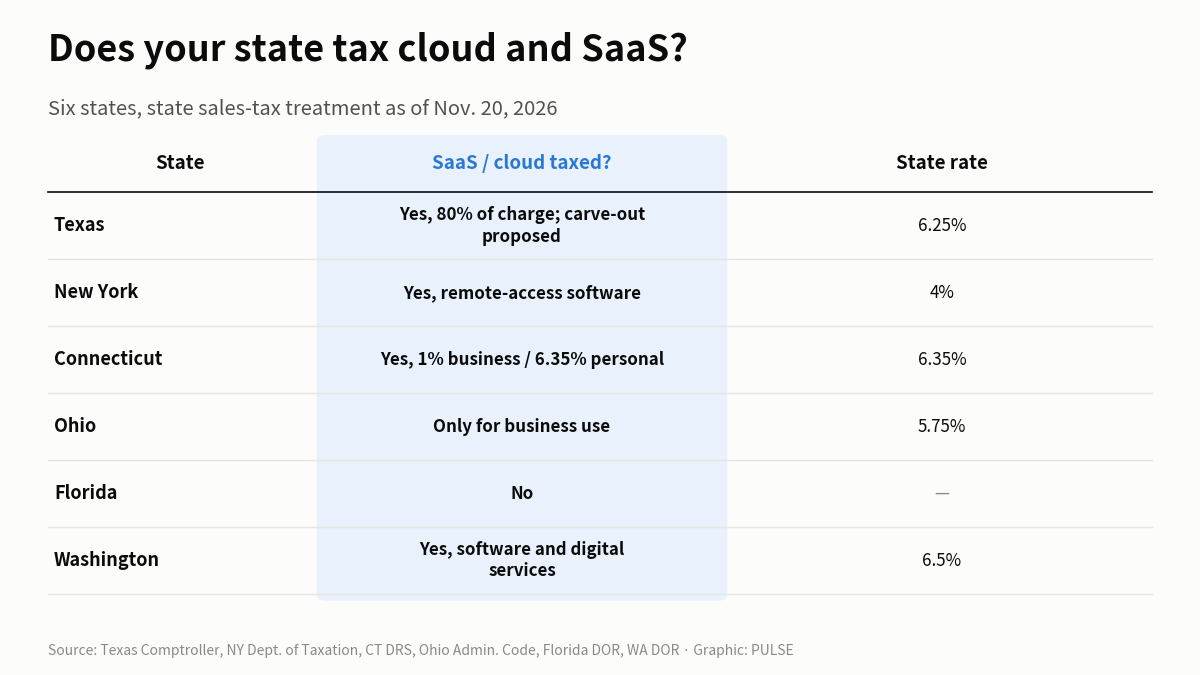
Texas has long treated a wide band of computing as a taxable "data processing service." The Comptroller's own list of taxable services spells it out: "web hosting, web site creation and maintenance" and "data storage, including offsite backup of electronic files" are taxable, and "twenty percent of the charge for data processing services is exempt from tax." In practice, tax applies to 80 percent of the charge at the state's 6.25 percent rate, before local add-ons.
On November 18, outgoing Comptroller Don Huffines announced proposed amendments confirming that "internet hosting, cloud computing, artificial intelligence, and other hosted technology services are not taxable data processing services." The office framed it in household terms: "Texans shouldn't have to pay a tax to store their family photos and other documents in the cloud, and small businesses shouldn't have to pay a tax to have their websites hosted." The proposal would carve those offerings into a new, untaxed category of "hosted technology service."
The change carries a price. The comptroller's office projects it would cut about $1.9 billion in state revenue and nearly $600 million in local sales tax in fiscal 2027 alone, and roughly $18 billion over six years, according to figures the office published and the Texas Tribune reported. The rule is set for publication in the Texas Register with a 30-day public comment period that runs to about December 20, and could take effect before Comptroller-elect Sarah Eckhardt is sworn in on January 1, 2027.
Why the same subscription is taxed or free at the state line
States that impose sales tax reach software and cloud services in different ways. Some treat remotely accessed software as taxable property. Some tax only the data-processing or information service wrapped around it. Some tax nothing at all because no physical item changes hands.
New York taxes prewritten software no matter how it reaches you. Its guidance states that "the sale to a purchaser in New York of a license to remotely access software is subject to state and local sales tax," with custom software built for one buyer exempt. The state rate on that software is 4 percent, before local tax.
Washington reaches cloud services from the other direction, as digital products. The state Department of Revenue treats remotely accessed software and "digital automated services" as retail sales subject to its 6.5 percent retail sales tax, and it notes that, effective October 1, 2025, more technology services were pulled in as taxable.
Florida sits at the opposite end. In a Technical Assistance Advisement, the Department of Revenue concluded that subscriptions to electronically delivered software and cloud-computing services are not subject to Florida sales tax as long as nothing tangible is conveyed. No SaaS bill, business or personal, carries the state's tax.
| State | SaaS / cloud taxed? | State rate |
|---|---|---|
| Texas | Yes, 80% of charge; cloud carve-out proposed | 6.25% |
| New York | Yes, remote-access software | 4% |
| Connecticut | Yes, 1% business, 6.35% personal | 6.35% |
| Ohio | Only when bought for business use | 5.75% |
| Florida | No | — |
| Washington | Yes, remote software and digital services | 6.5% |
How "business use" can flip the bill
Two of these states charge you differently depending on who is buying. Connecticut taxes electronically accessed canned software, but a business buying it for its own use pays the reduced 1 percent rate for computer and data processing services, while the same product bought for personal use is taxed at 6.35 percent, a split set in DRS Special Notice 2019(8), effective October 1, 2019.
Ohio runs the test in reverse. It taxes automatic data processing, computer services and electronic information services only when they are sold "for use in business by the consumer," so a company's SaaS subscription is generally taxable at the 5.75 percent state rate while an individual's is not. Who signs up, and why, can decide whether tax applies.
That is why a single national chart can mislead. The same product can be taxable in one state, taxable only for businesses in another, and exempt next door, and even within one state the classification, canned software versus a data service, moves the rate.
The ground is still moving under these rules
Texas is not the only state rewriting its answer. Washington's October 1, 2025 expansion added technology services to its sales tax base. Moving the other way is California, which currently does not tax SaaS but will: under SB 122, enacted in June 2026, the state will apply sales and use tax to prewritten software and SaaS beginning January 1, 2027, at its 7.25 percent base rate plus local district taxes, according to analyses by PwC summarizing the law and the state tax agency's draft rules. Custom software stays exempt there.
So two of the largest state economies are set to change in opposite directions within weeks of each other. Texas proposes to stop taxing hosted technology; California starts taxing remotely accessed software. A figure you confirm today can be wrong by New Year's Day.
What to check before your next invoice
Start with the bill you already have. Pull a recent invoice from your hosting, backup or SaaS vendor and look for a sales tax line, then match it to your state's treatment above. If you are billed in Texas, watch the comment period that closes around December 20; the carve-out is a proposal, not yet final, and the tax still applies until a rule is adopted. If you buy in Connecticut or Ohio, confirm the vendor has you classified correctly as a business or personal buyer, because that choice sets your rate or whether you pay at all. If you operate in California, check whether you need to register before January 1, 2027. And because vendors sometimes bundle a taxable service with an exempt one, ask how each charge is classified and sourced to your location; that is where errors hide. When a value cannot be confirmed on an official state page, treat it as unsettled and ask your state's revenue department in writing.
How we checked this
We read the Texas Comptroller's November 18 press release and its taxable-services publication 96-259, the Texas Tribune's report on the revenue estimate and timeline, New York's Tax Bulletin TB-ST-128 on computer software, and the Washington Department of Revenue's guidance on digital products, all on November 20, 2026. For Connecticut's DRS Special Notice 2019(8), Ohio Administrative Code 5703-9-46, the Florida Technical Assistance Advisement 16A-014, and California's SB 122, the official pages would not open from our connection on November 20; we relied on the documents' text as indexed from those official sources and from a PwC summary of the California law, and we link to each. We compared six states, and the figures above come from state agencies except where attributed. We did not independently confirm every local rate, and the Texas and California changes were not yet in effect as of this writing. Spot an error? Write to connect@blinkhub.net.
Cover photo: panumas nikhomkhai / Pexels