Say you own a single-family house on an ordinary lot, and you want it to hold four homes instead of one: a place for you, a place for a parent, and two to rent. Ten years ago, in most of the country, the answer was a flat no. Today, in a short but growing list of states, the answer is a qualified yes.
The catch is that two separate rules have to line up, and most owners never think to pull them apart. One is zoning, which decides whether your city will let four units stand where a single house stands now. The other is the building code, which decides what those four units cost to build once zoning allows them. Oregon just moved the second rule, and that is what makes this worth a fresh look.
What Oregon changed, and why it lowers the price of a fourplex
Oregon's building regulators have made it cheaper to build four homes in one structure. On the state's residential permitting notice, carried by the city of Portland, officials explain that the Oregon Residential Specialty Code now lets a stacked, two-family dwelling be attached to another stacked two-family dwelling, four units in one building, without fire sprinklers, as long as a wall rated to resist fire for two hours separates the two halves.
That matters because of what the rule replaced. Before the change, a four-unit building had to be built under the Oregon Structural Specialty Code, the commercial standard, which is heavier and more expensive to meet. Shifting four units into the residential code trims the cost of the smallest apartment building a person can own.
The provision is no longer a one-off. It was folded into the 2026 Oregon Residential Specialty Code, which the Building Codes Division adopted effective Oct. 1, 2026, with a phase-in that lets permit applicants keep using the older edition through March 31, 2027. Attach three or more of these buildings together, past six units, and NFPA 13D sprinklers come back into the picture.
Zoning says whether you may build; the code says how much it costs
A building-code change does nothing if your lot is still zoned for one house. That is the first gate, and it is set by state zoning-preemption laws that override local single-family rules.
Oregon's own zoning law is the reason the code change has anywhere to apply. House Bill 2001, passed in 2019, requires larger cities, those above 25,000 people plus the Portland metro area, to allow fourplexes in residential zones that permit single-family homes, and requires cities of 10,000 to 25,000 to allow at least duplexes, as the state's Land Conservation and Development overview describes it. "By right" means a permitted use: if your plans meet the city's written, objective standards, you do not need a rezoning or a discretionary hearing.
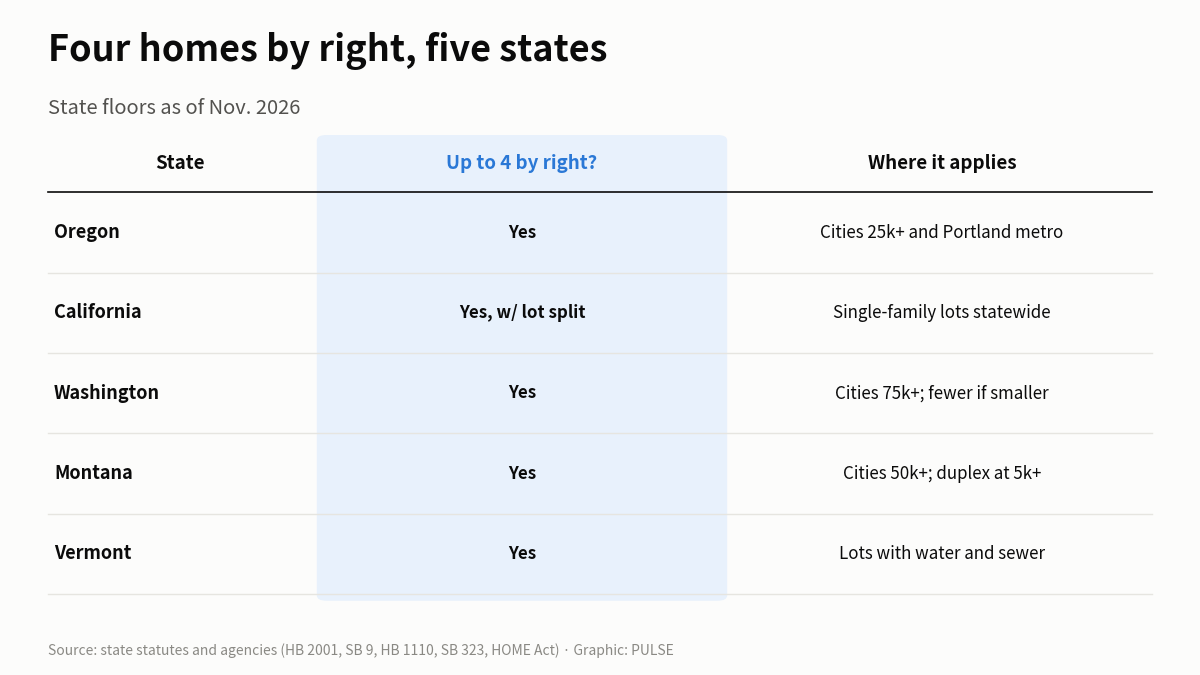
| State | Up to 4 homes by right? | Where it applies |
|---|---|---|
| Oregon | Yes | Cities 25,000+ and Portland metro |
| California | Yes, with a lot split | Single-family lots statewide |
| Washington | Yes | Cities 75,000+; fewer if smaller |
| Montana | Yes | Cities 50,000+; duplex at 5,000+ |
| Vermont | Yes | Lots with municipal water and sewer |
Five states, five different answers
The floor each state sets is not the same number, and the conditions attached to it vary widely.
California reaches the four-home figure by a different path. Its Senate Bill 9, the HOME Act, requires ministerial, meaning by-right, approval of up to two primary units on a single-family lot, and allows a lot split that, combined with those units, can yield four homes on what was one parcel. The state's Housing and Community Development fact sheet sets the terms: lots stay in urbanized areas, each unit can be at least 800 square feet, and an owner who splits a lot must sign an affidavit to live there for three years.
Washington's House Bill 1110 scales the number to city size. Cities of 75,000 or more must allow at least four units on every residential lot, and six near frequent transit or when units are affordable; cities of 25,000 to 75,000 must allow at least two, and four near transit. Each city writes the rule on the clock of its own growth-management plan update, and the bill report ties compliance to six months after that update is due, so some ordinances are still being adopted.
Montana's Senate Bill 323 requires cities of 5,000 or more to allow duplexes, and cities of 50,000 or more to allow triplexes and fourplexes, where single-family homes are permitted. A homeowner group sued to block the package, and the Montana Supreme Court upheld the laws on March 18, 2026, so they now stand.
Vermont's HOME Act of 2023 requires duplexes wherever single-family homes are allowed, and permits up to four units on lots served by municipal water and sewer, as the Congress for the New Urbanism summary lays out. Maine took a similar shape with LD 2003, which generally requires two to four units per lot in designated growth areas and can count an accessory apartment as one of the four.
Not every state picked the fourplex. Colorado's 2024 land-use package leaned on accessory dwelling units and transit-oriented density rather than four homes on every lot, and most states still have no statewide rule at all, as the Lincoln Institute's tracker shows. Where no state law exists, single-family-only zoning remains the local default.
The population of your city often sets your number
Read the table and one pattern jumps out: the headcount of your city tends to set the ceiling. A homeowner in a Montana town of 6,000 can add a second unit but not a fourth; the same person in Billings could build a fourplex. In Washington, crossing the 75,000 line doubles the floor from two units to four, and living within a quarter mile of a major transit stop can push it to six.
Lot size, water and sewer service, parking rules, and historic-district status all narrow the picture further. A statute that says "up to four" is a floor the city must meet, not a promise that your specific parcel qualifies.
What to check before you draw up plans
Treat the state law as the starting point and the local code as the deciding one.
- Find your parcel's zoning designation and whether your city clears the state law's population threshold.
- Read the objective development standards, the setbacks, lot coverage, height, and parking, because meeting them is what makes a project by-right.
- In Washington and Maine, ask your planning office whether the local middle-housing ordinance is final yet; some are still on the comprehensive-plan clock.
- In Oregon, confirm whether your four-unit building can use the residential code and whether sprinklers apply to your layout.
- Confirm the current numbers with the city. State law sets a minimum; a city may allow more, and litigation or amendments can shift the details.
How we checked this
We read Oregon's residential-permitting notice and its 2026 code-adoption document, the text of Oregon House Bill 2001, California HCD's SB 9 fact sheet, Washington's official HB 1110 bill report and the Furman Center's summary, the Montana SB 323 statute and Montana Free Press's report on the March 18, 2026 Supreme Court ruling, Vermont's HOME Act as summarized by the Congress for the New Urbanism, and Maine's DECD guidance on LD 2003. Figures were checked on Nov. 20, 2026. Direct document downloads for California's HCD fact sheet and Oregon's LCD overview returned access errors, so we relied on the agencies' published text as surfaced in search; the underlying sources are the official agencies, and we link them above. We did not independently confirm every city's current ordinance, because those are adopted locally and change on each city's schedule. Spot an error? Write to connect@blinkhub.net.
Cover photo: Freek Wolsink / Pexels