Put $8,000 into Georgia's Path2College 529 plan this year and you can subtract that amount from your Georgia taxable income. Move the identical money into a plan another state runs, and in most cases that write-off vanishes. So the real question for a parent opening a college account isn't only which plan an analyst likes best. It's whether your own state pays you to keep the money at home.
That tension got sharper this week. On November 19, Michigan's Treasury announced that the Michigan Education Savings Program had earned a Gold rating from Morningstar, the firm's highest grade. For a Michigan family already getting a state deduction, that is close to a free upgrade. For a saver in a state with a weaker plan, it reopens an old choice: chase the rating, or keep the tax break.
Nine plans earned the top mark, and Michigan just joined
In its 2026 medalist ratings, Morningstar handed out nine Gold ratings, 14 Silver, 12 Bronze, 19 Neutral, and six Negative, with ten upgrades and no downgrades, according to the firm's release carried over the wire. The nine Gold plans sit in nine states: Alaska, California, Connecticut, Georgia, Illinois, Massachusetts, Michigan, Pennsylvania, and Utah.
Four of those are new to the top tier this year. California's ScholarShare, Connecticut's CHET Direct, Georgia's Path2College, and Michigan's MESP each moved up from Silver. Utah's my529 kept a Gold rating it has held every year since Morningstar began the ratings. Morningstar weighs a plan's investment process, the team running it, and the strength of the parent organization overseeing it, the Michigan announcement said.
The tax break that usually only works at home
A 529 grows tax-deferred and comes out tax-free for qualified education costs no matter where you live. The part that varies is the state deduction or credit you get for putting money in. Most states that offer one attach a string: the contribution has to go into that state's own plan.
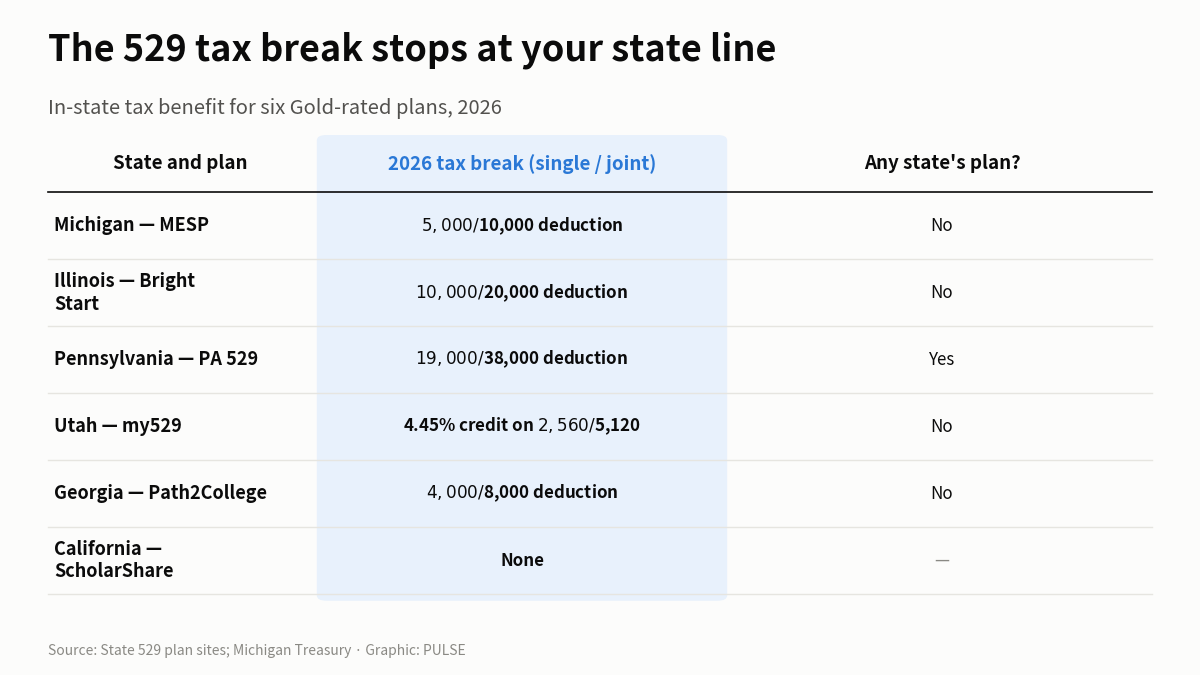
Michigan is typical. Taxpayers can cut their state taxable income by up to $5,000 as a single filer, or $10,000 filing jointly, but only on contributions to a Michigan Education Savings Program account. Illinois works the same way, allowing up to $10,000 single or $20,000 joint across its in-state programs. Georgia's deduction runs up to $4,000 single and $8,000 joint per beneficiary.
Utah hands out a credit instead of a deduction. For 2026 it equals 4.45% of what you contribute to my529, on up to $2,560 per beneficiary for single filers or $5,120 for joint filers, which works out to a maximum of about $114 or $228 off the tax bill. A credit cuts tax owed directly; a deduction only shrinks the income that gets taxed.
A handful of states break the home-plan rule. Pennsylvania is one. It lets residents deduct up to $19,000 per beneficiary, or $38,000 for a married couple, and it applies that deduction to contributions made to any state's 529 plan, a feature often called tax parity. The PA 529 site confirms the deduction exists but does not post the dollar cap; the $19,000 figure is the federal annual gift-tax exclusion the deduction is tied to, claimed on PA-40 Schedule O. Fidelity lists Pennsylvania among the parity states, alongside Arizona, Arkansas, Kansas, Minnesota, Missouri, Montana, Maine, and Ohio.
| State and plan | 2026 in-state tax break (single / joint) | Any state's plan? |
|---|---|---|
| Michigan — MESP | $5,000 / $10,000 deduction | No |
| Illinois — Bright Start | $10,000 / $20,000 deduction | No |
| Pennsylvania — PA 529 | $19,000 / $38,000 deduction | Yes |
| Utah — my529 | 4.45% credit on $2,560 / $5,120 | No |
| Georgia — Path2College | $4,000 / $8,000 deduction | No |
| California — ScholarShare | None | — |
Why a one-basis-point fee can outweigh a shinier rating
Ratings aside, the number that quietly compounds over 18 years is the fee. Michigan's Treasury says MESP now charges a 0.01% annual program management fee, which it calls the lowest of any 529 plan in the country, with TIAA running the investments. The state tied that figure to a broader fee cut it announced in September, when the plan also passed $10 billion in assets.
One basis point is one cent per $100 per year on the program fee itself. That is not your whole cost, since each investment option also carries the expense ratio of the underlying funds, so your all-in price depends on the portfolio you pick. Still, a rock-bottom management layer is exactly the kind of structural edge Morningstar rewards, and it is the main reason a plan with no flashy features can still outrun a pricier rival.
When moving out of state actually pays
Your state's answer falls into one of a few buckets. If you live in a parity state like Pennsylvania, you can take the deduction and still send your money to any Gold plan you prefer, so the rating is the deciding factor. If you live in one of the nine states with no income tax, there is no deduction to lose, and you are free to shop purely on quality and cost.
California shows the other edge of this. Its ScholarShare plan is Gold-rated, yet the state offers no deduction at all. The plan's own materials state flatly that there is no California state income tax deduction for contributions to ScholarShare or to any other state's plan. For a Californian, the rating is the entire value proposition, because the tax code adds nothing either way.
Where it gets genuinely close is a state with a modest in-state-only break and a middling plan. There, the math is a trade: the upfront deduction against years of lower fees or stronger portfolios somewhere else. A larger deduction and a shorter time horizon tilt toward staying home; a small deduction and a newborn beneficiary tilt toward leaving.
What to check before you move your money
Start by pulling up your own state's plan page and confirming three things as they stand now: whether there is a deduction or credit, the exact dollar cap for your filing status, and whether the break is limited to the in-state plan. Those figures move, and several states index them to the federal gift-tax exclusion, which rises most years. Then compare your home plan's program fee and its Morningstar rating against a Gold plan you could use instead, and weigh the one-time tax savings against the fee gap over the years until your child enrolls. If your state offers no deduction or grants parity, you can ignore residency and pick on quality alone. One more thing to watch: using 529 money for K–12 tuition can trigger a recapture of a previously claimed state deduction in some states, including Michigan, so check the rules before you tap the account early.
How we checked this
We read the Michigan Treasury's November 19, 2026 announcement and its September 2026 fee release, the 2026 Morningstar medalist ratings as republished over the wire, and the official plan pages for Michigan's MESP, Illinois' Bright Start, Utah's my529, Georgia's Path2College, California's ScholarShare, and Pennsylvania's PA 529. We also used Fidelity's reference for the list of tax-parity states. All figures were confirmed current as of November 19, 2026. We could not verify the exact Pennsylvania deduction cap on the official pa529.com page, which states the deduction exists but not the dollar limit; the $19,000 figure reflects the federal annual gift-tax exclusion the deduction is tied to and is reported on PA-40 Schedule O. Morningstar's own news release returned an access error, so we relied on a verbatim wire republication for the rating counts and the Gold list. Spot an error? Write to connect@blinkhub.net.