
Clock in for a full-time minimum-wage shift in Washington state next year and your pay floor is $17.73 an hour. Do the identical job in Texas and it stays $7.25. Forty hours, a gap above $400 a week, and the only difference is the state line you live on. The federal minimum has not moved since 2009, so the number that actually lands in your check is written by your state.
On January 1, 2027, a new round of state rates takes effect. Sixteen states are scheduled to raise their minimum wage that day, according to Experian's employer tracker. The increases are not uniform: some are a nickel-sized inflation bump, some are the final step of a multiyear law, and roughly twenty states post no change at all because they sit at the $7.25 federal floor.
Why Virginia is the state to watch this year
Virginia is mid-climb. Governor Abigail Spanberger signed a bill in April 2026 that raises the state minimum to $13.75 per hour on January 1, 2027, then to $15.00 on January 1, 2028. The widely reported "$15" headline is the 2028 figure. For 2027 the number is $13.75, up from the current $12.77. A separate bill extends the state minimum to farm workers starting January 1, 2027, and the rate is set to track the Consumer Price Index beginning in 2029.
That two-step structure is a useful reminder: a law reaching $15 "by 2028" does not mean $15 next year. If you budget around the headline, you can be off by more than a dollar an hour.
The same date, very different numbers
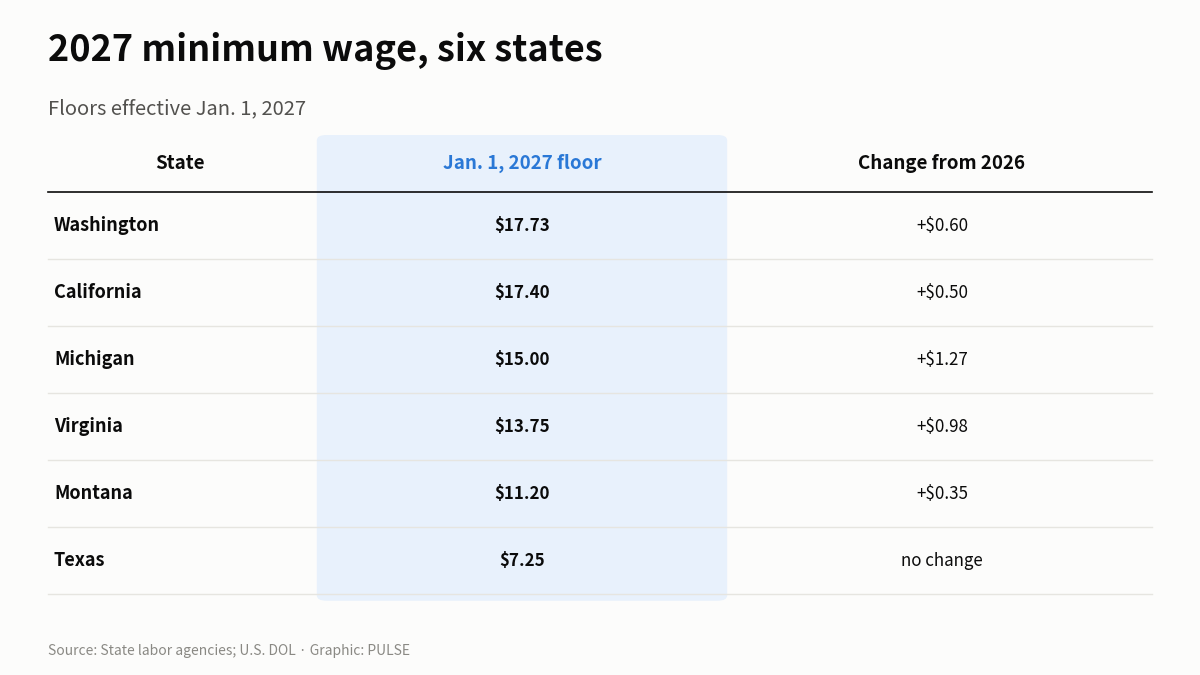
Here is how a handful of states compare on the same January 1, 2027 effective date. Each figure below was confirmed on an official state or federal page; where a state defaults to the federal rate, the number does not change.
Washington indexes its wage to inflation every year and lands at $17.73, a 3.5 percent rise from $17.13. California's Department of Industrial Relations set the 2027 rate at $17.40, up from $16.90. Michigan finishes a legislated schedule, reaching $15.00 from $13.73, the largest single jump in the group. Montana's cost-of-living formula nudges its floor to $11.20 from $10.85. Texas, which adopts the federal rate by reference, stays at $7.25.
Twenty states never left the federal floor
The $7.25 states are not a rounding error. The U.S. Department of Labor's state wage table shows that about twenty states either match the federal minimum or have no state rate of their own, a group that includes Texas, Georgia, Tennessee, and the Carolinas. A few state statutes technically list a lower number, such as Georgia's $5.15, but federal law overrides it for most covered employees.
So if you live in one of those states and expect a January raise, there is no state increase coming. Any bump would have to come from a city or county ordinance, from a federal change that Congress has not passed, or from your employer.
January 1 is not the only date that matters
The reader question — what will the floor be where I live when 2027 rates take effect — has a hidden wrinkle: states change their numbers on different days. Oregon does not adjust on January 1 at all. Its rate shifts every July 1, so its $15.55 standard rate holds through June 30, 2027, with the next change set for that summer. New York runs its own calendar too, and for 2027 it is standing still: the state confirms that an "off-ramp" condition in its indexing law was met, so the rate stays at $17.00 in New York City, Long Island, and Westchester and $16.00 for the rest of the state on January 1, 2027.
| State | Jan. 1, 2027 floor | Change from 2026 |
|---|---|---|
| Washington | $17.73 | +$0.60 |
| California | $17.40 | +$0.50 |
| Michigan | $15.00 | +$1.27 |
| Virginia | $13.75 | +$0.98 |
| Montana | $11.20 | +$0.35 |
| Texas | $7.25 | no change |
The state number can still be the wrong number for you
Even a confirmed state rate may not be your rate. Many cities and counties set higher floors than the state, so a worker in Seattle, Denver, or parts of California can be owed more than the statewide figure. Tipped workers are a separate calculation entirely: Michigan's tipped minimum is $6.30 even as its standard rate hits $15.00, and tip-credit rules vary widely. Teen and training wages can also differ, as in Washington's lower rate for 14- and 15-year-olds.
What to check before January
Look up two things, not one. Find your state's 2027 rate on its labor department page, then check whether your city or county has a local ordinance that goes higher — the local number wins. If you are tipped, confirm the cash wage your employer must pay before tips, because that figure is often far below the headline rate. If you live in a $7.25 state, watch for local measures rather than a statewide change. And note your effective date: most increases hit January 1, but Oregon moves in July and New York is flat for 2027. Workers who think a raise is automatic can miss an underpayment that a two-minute check on an official page would catch.
How we checked this
We read primary sources for each state figure: the Office of the Governor of Virginia for Virginia's $13.75 and $15.00 steps; Washington's Department of Labor & Industries news release for $17.73; the California Department of Industrial Relations release 2026-66 for $17.40; Michigan's Department of Labor and Economic Opportunity for $15.00; the Montana Department of Labor & Industry's October 7, 2026 determination letter for $11.20; the U.S. Department of Labor state wage table for the $7.25 federal-floor states; New York State's official minimum wage page for its 2027 freeze; and Oregon's Bureau of Labor and Industries schedule for its July timing. The count of sixteen states raising rates on January 1 is attributed to Experian's tracker, not an official tally. We checked all figures on November 19, 2026, and confirmed they reflect current law. Two documents did not render in our reader tool — Oregon's BOLI PDF and Montana's determination-letter PDF — so for those we relied on the agencies' stated rates and schedules on the same official pages; we could not independently parse the PDF text. The Michigan Legislature's statute server was unreachable when we tried it, so we used the state labor department's published rate instead. Spot an error? Write to connect@blinkhub.net.
Cover photo: Pham Huynh Tuan Vy / Pexels