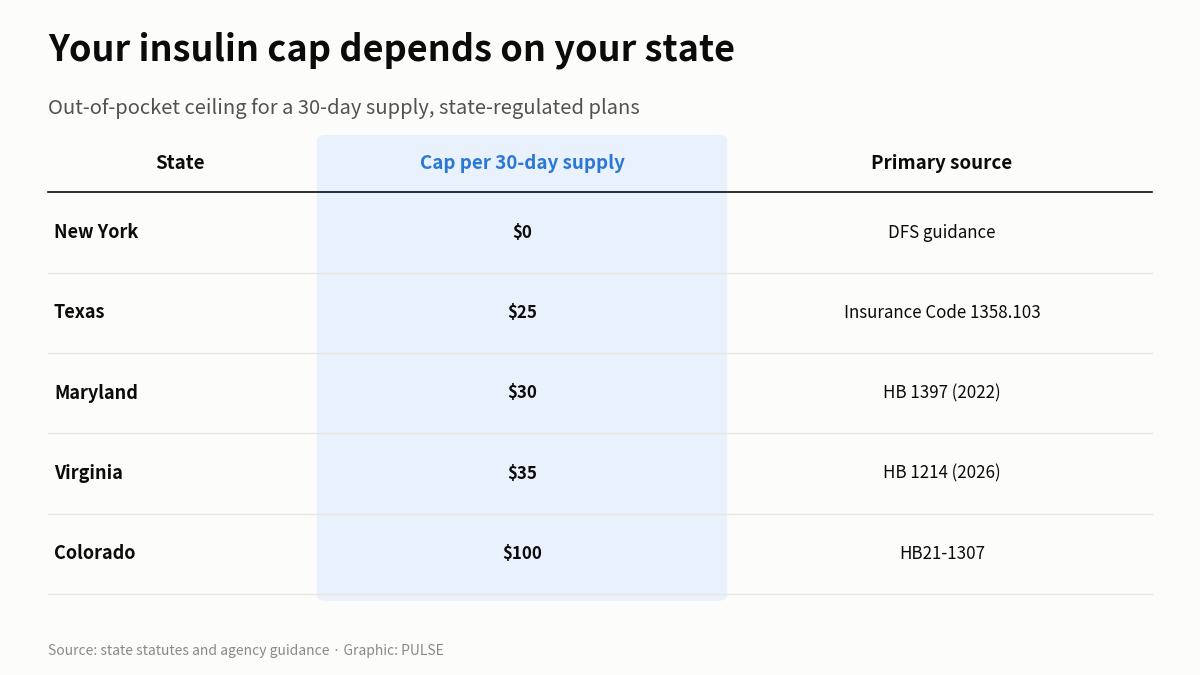
Fill a 30-day insulin prescription in New York and your plan can charge you nothing at the counter. Fill the same prescription in Colorado and it can charge you up to $100. In Texas the ceiling is $25. In Virginia, starting this year, it is $35.
The medicine is identical. The number you pay is set by your state and by whether your health plan is one a state gets to regulate.
Virginia just drew its line at $35 a month
On May 13, 2026, Governor Abigail Spanberger signed House Bill 1214, which caps the out-of-pocket cost of a 30-day supply of insulin at $35 for state-regulated plans. The governor's office says roughly 800,000 Virginians live with diabetes. The sponsor was Delegate Karrie Delaney, and the bill passed with support from both parties.
The word that matters in that sentence is state-regulated. It decides whether the cap reaches you, and we come back to it below.
The same idea, five different prices
At least 29 states and the District of Columbia have passed some form of insulin cost cap, according to the American Diabetes Association, which tracks them. The figures are not close to uniform.
New York went the furthest. Its Department of Financial Services says prescription insulin must be covered in full with no deductible, copayment, or coinsurance, a rule effective January 1, 2025 that replaced an earlier $100-a-month limit.
Texas sits near the other end of the low range. Its Insurance Code caps cost sharing at $25 per 30-day supply, regardless of the amount or type of insulin, under a 2021 law. Minnesota reaches the same $25 figure through a broader chronic-disease statute that also caps related supplies, such as test strips and pumps, at $50 a month under Minnesota Statutes 62Q.481.
Maryland splits the difference at $30 per 30-day supply, effective January 1, 2023. Colorado, which in 2019 became the first state to cap insulin at all, holds its limit at $100 for a 30-day supply and adds an emergency supply option of up to $35 once every 12 months.
| State | Cap per 30-day supply | Primary source |
|---|---|---|
| New York | $0 | DFS guidance |
| Texas | $25 | Insurance Code 1358.103 |
| Maryland | $30 | HB 1397 (2022) |
| Virginia | $35 | HB 1214 (2026) |
| Colorado | $100 | HB21-1307 |
The amounts the Diabetes Association lists for other states run across the same spread, from $25 in Massachusetts and New Mexico to $75 in Louisiana. We confirmed the five figures in the table on official state pages. We did not independently confirm Louisiana's $75 or Massachusetts's $25 on a primary page, so treat those as the association's reading until you check your own state.
Why the cap on paper may not be the cap at your counter
A state insurance law reaches plans the state regulates, which generally means fully insured coverage you buy on your own or through a smaller employer. It does not reach self-funded employer plans, the kind many large companies use, because those are governed by the federal ERISA law. New York's own guidance says its rule excludes self-funded ERISA plans.
That gap is not small. The Health Care Cost Institute found that more than 40% of insulin users with employer-sponsored insurance paid more than $35 out of pocket for a 30-day supply.
Medicare runs on a separate track. Under the Inflation Reduction Act, Part D and Medicare Advantage drug plans cap each covered insulin at $35 for a one-month supply, with no deductible, and that federal cap holds in 2026. There is no matching federal cap for commercial or employer plans; Congress dropped that piece before the law passed. The three big insulin makers have each volunteered their own $35 commercial caps, but those are company programs, not a legal right.
What to check before your next refill
Look at your insurance card and ask the plan one question: is this coverage fully insured and state-regulated, or self-funded by my employer. If it is self-funded, your state cap does not bind it, and your real ceiling is whatever the plan and any manufacturer program set.
If you are on Medicare, the $35-per-insulin cap applies to products your plan covers, not to every insulin, so confirm your specific product is on the formulary. If a pharmacy charges you above your state's cap on a plan that should be covered, your state insurance regulator takes complaints; New York, for one, routes them through the Department of Financial Services. And watch your own legislature: these numbers move, as Virginia's new $35 line and New York's shift to $0 both show.
How we checked this
We read the Virginia governor's signing release for HB 1214, the New York Department of Financial Services insulin cost-sharing guidance, the Minnesota statute 62Q.481, the Maryland HB 1397 enrolled bill, the Colorado HB21-1307 summary, the Texas Senate Bill 827 analysis for Insurance Code Chapter 1358, a Kaiser Family Foundation explainer on the Medicare cap, and the Health Care Cost Institute report on employer-plan spending. We used the American Diabetes Association's state tracker only to locate states and flag figures we then checked. Checked November 18, 2026. We could not confirm Louisiana's $75 or every other state's amount on a primary government page, and the exact plan types each state law reaches can vary, so verify your own plan. The Texas statute text itself returned an access error, so we relied on the legislature's official bill analysis for that figure. Spot an error? Write to connect@blinkhub.net.
Cover photo: Nataliya Vaitkevich / Pexels