
Pull up your last Netflix or Spotify receipt and look near the bottom. Depending on which state you live in, a tax line quietly added roughly 5 to 8 percent to the price — or it added nothing at all. That gap is not set by the streaming company. It is set by your state. And this week one of the largest streaming-tax states moved to erase its own version.
The practical question for a subscriber is simple: on a $20 monthly plan, are you paying $20, or $21.10, or $21.49? The answer depends entirely on your ZIP code.
What Texas just moved to undo
On November 17, 2026, Texas Comptroller Don Huffines announced proposed amendments to the agency's Rule 3.313 that would stop the state from treating internet-delivered video as taxable cable television service. Since 2014, Texas had taxed streaming subscriptions under a cable-service rule that predates the services themselves. The state sales tax rate is 6.25 percent, and local add-ons can push the combined rate to 8.25 percent.
Read the fine print before you expect a cheaper bill. This is a proposed rule, not a finished one. The comptroller's office must take public comment for at least 30 days after the proposal publishes in the Texas Register, so the charge will not vanish from December statements. Huffines framed the move as leaving the decision to lawmakers, saying in the release, "If the Legislature wants to tax streaming, they can pass a law and own it."
Why your neighbor in another state pays a different price
There is no national rule. Each state writes its own definition of a taxable digital product, and those definitions diverge sharply. Pennsylvania has taxed streaming at 6 percent since Act 84 of 2016, and its revenue page names "a subscription to a streaming service, such as Netflix or Hulu" outright. Washington applies its retail sales tax to digital entertainment subscriptions whether you stream or download, on top of a 6.5 percent state rate plus local tax.
Maine is the newest entrant. Effective January 1, 2026, the state repealed its old Service Provider Tax and folded "digital audiovisual and digital audio services" into the regular 5.5 percent sales tax, a change that a Maine Public report described as adding about a dollar to a typical $20 plan.
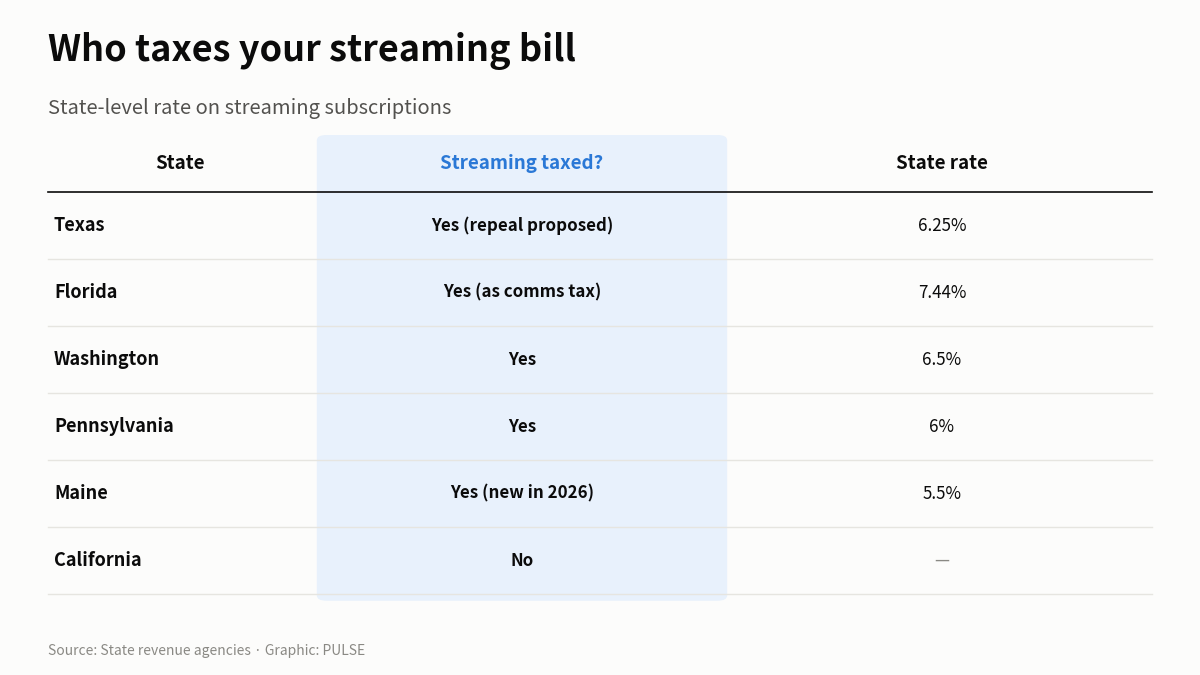
| State | Streaming taxed? | State-level rate |
|---|---|---|
| Texas | Yes (repeal proposed) | 6.25% |
| Florida | Yes (as communications tax) | 7.44% |
| Washington | Yes | 6.5% |
| Pennsylvania | Yes | 6% |
| Maine | Yes (new in 2026) | 5.5% |
| California | No | — |
The rates in the table are the state-level figures only. In Washington and Texas, local jurisdictions add their own points on top, so the amount on your statement can run higher than the number shown here.
Florida slips the charge in as a phone tax
Florida has no personal income tax and does not tax streaming through its general sales tax. It uses a separate mechanism, the Communications Services Tax, and that is why a Florida streaming bill looks different from a Pennsylvania one. The state's own Department of Revenue page lists "video and music streaming" as covered and sets the state rate at 7.44 percent — a 4.92 percent tax plus a 2.52 percent gross receipts component — with local tax added on top and no residential exemption for video.
The label matters for a reader trying to audit a bill. A Florida subscriber scanning for the words "sales tax" may not find them, because the charge is itemized as a communications services tax instead. Florida law requires providers to list that tax separately and bars them from absorbing it.
The states where streaming still rides free
Some states tax nothing here. California does not apply sales or use tax to streamed video and audio, and that stays true even after the state begins taxing software and SaaS on January 1, 2027. The law doing that, SB 122, carves out digital audio and audiovisual works from the definition of a taxable digital product. Because California's own tax agency has not yet posted machine-readable guidance we could quote, we are relying on an analysis by the law firm K&L Gates, which reads the statute as leaving Netflix and Spotify untaxed.
A handful of states have no statewide general sales tax at all, which tends to spare streaming from that particular charge even where other taxes exist. The broader pattern is that taxing authority sits with the state, and the direction of travel is not uniform. Maine added a tax this year. Texas is trying to drop one. Pennsylvania reaffirmed and clarified its reach with a 2026 law taking effect in July.
What to check before your next payment posts
Find the tax line on your current statement and compare it with the state rate above. If you live in Texas, treat the streaming charge as still active until the comptroller finalizes the Rule 3.313 change; watch the Texas Register and the 30-day comment window for the effective date. If you are in Pennsylvania and your provider never collected the tax, the state asks you to report it as use tax on your income tax return. And if the number on your bill does not match your state's posted rate, the fastest way to confirm what applies to your address is your own state revenue department's rate lookup, since local add-ons vary block by block.
How we checked this
We read the Texas Comptroller's November 17, 2026 announcement and its Rule 3.313 text; the Pennsylvania, Washington, and Florida revenue departments' official digital-products and communications-tax pages; and Maine Revenue Services guidance document GIB 115. For California we used law-firm analysis of SB 122 and noted it in the text, because the state tax agency's PDF did not return readable text when we fetched it on November 18, 2026. Rates are state-level figures current as of that date; combined rates including local tax can be higher, and we could not independently confirm every local add-on. The Maine guidance PDF returned a server error on direct fetch, so we relied on its indexed contents plus local news confirmation. Spot an error? Write to connect@blinkhub.net.
Cover photo: https://kaboompics.com/ / Pexels