Starting November 18, a Connecticut resident can load a version of their driver's license onto a phone and show it to a TSA officer at Bradley International or Tweed New Haven instead of pulling out the plastic card. A few hours later, if a state trooper pulls that same driver over, the app does nothing. The physical license still has to come out of the wallet.
That split — handy at the airport, useless at a traffic stop — is the real shape of digital driver's licenses almost everywhere they exist. The question most people have is simple: can I put my license on my phone where I live, and what will it actually do? The answer depends heavily on your state.
What Connecticut turned on this week
Governor Ned Lamont and the state Department of Motor Vehicles announced the launch of Connecticut Mobile ID, a free app that holders of a state driver's license or ID card can download from the Apple App Store or Google Play. To set it up you need the physical card in hand. The credential is locked behind your phone's face or fingerprint check.
At launch it is accepted by the Transportation Security Administration at participating airport checkpoints nationwide. Bars, restaurants, and cannabis sellers can choose to accept it for age checks, but only through a specialized scanning app, not by flashing the screen. The DMV said the program cost $2.1 million to build, and officials said it cannot be used for voting. Local police will not accept it as a substitute for the physical license; the commissioner said that would likely take an act of the legislature. The state's own guidance is blunt: Mobile ID complements the card, it does not replace it.
The one thing every state's version can do: airport security
The common thread across digital IDs is TSA. The agency keeps an official list of participating states, and Connecticut now sits on it alongside Alaska, Arizona, Arkansas, California, Colorado, Georgia, Hawaii, Illinois, Iowa, Kentucky, Louisiana, Maryland, Montana, New Mexico, New York, North Dakota, Ohio, Oklahoma, Puerto Rico, Utah, Virginia, and West Virginia. A separate TSA page on mobile driver's licenses also counts Washington, D.C., so the exact total depends on which TSA page you read.
Two caveats matter for travelers. TSA accepts a digital ID only if it is built on a REAL ID-compliant license, and the agency strongly encourages everyone to carry the physical REAL ID card too, because a scanner can fail. And acceptance is not permanent: TSA's own list shows Utah's mobile ID dropping off on January 1, 2027, and West Virginia's on May 4, 2027.
Where you add it changes what it is
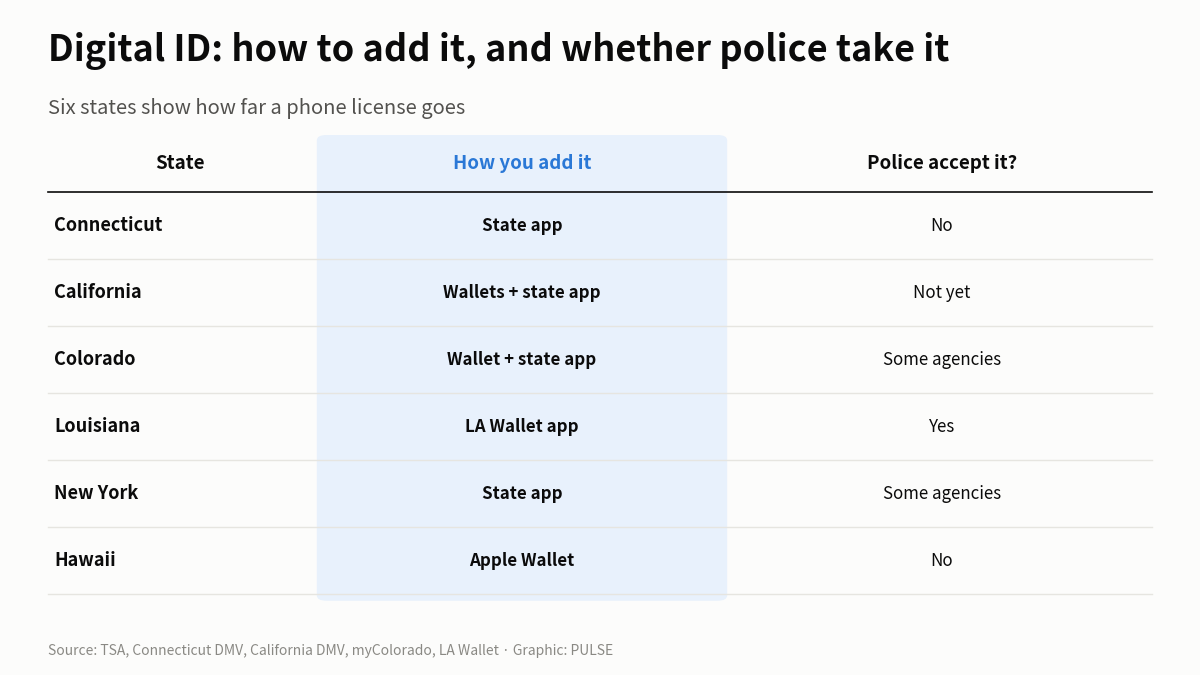
Some states deliver the credential through a state-built app. Connecticut, New York, and Kentucky work that way. Others let you add the license to Apple Wallet, Google Wallet, or Samsung Wallet, sometimes in addition to a state app. California offers both: you can use the CA DMV Wallet or add the license to Apple, Google, and Samsung wallets. Hawaii, by contrast, appears on TSA's list only through Apple Wallet.
This is why "does my state have it" is the wrong first question. The better one is where you add it and what that unlocks.
| State | How you add it | Do police accept it? |
|---|---|---|
| Connecticut | State app | No |
| California | Wallets + state app | Not yet |
| Colorado | Wallet + state app | Some agencies |
| Louisiana | LA Wallet app | Yes |
| New York | State app | Some agencies |
| Hawaii | Apple Wallet | No |
Louisiana is the outlier that shows what's possible
In most states a digital license stops at the TSA line and a few bars. Louisiana is different. The state's LA Wallet grew out of a 2016 law, Act 645, that directed the state to build a digital license its own police would honor, as Government Technology reported when the app rolled out. Inside the app, the rendered license is a legally accepted ID at a traffic stop, at many venues, and even at the polls.
Colorado sits in between. The myColorado app's digital ID is accepted by the State Patrol and by a list of local departments the governor's office has published, including Denver, Colorado Springs, and Lakewood. But acceptance is not statewide, and the State Patrol still reminds drivers that state law requires carrying the physical card. California says the same thing plainly: many agencies and businesses do not take the mobile license yet, so keep the plastic one.
What to do before you rely on your phone
If you want to add your license, start at your state DMV's own page rather than a wallet app, because the DMV tells you which method your state actually supports and what it is good for. Treat the digital ID as an airport convenience first and a general ID second. Keep the physical card with you, especially when driving, in every state covered here. If you travel, check TSA's participating-states list close to your trip, and note the Utah and West Virginia end dates if either is your home state. If voting or a traffic stop is the use you care about, confirm your state allows it in writing before you leave the card at home, because outside Louisiana and a patchwork of agencies elsewhere, the answer is usually no.
How we checked this
We read Connecticut's launch announcement from the governor's office, the TSA pages listing participating states and explaining mobile driver's licenses, the California DMV's mobile license FAQ, Colorado's myColorado and Office of Information Technology pages plus a State Patrol advisory, and LA Wallet's and Government Technology's descriptions of Louisiana's law. Figures were confirmed current as of November 17, 2026. We could not independently verify the exact number of TSA jurisdictions: the agency's participating-states table and its mobile-license page give slightly different counts because of Washington, D.C., so we described the discrepancy instead of picking a number. The $2.1 million development cost comes from the DMV as reported by Connecticut Public Radio, not from a figure we could pull off a state budget page. Spot an error? Write to connect@blinkhub.net.
Cover photo: Tranmautritam / Pexels