
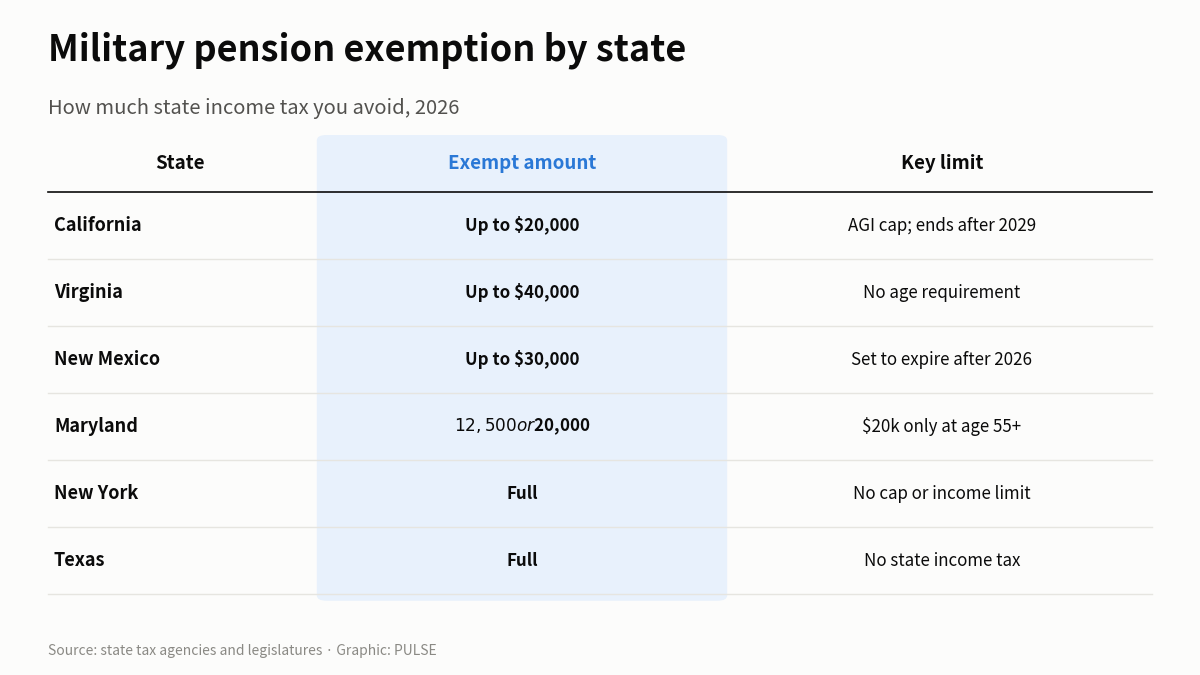
Say you retired from the military and drew a $40,000 pension this year. The state line you live behind decides how much of it you keep. In Texas you owe no state income tax on any of it. In New York the whole pension is exempt. In California the first $20,000 is now shielded, and the rest is taxed at regular rates.
That California figure is the new part. For years the state fully taxed military retirement pay, the last state with an income tax to do so. A 2025 law changed that, and it applies to the 2026 return you are about to file.
What California's $20,000 break actually covers
Under current law a qualified California taxpayer can exclude up to $20,000 of federal uniformed-services retirement pay, or of Survivor Benefit Plan annuity payments, from state gross income, according to the California Franchise Tax Board. The exclusion applies for tax years beginning in 2025 and runs through 2029.
It comes with income limits. Your federal adjusted gross income has to be $125,000 or less if you file as an individual, or $250,000 or less on a joint return or as a surviving spouse. Cross those lines and the break is gone, not reduced.
A larger version is pending, not law. Senate Bill 1407 would roughly double the exclusion to $40,000 and carry it into the 2030s. It cleared the state Senate but has not been enacted, so $20,000 is the figure that governs your 2026 taxes.
Why the amount you look up depends on your state line
No federal rule sets this. Each state writes its own treatment of military pensions, and the range is the whole spectrum. Some states levy no broad personal income tax, so the question never arises. Most states that do tax income now exempt military retirement pay in full. A smaller group, California among them, caps the exemption at a fixed dollar amount, which is where the number you look up really matters.
| State | Exempt amount | Key limit |
|---|---|---|
| California | Up to $20,000 | AGI cap $125k single / $250k joint; ends after 2029 |
| Virginia | Up to $40,000 | No age requirement |
| New Mexico | Up to $30,000 | Set to expire after 2026 |
| Maryland | $12,500 or $20,000 | $20k only at age 55 and up |
| New York | Full | No cap or income limit |
| Texas | Full | No state income tax |
Even inside the capped group the design differs. Virginia lets any military retiree subtract up to $40,000 with no age test, the Virginia Department of Taxation says, and the benefit reached that full amount for the 2025 tax year. At the other end, New York exempts every dollar with no cap, age, or income restriction, and Texas never taxes the pension because it has no personal income tax.
The deadlines that can quietly erase a break
Two of these numbers have expiration dates built in. New Mexico exempts up to $30,000 of armed-forces retirement pay for tax years 2024 through 2026, and the exemption is scheduled to end after 2026 unless lawmakers extend it, according to a New Mexico Legislature bill analysis. Bills to make it permanent or to exempt the full pension were introduced in the 2026 session; the analysis shows the exemption still sunsetting under existing law.
California's $20,000 exclusion carries its own end date after tax year 2029. A break on the books today is not a promise for the year you plan to claim it, so the expiration matters as much as the dollar figure.
The age and income tests that shrink the number
The headline amount is often the best case. Maryland splits its break by age: a retiree under 55 can subtract up to $12,500 of military retirement income, while a retiree 55 or older can subtract up to $20,000, the state's Department of Veterans and Military Families says. Pending Maryland legislation would raise those caps and drop the age split, but the $12,500 and $20,000 tiers are what apply now.
California's income ceilings work the same way. A married couple with $260,000 in combined AGI gets nothing, even if one spouse is a retired service member, because the $250,000 joint limit is a cliff rather than a phase-out.
What to check before you file for 2026
Pull your state's current military-pension rule from its own tax agency, not a summary, and match three things to your situation: the dollar cap, any age threshold, and any income limit. Confirm the rule still applies to the 2026 tax year, since New Mexico's break is set to lapse and California's has a 2029 end date. If you moved states mid-year, check both. And watch the pending bills in California and Maryland. If either is signed, the amount you can exempt could rise before you file again.
How we checked this
We reviewed primary material from each state: the California Franchise Tax Board and its analysis of Senate Bill 1407, the Virginia Department of Taxation's military benefits guidance, the Maryland Department of Veterans and Military Families, a New Mexico Legislature bill analysis describing the current exemption and its sunset, New York's Department of Taxation and Finance military page, and the Texas Comptroller's tax research system. Figures were checked on November 11, 2026, and reflect current law for the 2026 tax year. Our fetch tool was blocked by several agency servers; for those pages we relied on the agencies' own published text as returned in their site search results, and we confirmed the California, Maryland, and New York figures through pages we read directly. We did not independently audit the status of every pending bill beyond the official records cited. Spot an error? Write to connect@blinkhub.net.
Cover photo: George Pak / Pexels