If you refine, blend, or buy jet fuel made from plants instead of petroleum, the state line you operate across now changes your tax bill by as much as $2 a gallon. On November 6, Washington became the latest state to switch on a credit for that fuel, and four other states already have one on the books.
The question for anyone in the supply chain is simple and the answers are not: which states pay, how much, and whether the money lands with the company that makes the fuel or the airline that burns it.
What Washington just turned on
Governor Bob Ferguson's office said the state's sustainable aviation fuel credit activated because in-state producers can now make at least 20 million gallons a year, the production milestone written into the law as the trigger. The credit is worth $1 per gallon for jet fuel with at least 50% lower greenhouse gas emissions than conventional fuel, and up to $2 for fuels that cut emissions further. The state says it can be stacked on top of credits earned under Washington's Clean Fuel Standard.
That stacking is the part worth pausing on. Washington is currently the only state that pairs a dedicated per-gallon SAF credit with a clean fuel program, which is why the governor's office called it the strongest package in the country.
How much each state's credit is worth
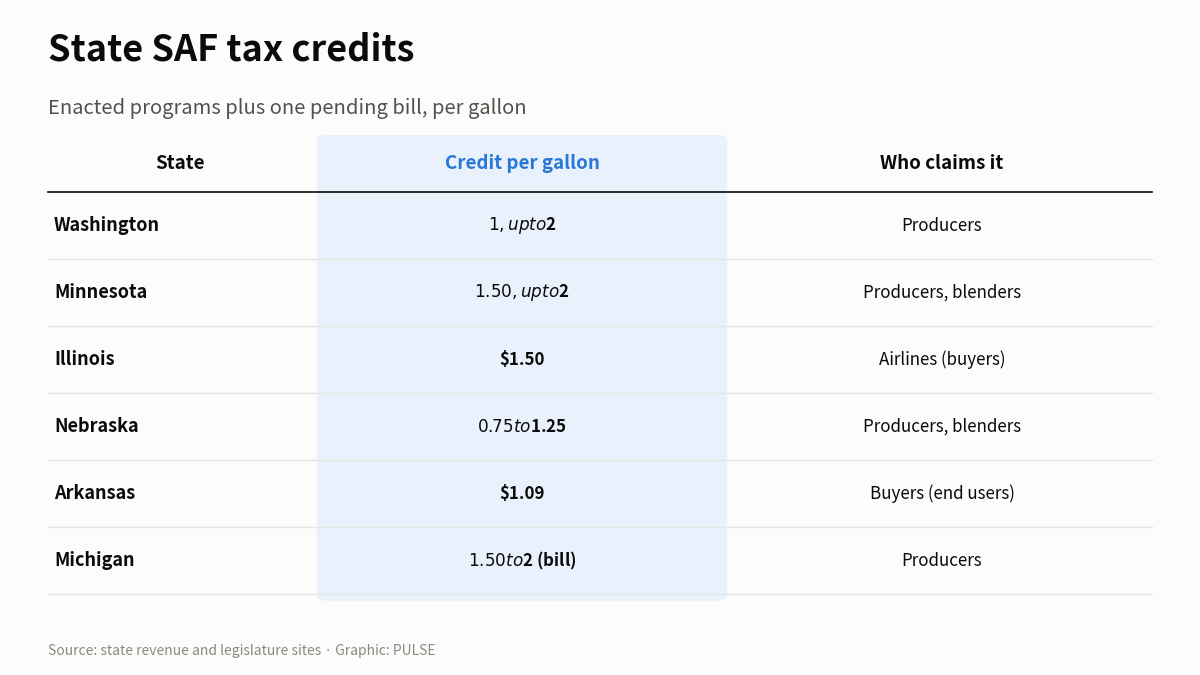
Minnesota and Illinois both top out at $1.50 a gallon on the headline number, but they reward different things. Minnesota pays producers and blenders $1.50 for each gallon produced in the state or blended there, and the state statute adds 2 cents per gallon for every percentage point of carbon-intensity reduction above 50%, capped at $2 a gallon. Illinois instead pays the buyer: $1.50 per gallon of qualifying fuel sold to or used by an air common carrier in the state.
Nebraska starts lower and climbs. Its law sets a base of $0.75 a gallon for fuel that cuts lifecycle emissions by at least 50%, plus a penny for each point above that, to a maximum of $1.25. Arkansas takes yet another route, and a narrower one.
| State | Credit per gallon | Who claims it |
|---|---|---|
| Washington | $1, up to $2 | Producers |
| Minnesota | $1.50, up to $2 | Producers, blenders |
| Illinois | $1.50 | Airlines (buyers) |
| Nebraska | $0.75 to $1.25 | Producers, blenders |
| Arkansas | $1.09 | Buyers (end users) |
| Michigan | $1.50 to $2 (bill) | Producers |
Whether the money goes to the maker or the buyer
The split matters more than the dollar figure. A producer credit, like Washington's, Minnesota's, and Nebraska's, lowers the cost of making fuel. A purchase credit, like Illinois's, lowers the cost of buying it, which is why an airline fueling at a Chicago airport cares about Illinois but a refinery does not.
Arkansas does both in one law. Act 546, the Sustainable Aviation Fuel Incentive Act, gives end users an income tax credit of $1.09 per gallon on up to 100,000 gallons a year, and separately lets producers claim 30% of the cost of qualifying production equipment or facilities, according to an analysis by the law firm Mitchell Williams, which tracked the bill through the 2025 session. That firm's reading notes the credit cannot exceed half of a taxpayer's income tax liability in a year.
The caps and conditions that trim the headline number
None of these pay the sticker price without strings. Every state requires at least a 50% cut in lifecycle greenhouse gas emissions before a gallon qualifies. Several add limits that can run out well before a buyer's demand does.
Illinois caps the credit on soybean-oil feedstock at 10 million gallons across all carriers in a year, bars palm derivatives, and from June 1, 2028 requires domestically sourced biomass. Nebraska caps total approved credits at $500,000 per fiscal year and lets a producer claim for only five tax years. Arkansas defines eligible fuel narrowly, as naphtha-type jet fuel derived from wood biomass, so a soybean or used-cooking-oil pathway that qualifies in Minnesota may not qualify there.
The clocks differ too. Illinois runs July 1, 2023 through December 31, 2032. Minnesota applies to fuel sold after June 30, 2024 and before July 1, 2030. Nebraska does not start until January 1, 2027 and sunsets January 1, 2035. Arkansas took effect for tax years beginning on or after January 1, 2025. A credit you count on for a 2033 contract may not exist by then.
What to watch before you bank on a credit
Confirm three things for your own case before you price fuel around any of these. First, the carbon-intensity math: your fuel has to clear the 50% threshold under the state's accepted accounting, and in Minnesota and Nebraska every point above 50% is worth real money. Second, the annual cap, because Nebraska's $500,000 pool and Illinois's soybean-oil ceiling are first-come constraints that can close for the year. Third, whether you are the producer or the purchaser, since that decides which state's form you file.
Watch Michigan. A bipartisan pair of bills, Senate Bills 235 and 236, would create a $1.50-per-gallon producer credit rising to $2 for deeper emissions cuts, with a $4.5 million annual program cap. The Michigan Senate passed the package in June 2025, but as of today it sits in the House and is not yet law, so no one can claim it. Montana, often grouped with these states because of its large SAF refinery, offers property tax abatements for facilities rather than a per-gallon credit, so it is not on this list.
How we checked this
We read Washington's announcement from the governor's office; Minnesota's credit page at the Department of Revenue and the statute at the Minnesota Revisor's Office (41A.30); the Illinois Department of Revenue bulletin FY 2023-23 describing 35 ILCS 110/3-72; the Nebraska Legislature's statute 77-7018, part of the Sustainable Aviation Fuel Tax Credit Act; and a Mitchell Williams law firm analysis of Arkansas Act 546, which we attribute because we could not load an Arkansas state page today. We also read the Michigan Senate Fiscal Agency analysis of Senate Bills 235 and 236. Checked November 8, 2026. Several state sites, including the Illinois, Nebraska, and Arkansas revenue pages, were unreachable from our connection today; where that happened we relied on the statute text, an official legislative analysis, or an attributed report rather than implying we reached the agency page. We could not independently confirm on a live state page whether any 2026 amendment has changed the Illinois or Arkansas figures since enactment. Spot an error? Write to connect@blinkhub.net.
Cover photo: Matthew Jackson / Pexels