
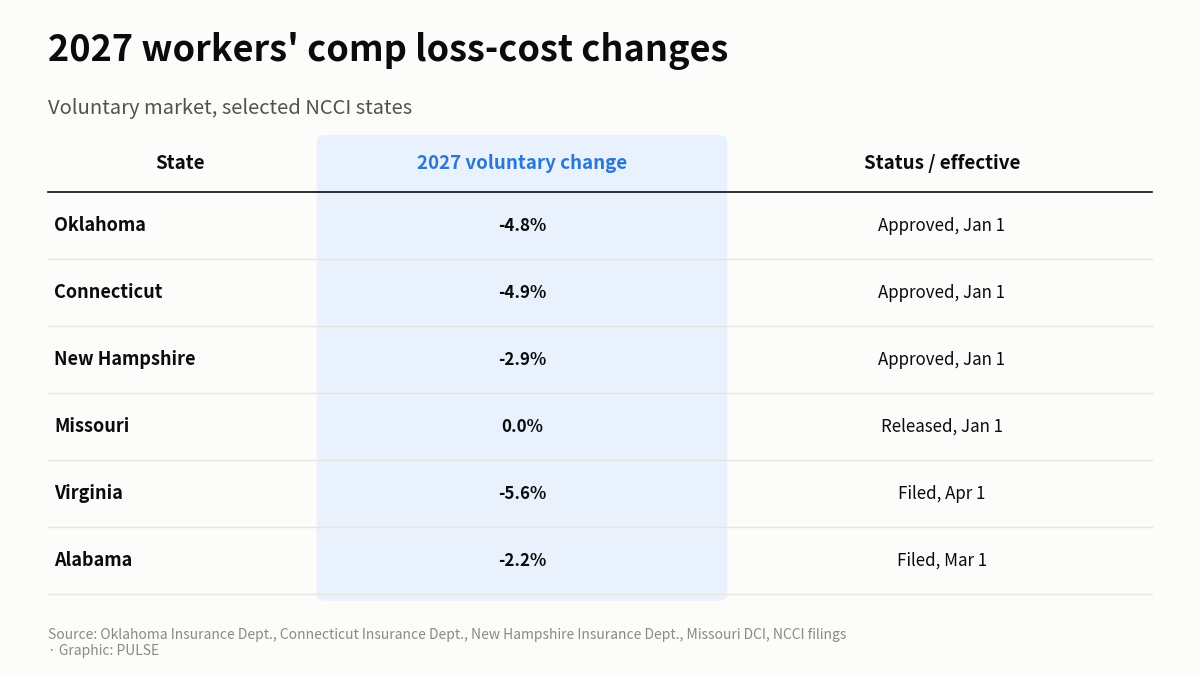
If you employ people in Oklahoma, the price benchmark that sits underneath your workers' compensation premium is about to drop 4.8 percent for policies that renew on or after January 1, 2027. Insurance Commissioner Glen Mulready approved the reduction in early November, the latest in a long run of annual cuts, with the department quoting him as saying the change "demonstrates the strength and stability of Oklahoma's workers' compensation system" (Oklahoma Insurance Department release).
Oklahoma is not alone, and your state may be moving by a very different amount. Here is what the 2027 numbers say and how to read them before you renew.
What the 2027 cut means on your renewal, and what it does not
A loss cost is the rating organization's estimate of what workplace injuries will cost per $100 of payroll in a given job classification, covering medical treatment and lost wages. It is the raw ingredient, not the final price. Your insurer multiplies the loss cost by its own factor for expenses and profit, then adjusts for your payroll and your experience modification rating, which reflects your own claims history.
So a 4.8 percent cut in loss costs does not translate into a 4.8 percent cut on your invoice. A business with a worsening injury record can still see its premium climb while the statewide benchmark falls. The benchmark sets the direction; your own numbers set the rest.
Most states are trimming, but the cut is not the same size
The National Council on Compensation Insurance, the rating organization that files loss costs in Oklahoma and about 37 other states, has proposed or won approval for reductions in most of the states acting for 2027. The reason regulators keep citing is a long decline in how often workers get hurt on the job.
Connecticut's regulator approved an average 4.9 percent decrease to voluntary loss costs, its thirteenth straight annual cut, as confirmed by the state's agent association. New Hampshire approved a 2.9 percent voluntary cut, its fifteenth consecutive year of decline. Missouri went a different way: its Department of Commerce and Insurance released rate-neutral loss costs at 0 percent, holding the statewide average steady even as individual industry groups shift up or down.
| State | 2027 voluntary loss-cost change | Status and effective date |
|---|---|---|
| Oklahoma | −4.8% | Approved, Jan 1, 2027 |
| Connecticut | −4.9% | Approved, Jan 1, 2027 |
| New Hampshire | −2.9% | Approved, Jan 1, 2027 |
| Missouri | 0.0% | Released, Jan 1, 2027 |
| Virginia | −5.6% | Filed, Apr 1, 2027 |
| Alabama | −2.2% | Filed, Mar 1, 2027 |
Two of those lines carry a different weight than the others, which is the point of the status column.
Approved, filed, or advisory changes what you can count on
Virginia and Alabama are still proposals. NCCI has filed a 5.6 percent voluntary cut in Virginia under case INS-2026-00031, with a proposed effective date of April 1, 2027, but the State Corporation Commission's Bureau of Insurance has not signed off as of today. Alabama's proposed filing would cut voluntary loss costs 2.2 percent effective March 1, 2027. Until a regulator approves a filing, the number can change.
The effective date matters as much as the percentage. Oklahoma, Connecticut, New Hampshire and Missouri use January 1. Alabama's filing targets March 1 and Virginia's targets April 1, so a policy that renews in February could still be priced off the 2026 benchmark. Read your renewal date against your state's effective date before you assume the new figure applies to you.
The assigned-risk pool and California move on their own terms
If your business cannot buy coverage on the open market and lands in the state assigned-risk plan, your benchmark can move in a different direction and by a different amount than the voluntary market. Connecticut paired its 4.9 percent voluntary cut with a 5.8 percent cut to assigned-risk rates. New Hampshire's assigned-risk rates fell 3.4 percent. In Alabama, the proposed filing moves the other way, with assigned-risk rates set to rise about 1.6 percent even as voluntary loss costs fall.
California is the clearest exception, and it runs on a separate system. It does not use NCCI; the Workers' Compensation Insurance Rating Bureau of California files an advisory pure premium rate, and the cycle runs to a September 1 effective date rather than January 1. For the current period, Insurance Commissioner Ricardo Lara adopted an average advisory rate of $1.65 per $100 of payroll, a 6.6 percent increase effective September 1, 2026, below the bureau's requested 10.4 percent (California Department of Insurance release). That rate is advisory only, so California insurers are free to set their own prices. The direction there is up, not down.
What to check before you sign a 2027 renewal
Pull two numbers off your renewal paperwork: your effective date and your experience modification rating. If you renew after your state's effective date, ask your agent or carrier whether the quote reflects the 2027 loss costs or the old ones. If your mod has risen, a statewide cut can be erased on your own account, so ask what is driving it and whether open claims can be closed before renewal. Employers in a state with a filing still pending, such as Virginia or Alabama, should watch the regulator's decision rather than treat the proposed figure as final. And remember that an insurer's loss-cost multiplier, not just the benchmark, decides your rate, so comparing quotes from more than one carrier still pays. Your state insurance department posts approved filings; that page, not a broker's summary, is the figure that governs your policy.
How we checked this
We read the Oklahoma Insurance Department's 2027 release, trade and press coverage of the Connecticut, New Hampshire and Missouri approvals, NCCI's published filing summaries for Virginia and Alabama, and coverage of California's advisory pure premium rate, on November 8, 2026. Several official pages would not load for us directly: the New Hampshire Insurance Department page returned an access error, and the California Department of Insurance release and NCCI's filing PDFs refused connections, so for those states we relied on the agencies' and rating organization's announcements as carried by Insurance Journal, WorkCompWire and state business groups, and attributed them in the text. We could not independently confirm each number on its originating state agency page; the Virginia and Alabama figures are proposals that regulators had not approved as of our check date, and the assigned-risk and California figures use rating systems that differ from the voluntary NCCI loss costs shown in the table. Spot an error? Write to connect@blinkhub.net.
Cover photo: Tiger Lily / Pexels