
If someone you know is finishing a prison or jail term, the practical question is blunt: on the day they walk out, will a prescription, a counseling appointment, or addiction medication already be paid for? The answer increasingly turns on the state — and on how many days before release that state's Medicaid program is permitted to start helping.
Connecticut is the newest test case. On November 6, 2026, Gov. Ned Lamont's office announced that federal regulators approved a plan to begin Medicaid-covered services up to 60 days before a person leaves a correctional facility. The state said the change affects roughly 12,000 adults and 650 adolescents released each year.
What coverage before release actually buys
Start with what the waiver is not. Under longstanding federal rules, Medicaid generally cannot pay for care delivered inside a jail or prison — the so-called inmate exclusion, which KFF describes as a bar on federal Medicaid matching funds during incarceration. The reentry waivers, authorized under Section 1115 of the Social Security Act, carve out a narrow exception for a defined package of services in the final stretch before someone goes home.
So the pre-release window does not switch on full coverage. It pays for a limited set of transition services — things like case management, behavioral health and substance use treatment, and a supply of medications to leave with. Full Medicaid benefits generally resume on the release date itself, when the person is no longer excluded. The window is the on-ramp, not the highway.
Why some states say 90 days and others say 60
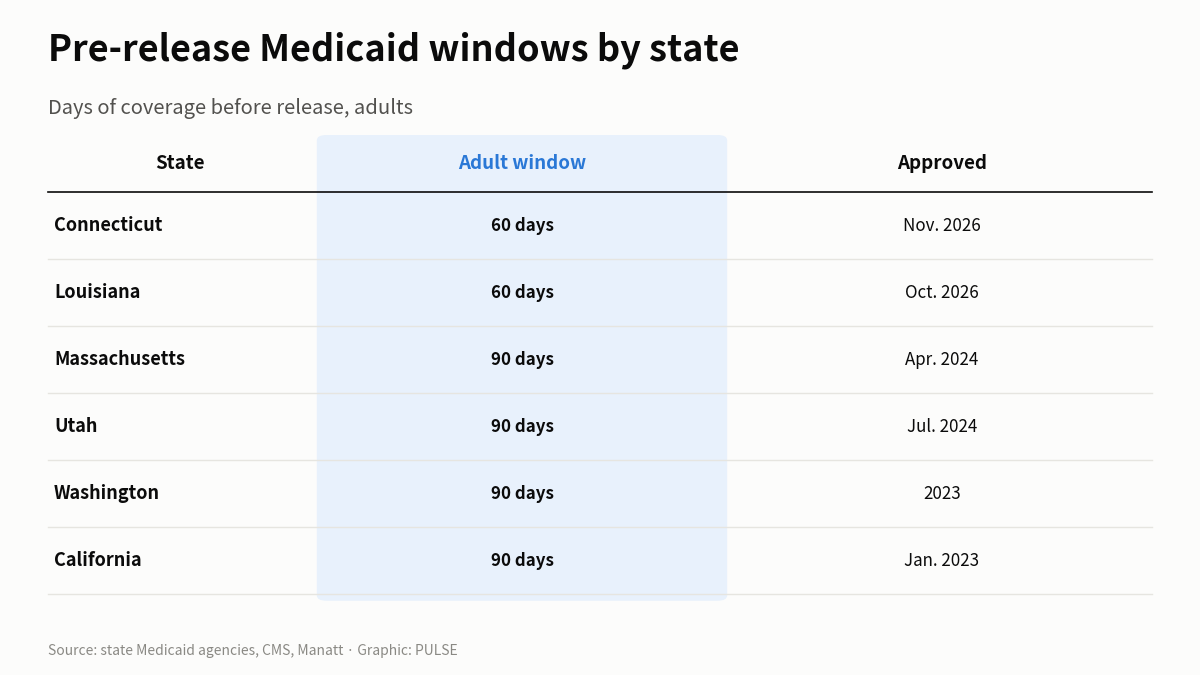
The early adopters generally secured a 90-day runway. California was first, approved in January 2023 for up to 90 days of pre-release services. Washington followed in 2023, also at 90 days. Massachusetts won approval in April 2024, and in July 2024 the federal government authorized Illinois, Kentucky, Oregon, Utah, and Vermont for up to 90 days as well.
That ceiling has since moved. The law firm Manatt, Phelps & Phillips, reading recent federal guidance, reports that the Centers for Medicare & Medicaid Services now treats up to 60 days of pre-release coverage as appropriate for adults in prisons and jails, while continuing to allow up to 90 days for people in youth facilities. That is why Connecticut and Louisiana, both approved in the fall of 2026, land at 60 days for adults, while several states that got in earlier kept their 90.
| State | Adult pre-release window | Approved |
|---|---|---|
| Connecticut | 60 days | Nov. 2026 |
| Louisiana | 60 days | Oct. 2026 |
| Massachusetts | 90 days | Apr. 2024 |
| Utah | 90 days | Jul. 2024 |
| Washington | 90 days | 2023 |
| California | 90 days | Jan. 2023 |
Approved is not the same as available today
A federal signature is the start of a multi-year build, not a switch that flips statewide. California was approved in early 2023 but did not begin delivering pre-release services until October 2024, and then only at an initial batch of facilities that grows over time. Utah's approval came in July 2024, with jail and prison coverage phasing in beginning in early 2026. Connecticut's own announcement says the services will roll out facility by facility.
So even in a state with a 60- or 90-day waiver, the honest answer for a specific person is: it depends on which facility holds them and whether that site has gone live. A release next month from a participating prison is a very different situation from a release from a county jail that has not yet started.
The services differ, but a medication supply is the common thread
Across states, the covered packages overlap more than they diverge. Utah lists intensive case management, medication-assisted treatment for substance use disorders, lab and radiology, and screening for housing needs. Washington's program centers on case management, medication-assisted treatment, and a 30-day supply of prescriptions at release. Louisiana's approval covers substance use treatment, behavioral health assessments, lab and diagnostic services, durable medical equipment, and a 30-day drug supply. Connecticut describes care management, mental health services, substance use treatment, and chronic condition management.
The 30-day supply of medications handed over at the door shows up again and again. For a person managing diabetes, HIV, or opioid use disorder, that single provision is often the difference between a continuous prescription and a gap in the first week out.
More than 20 states and the District of Columbia now hold approvals, according to the federal reentry demonstration list; Connecticut's November 6 approval is recent enough that it has not yet appeared on that list.
What to check before the release date
Three things are worth confirming directly, and soon. First, whether the specific facility is live — call the state Medicaid agency or the facility's reentry or discharge-planning staff and ask, rather than assuming the waiver means every site is active. Second, whether a Medicaid application is already in process, because benefits are meant to resume on the release date and a lapsed or never-filed application can delay that. Third, what leaves with the person physically — ask whether a 30-day medication supply and a scheduled first appointment are part of the discharge plan. The window only helps if someone starts the paperwork inside it; a release 20 days out still fits inside a 60-day window, but only if the clock was started.
How we checked this
We read the Connecticut Governor's Office announcement (reproduced on a press wire), the federal Medicaid reentry demonstration page, the July 2024 CMS press release on five additional states, and state program pages for California, Washington, Massachusetts, and Utah. For the current 60-day adult and 90-day youth policy, we relied on a summary by the law firm Manatt, Phelps & Phillips citing CMS guidance; the underlying CMS guidance PDF would not render in legible text when we tried to read it, so we attribute that point to Manatt. We could not reach the Louisiana Department of Health page directly (it returned an access error), so Louisiana's 60-day window and approval date are drawn from a public-radio reprint of the department's release. Windows and dates were checked on November 7, 2026; because facility-level rollout is phased, an approved window does not guarantee the service is active at a given prison or jail today. Spot an error? Write to connect@blinkhub.net.
Cover photo: Magda Ehlers / Pexels