If you drive an electric car in Oregon, the state plans to start billing you for every mile you drive, beginning in the summer of 2027. Gas drivers will keep paying at the pump for now. But the shift underway in Oregon is the clearest sign yet of where road funding is headed for everyone else.
The trigger is money. Oregon's motor fuels tax revenue fell 2.2% through the first nine months of 2026 compared with the same stretch of 2025, the first such drop in years, according to the Oregon Department of Transportation. The agency's own funding page says gas tax revenue has plateaued and is predicted to decline in the coming years.
Why the pump keeps collecting less
Cars simply burn less fuel than they used to. ODOT says average fuel economy in Oregon has climbed past 25 miles per gallon, up from about 21 in 2016, and more than 140,000 plug-in and electric vehicles are now registered in the state, per the department's account. Every efficient car and every EV uses the same roads while paying less, or nothing, in fuel tax.
Oregon's gas tax sits at 40 cents a gallon and will stay there unless lawmakers act, since the last of a series of scheduled increases took effect in 2024. Deputy director Travis Brouwer framed the decline as a mixed result, telling ODOT that reduced fuel use "is worth celebrating because it means cleaner air" even as it leaves agencies with fewer dollars to maintain roads.
The four states already charging by the mile
Oregon is not alone. Hawaii, Oregon, Utah and Virginia all run permanent road usage charge programs, and more than a dozen other states are studying the idea, according to the National Conference of State Legislatures. The mechanics differ, but the principle is the same: pay for the miles you drive rather than the gallons you buy.
Oregon's program, OReGO, has been voluntary since 2015 and charges participants 2 cents per mile, with a credit for fuel tax paid at the pump. That changes under House Bill 3991, which Gov. Tina Kotek signed on Nov. 7, 2025. ODOT says the law creates a mandatory per-mile road usage charge starting July 1, 2027 for existing electric vehicles, with new EVs and hybrids phased in the following year.
A twist matters here. Oregon voters rejected most of the tax and fee increases in HB 3991 through a ballot measure, but ODOT says the mandatory road usage charge was not subject to that vote and proceeds as scheduled. News reporting on the bill has put the mandatory rate near 2.3 cents per mile with a flat annual option around $340, as covered by PBS NewsHour; ODOT's own HB 3991 page does not yet post a per-mile figure, so treat the exact number as not final.
What a per-mile bill actually looks like
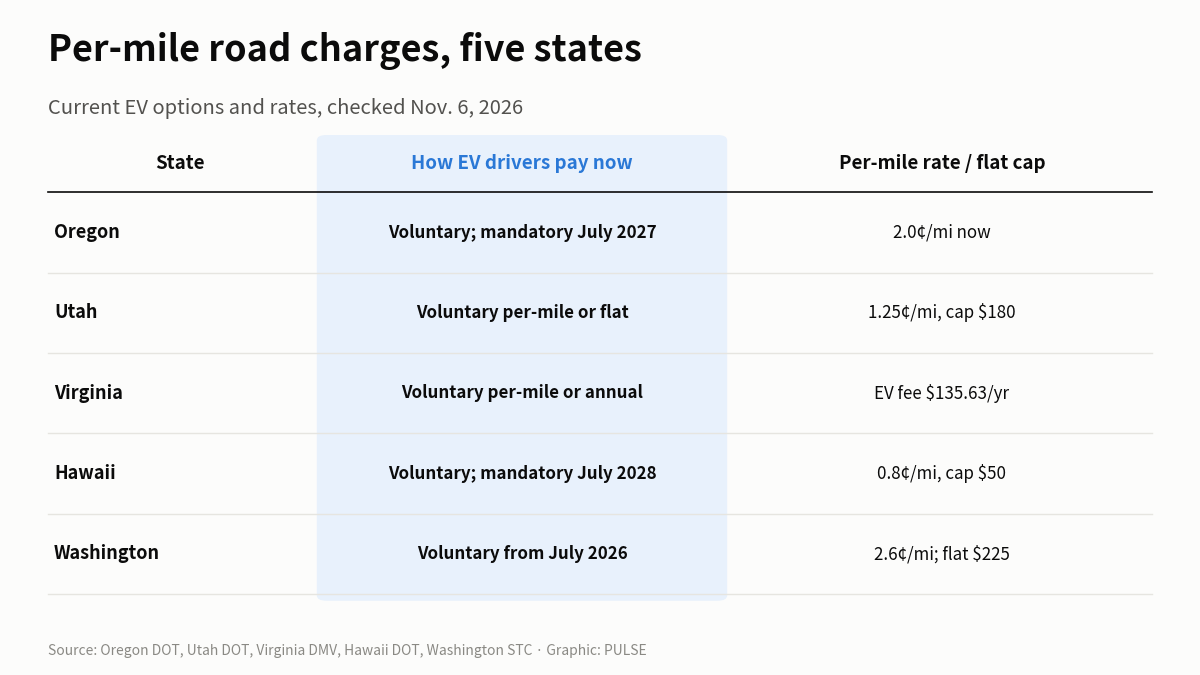
The rates in effect today are modest, and most programs cap what you can owe so a mileage charge never costs more than the flat fee it replaces. Utah charges 1.25 cents per mile in 2026, capped at $180, the same as its flat EV fee; both the rate and cap rise on Jan. 1, 2027, to 1.5 cents and $280. Hawaii charges $8 per 1,000 miles — eight-tenths of a cent per mile — capped at $50, matching its flat option.
| State | How EV drivers pay now | Per-mile rate / flat cap |
|---|---|---|
| Oregon | Voluntary (OReGO); mandatory July 2027 | 2.0¢/mi now |
| Utah | Voluntary per-mile or flat fee | 1.25¢/mi, cap $180 |
| Virginia | Voluntary per-mile or annual fee | EV fee $135.63/yr |
| Hawaii | Voluntary; mandatory July 2028 | 0.8¢/mi, cap $50 |
| Washington | Voluntary from July 2026 | 2.6¢/mi; flat fee $225 |
Virginia takes a different path. Its Mileage Choice Program is voluntary, and the per-mile rate is set by dividing a driver's annual highway use fee by 11,600, the state's estimate of average annual miles. The highway use fee for an all-electric vehicle is $135.63 for the year running July 2026 through June 2027. As in Utah and Hawaii, participants will not pay more than that annual amount.
The flat EV fee most drivers still pay
Per-mile charges remain the exception. The common tool is still a flat annual registration surcharge on electric vehicles, and those have been climbing. The Tax Foundation counts 41 states with an EV fee in 2026, ranging from zero in states such as Arizona and Florida up to $270 in New Jersey, with a median near $130. Michigan sits just behind New Jersey at about $267, and Washington and Texas each top $200.
These flat fees are blunt. A retiree who drives 4,000 miles a year pays the same surcharge as a commuter logging 20,000. That is exactly the complaint mileage programs are built to answer, and it is why states keep testing the per-mile model even as the flat fee does the heavy lifting today.
Washington and the next wave
Washington is the state to watch next. Its road usage charge opens to electric and hybrid drivers on a voluntary basis beginning July 1, 2026, at 2.6 cents per mile, and drivers who enroll stop paying the $225 flat EV fee. As in other states, you pay the mileage charge or the gas tax, not both, with pump taxes credited against what you owe.
The pattern across these five states is consistent: start voluntary, cap the downside, then decide whether to make it mandatory once the technology and public trust are in place. Oregon is the first to set a hard mandatory date for a broad class of vehicles.
What to check before your next registration renewal
If you drive an EV or a high-mileage hybrid, look at your state DMV's registration page before you renew, because the flat surcharge is the line that has been changing fastest. If you live in Oregon, Utah, Virginia, Hawaii or Washington, compare the per-mile option against the flat fee using your real annual mileage — the caps mean low-mileage drivers often come out ahead on the per-mile plan, while high-mileage drivers hit the cap and pay the same either way. Oregon EV owners specifically should watch for ODOT to publish the final mandatory rate ahead of the July 2027 start, since the figure circulating now is from reporting, not the agency's posted schedule. And if your state is among the roughly dozen studying mileage fees, expect a voluntary pilot to arrive before any mandate.
How we checked this
We read primary sources: ODOT's statement on the 2.2% revenue decline and its HB 3991 and OReGO pages; the Utah DOT road usage charge site; the Virginia DMV Mileage Choice page and its 2026 highway use fee chart; the Hawaii DOT road usage charge program page; and the Washington State Transportation Commission road usage charge page. We used the Tax Foundation's 2026 EV tax dataset and the National Conference of State Legislatures for the national comparison of flat fees, and PBS NewsHour for the reported Oregon mandatory rate. All pages were checked on Nov. 6, 2026. We could not confirm Oregon's exact mandatory per-mile rate or flat annual fee on any ODOT page; those figures come from news reporting and are not yet official. We could not independently verify the Hawaii flat-fee end date on the state page. Spot an error? Write to connect@blinkhub.net.
Cover photo: Engin Akyurt / Pexels