
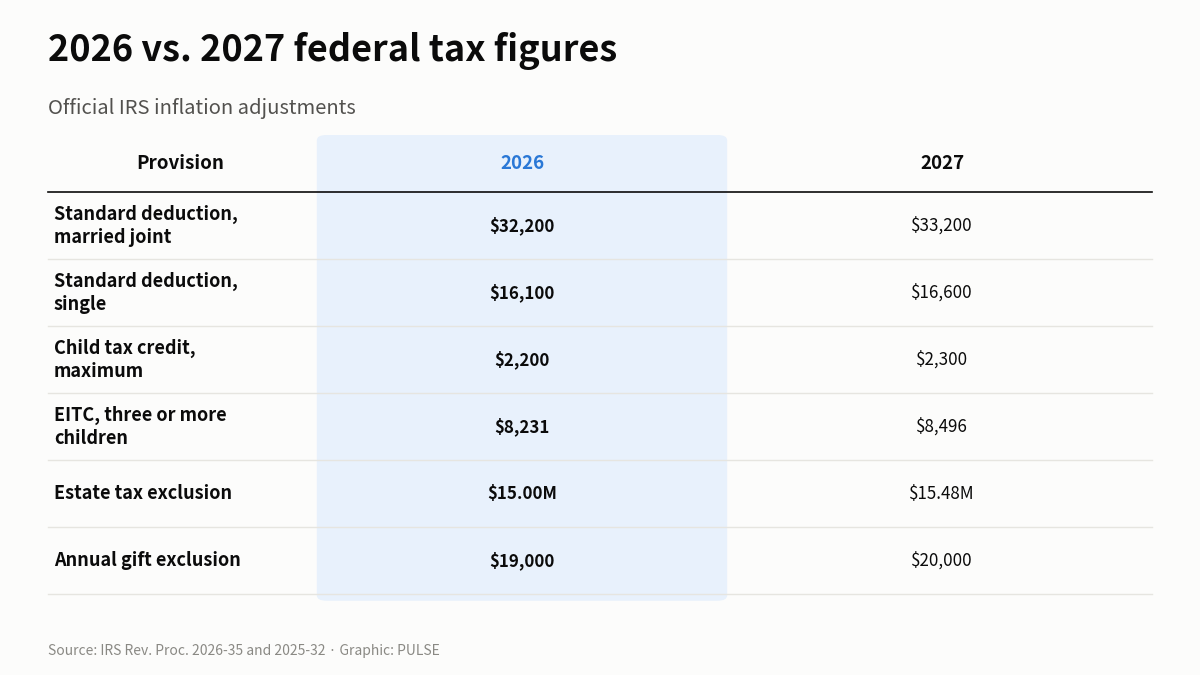
If you are married and file a joint return, the slice of income the government will not tax at all grows by $1,000 next year. Your standard deduction rises to $33,200 for tax year 2027, up from $32,200 this year, according to the Internal Revenue Service. That is a change of about 3 percent. It is the single number that touches the most returns, and it sets the tone for the rest of the adjustments.
The IRS announced the changes on November 5, 2026, in news release IR-2026-133 and spelled them out in Revenue Procedure 2026-35. They apply to income earned in 2027, on returns most people will file in early 2028. They do not change the return you file next spring for 2026.
The deduction and the credit that reach the most households
For single taxpayers and for married people filing separately, the standard deduction climbs to $16,600, up $500 from $16,100 this year. Heads of household get $24,925, up $775 from $24,150. Each of those moves is close to 3 percent, in line with the married-filing-jointly figure.
The child tax credit rises to $2,300 per qualifying child, an increase of $100 over the $2,200 the IRS lists for 2026. The refundable portion, the part you can receive as a payment even if you owe no tax, goes to $1,800 from $1,700. The $100 bump works out to roughly 4.5 percent, slightly ahead of the deduction changes.
The earned income tax credit, aimed at lower- and moderate-income workers, tops out at $8,496 for a household with three or more qualifying children, up from $8,231 this year. That is about a 3.2 percent increase, confirmed against the IRS figure for tax year 2026.
Why the jump is small this year
These are inflation adjustments, not a tax cut passed by Congress. The IRS recalculates dozens of dollar thresholds each year so that a raise that only keeps pace with prices does not quietly push you into a higher bracket. When inflation runs hot, the numbers jump; when it cools, they barely move. The increases this year sit near 3 percent across most provisions, a smaller step than filers saw in the high-inflation adjustments of a few years ago.
The marginal rate brackets shifted by the same logic. The top 37 percent rate now starts at $661,375 for single filers and $793,650 for married couples filing jointly in 2027, up from $640,600 and $768,700 this year, per the IRS 2026 and 2027 releases. Every lower threshold rose as well, which means a given salary is taxed a little more gently in 2027 than the identical salary in 2026.
| Provision | 2026 | 2027 |
|---|---|---|
| Standard deduction, married joint | $32,200 | $33,200 |
| Standard deduction, single | $16,100 | $16,600 |
| Child tax credit, maximum | $2,200 | $2,300 |
| EITC, three or more children | $8,231 | $8,496 |
| Estate tax exclusion | $15.00M | $15.48M |
| Annual gift exclusion | $19,000 | $20,000 |
Where the bigger dollars move: estates, gifts, and the alternative minimum tax
Some figures changed by large absolute amounts even though the percentage was ordinary. The estate tax exclusion, the amount a person can pass on at death before the federal estate tax applies, rises to $15,480,000 for people who die in 2027, up from $15,000,000 this year. That is a $480,000 move, though it is still about 3.2 percent.
The amount you can give any one person in a year without filing a gift tax return goes to $20,000, up from $19,000, according to the IRS figures for 2026 and 2027. The alternative minimum tax exemption, a parallel system meant to keep higher earners from erasing their bill with deductions, rises to $93,000 for single filers and $144,700 for married couples, up from $90,100 and $140,200. The foreign earned income exclusion for Americans working abroad increases to $137,300 from $132,900.
Benefits tied to your paycheck and your family
Several adjustments show up through an employer rather than on a 1040. The health flexible spending account limit, the pretax money you can set aside for medical costs, rises to $3,500 from $3,400. The monthly cap on pretax transit and parking benefits goes to $350 from $340. The maximum adoption credit increases to $18,250 from $17,670, and its refundable portion rises to $5,280 from $5,120.
None of these is dramatic on its own. Together they are the plumbing of a paycheck, and they reset every January whether or not a filer notices.
What the "Working Families Tax Cuts" label does and does not cover
The IRS packaged this release under the banner "Working Families Tax Cuts," which the agency ties to the 2025 law it calls the One, Big, Beautiful Bill. That page describes separate provisions that are not the same as the annual inflation math: an additional $6,000 deduction for people 65 and older through 2028, a deduction of up to $25,000 for qualified tips, and a deduction for certain overtime pay, each with its own income phase-outs. Those were set by statute. The standard deduction and credit figures in this article are the yearly inflation adjustments layered on top. Readers who qualify for the senior, tip, or overtime deductions should treat them as a separate calculation and check the eligibility limits on the IRS page, because they carry expiration dates the indexed figures do not.
What to do before these numbers take effect
Nothing here changes your 2026 return. Use the 2026 column when you file next spring and the 2027 column for planning income, gifts, or withholding during the coming year. If you adjust payroll withholding, December is the practical moment, because the 2027 brackets govern the paychecks you start receiving in January. Anyone weighing a large gift or an estate plan should note that the higher exclusion applies only to gifts made and estates settled in 2027. Watch for the IRS to publish updated withholding tables and the full Revenue Procedure 2026-35 text, which carries the thresholds not summarized in the news release.
How we checked this
We read the IRS news release for tax year 2027 (IR-2026-133, November 5, 2026) and the agency's published figures for tax year 2026, plus the IRS "Working Families Tax Cuts" page, all on irs.gov, and compared each 2027 dollar amount against the matching 2026 figure. The percentage changes shown are our own arithmetic from those official numbers. We confirmed the figures as current on November 6, 2026. We relied on the IRS news releases and could not independently open the full Revenue Procedure 2026-35 document, so thresholds not restated in the release are not reported here. The 2026 child tax credit maximum is taken from the IRS's own statement in the 2027 release that the credit rose by $100. Spot an error? Write to connect@blinkhub.net.
Cover photo: Nataliya Vaitkevich / Pexels