
If you are 58, between jobs, and have collected SNAP for years without anyone asking how many hours you work, that arrangement ended for much of the country around November 1. A federal law enacted in 2025 pulled adults in their late 50s and early 60s into the same work rules that used to stop at age 54, and it shrank the age of the child that shields a parent, from under 18 to under 14.
Whether the rules reach you right now still turns on geography. The federal time limit applies everywhere, but your county may hold a temporary waiver that your neighbor's county does not. Here is who is covered, what still exempts you, and how five states have drawn very different maps.
Who the clock is now running against
The rule in plain terms: if you are 18 to 64, able to work, and have no child under 14 in your home, you can get SNAP for only three months in any 36-month period unless you put in 80 hours a month of qualifying activity. That is about 20 hours a week.
The hours do not have to be a paycheck. Paid work, self-employment, in-kind work, volunteering at a nonprofit, or an approved training program all count, as New Jersey spells out on its benefits page. Looking for work, on its own, does not.
The 2025 law raised the top age from 54 to 64 and cut the dependent-child age to 14, meaning parents of teenagers and many adults aged 55 to 64 are newly on the hook, a shift the Center on Budget and Policy Priorities estimates could cost more than a million older adults their food aid, according to Think Global Health. In Michigan, the state health department said these federal rules were reinstated in eight counties starting November 1, 2026, per reporting that cited MDHHS.
The shields that disappeared this year
Three groups that were protected as recently as 2024 are not anymore. The law ended the special exemptions for veterans, people experiencing homelessness, and young adults who aged out of foster care. Pennsylvania's human services department confirms the veteran and former-foster-youth carve-outs expired at the end of October 2025.
One exemption was added. Members of federally recognized tribes, Urban Indians, and California Indians are now exempt, a change Minnesota logged as taking effect November 1, 2025.
Plenty of exemptions remain. You are generally outside the time limit if you are pregnant, physically or mentally unfit for work, caring for a child under 6 or for an incapacitated person, enrolled at least half-time in school, or already working enough hours. North Carolina also lists chronically homeless people, recent domestic-violence survivors, and adults 55 to 64 who face several barriers at once, such as limited education, no recent work history, and a health condition. Michigan's deferral list includes people receiving unemployment benefits and those in substance-abuse treatment, as described in MDHHS guidance.
Why one county enforces while the next one waits
For years, states could waive the time limit in areas that lacked enough jobs. The 2025 law closed that path. Now an area qualifies for a waiver only if its unemployment rate runs above 10 percent, with Alaska and Hawaii allowed to use areas at 1.5 times the national rate, as summarized from the USDA Food and Nutrition Service's waiver status table dated October 1, 2026.
The effect is a patchwork. By that federal table, no state holds a statewide waiver this quarter, and only twelve states hold any area waivers at all: Alaska, Arizona, California, Kentucky, Michigan, Minnesota, Nevada, New Jersey, New Mexico, New York, Oregon, and Wisconsin. Everywhere else, the limit applies to every eligible adult in the state. Brookings notes the law also weakens the program's ability to expand automatically when a recession hits, since the old high-unemployment waivers are gone, in its analysis of the cuts.
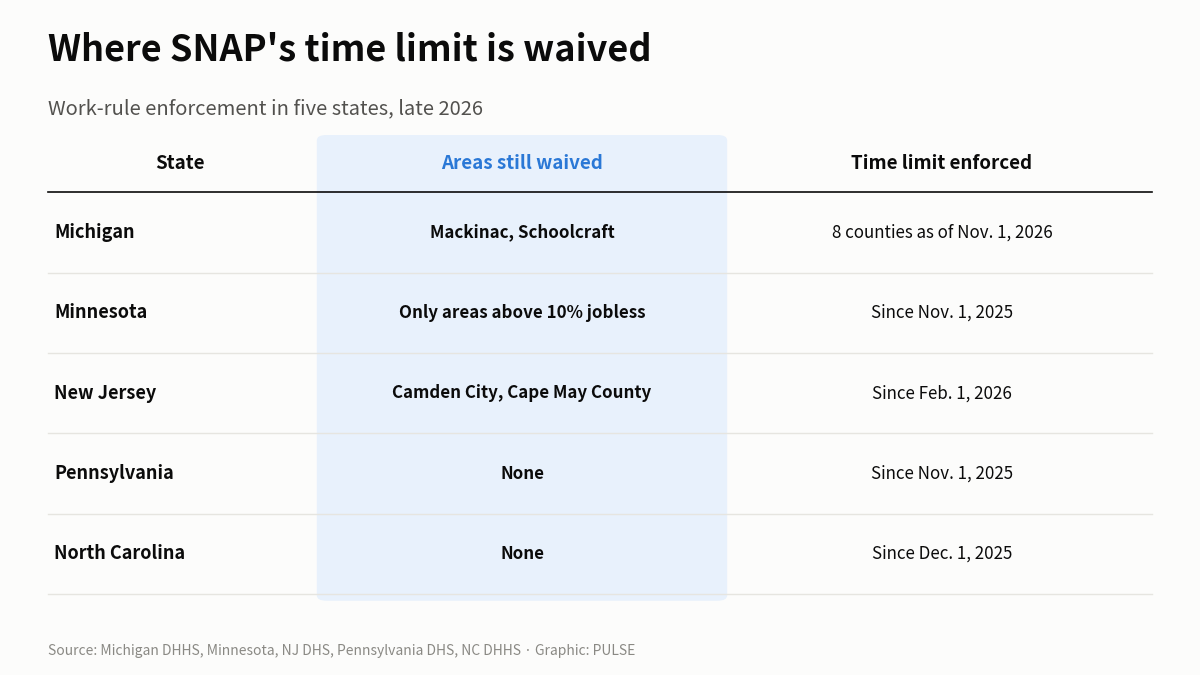
| State | Areas still waived | Time limit enforced |
|---|---|---|
| Michigan | Mackinac, Schoolcraft | 8 counties as of Nov. 1, 2026 |
| Minnesota | Only areas above 10% jobless | Since Nov. 1, 2025 |
| New Jersey | Camden City, Cape May County | Since Feb. 1, 2026 |
| Pennsylvania | None | Since Nov. 1, 2025 |
| North Carolina | None | Since Dec. 1, 2025 |
Five states, five maps
Michigan shows how fine the lines can get. The state said the rules returned in eight counties on November 1, 2026, including Alger, Iron, and Luce in the Upper Peninsula, while Mackinac and Schoolcraft counties stayed under a federal waiver.
Minnesota eliminated its old job-shortage waiver and now exempts only areas above 10 percent unemployment, which the state was still mapping, with the broader rules effective November 1, 2025.
New Jersey ran a waiver covering every county except Morris through January 31, 2026. As of February 1, 2026, the state's Division of Family Development says only Camden City and Cape May County remain waived.
Pennsylvania took the hardest line. Its human services agency states flatly that the state no longer qualifies for county or municipal waivers because of the federal change, with the expanded 18-to-64 rules live since November 1, 2025.
North Carolina applies the limit statewide, effective December 1, 2025, and counts the three months inside a tracking window that runs from January 1, 2025, through December 31, 2027.
What to check before your three months run out
Start by confirming your county's current waiver status with your state SNAP agency or caseworker, because it can change each federal quarter and is the single fact that decides whether the clock is even running for you. Say you are 60 and caring for a grandchild who is 12; that child under 14 should keep you exempt, but only if your case file reflects it.
If an exemption applies, make sure the agency has documented it, whether that is a disability determination, a pregnancy, caregiving for a child under 6, or tribal membership. If you are working, report your 80 hours so a non-compliant month does not count against you. And if your benefits are cut, ask about the appeal window and about a notice period; several state pages tie restored eligibility to specific dates, such as New Jersey's reference to January 31, 2027. Watch the next federal waiver table too, since high-unemployment counties can move on and off the list.
How we checked this
We read the official SNAP work-requirement pages of five state agencies: North Carolina DHHS, Minnesota, New Jersey DHS and its federal-changes notice, and Pennsylvania DHS, plus federal guidance summarized by the National Association of Counties. Check date: November 3, 2026. We could not load Michigan's own michigan.gov work-requirements page or USDA's fns.usda.gov pages, which returned access errors, so the Michigan county details are attributed to reporting that cited MDHHS, and the national count of waived states is drawn from a secondary summary of USDA's October 1, 2026 waiver table rather than the table itself. We did not independently verify every county's unemployment rate or each state's live waiver list for areas outside the five profiled. Spot an error? Write to connect@blinkhub.net.
Cover photo: Gustavo Fring / Pexels