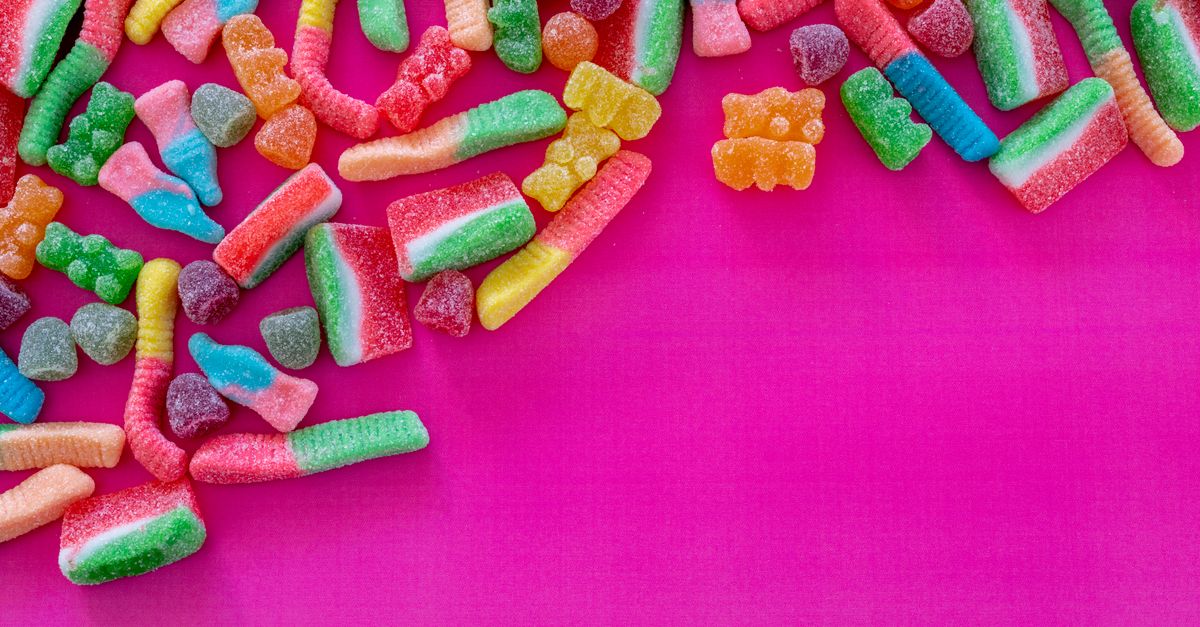
If you walked into an Oklahoma medical marijuana dispensary this week for a THC gummy shaped like a bear or a worm, you will not find one on a legal shelf. A state law that took effect November 1 bars edible medical marijuana from being made in the shape of humans, cartoons, animals, or commercially available candy. The same products were legal in late October.
Three days before that deadline, California's governor announced a fresh round of enforcement against deceptively packaged products that look harmless, pulling intoxicating hemp, kratom, and illicit cannabis from store shelves. Two states, one week, the same worry: products that read like Halloween candy but carry a drug dose.
Whether a candy-shaped or deceptively packaged THC, hemp, or kratom product is legal where you live, and what its label must now tell you, depends almost entirely on your state. Here is what five of them require as of today.
Oklahoma just drew a line it had not drawn before
House Bill 4454, authored by Rep. Carl Newton, R-Cherokee, prohibits edible medical marijuana from being shaped like a human, cartoon, animal, or a form of commercially available candy, and bars any image or words designed to appeal to someone under 18. It also forces a label change. Each package must state the number of THC servings inside and the amount of THC in a single serving, drinks included.
The law adds no new penalty. Licensed processors already face up to two yearly inspections by the Oklahoma Medical Marijuana Authority, and a $500 fine per deficiency if they do not fix problems within a month. What changed on November 1 is that transferring noncompliant products to a dispensary is now off limits.
Five states, five versions of the same candy ban
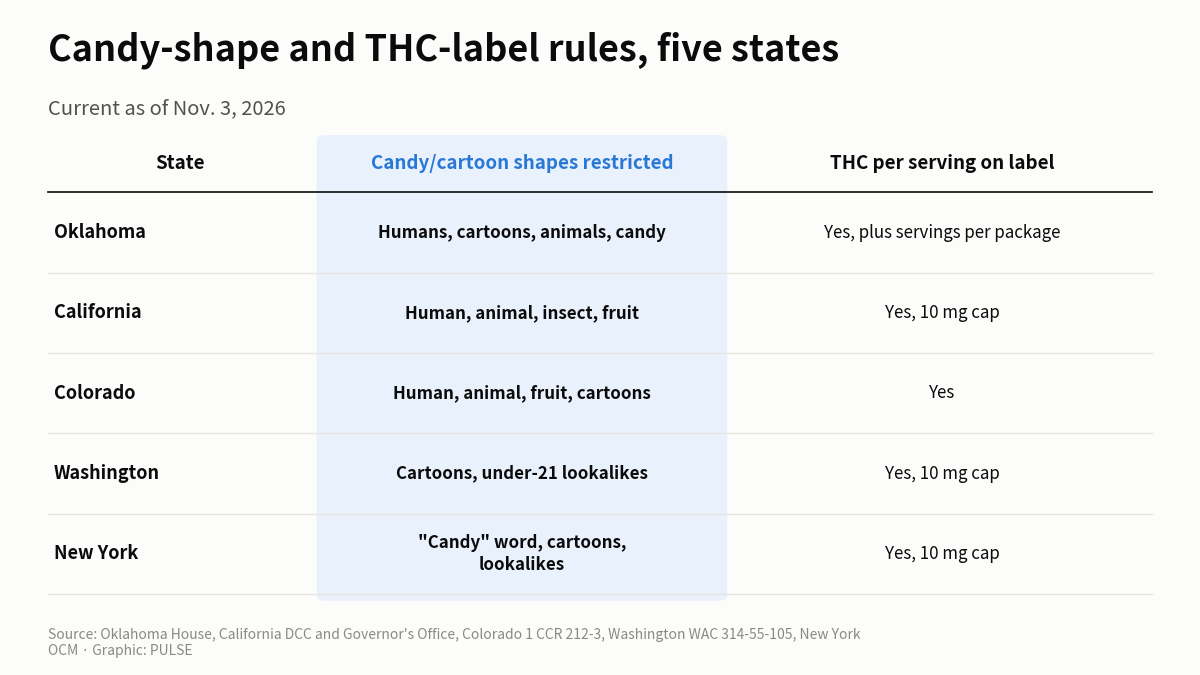
Oklahoma is late to a fight other states joined years ago. Colorado banned edibles in the distinct shape of a human, animal, or fruit, including realistic or cartoon renderings, back in 2017. Its rule still carves out exceptions, including geometric shapes that are merely fruit-flavored and the marijuana leaf itself.
California's Department of Cannabis Control prohibits any cannabis product in the shape of a human being, animal, insect, or fruit, and caps edibles at 10 milligrams of THC per serving and 100 milligrams per package. New York goes a step further on words. Its packaging rules ban the terms "candy" or "candies" and spelling variants, along with cartoons and any visual similarity to candy, cookies, soda, or cereal.
Washington reaches the same place through its appeal-to-minors rule, which bars cartoons, cartoon-like fonts, and any design that resembles a noncannabis product marketed to people under 21. The through-line is consistent even where the wording is not: a product should not look like something a child would reach for.
| State | Candy or cartoon shapes restricted | THC per serving on label |
|---|---|---|
| Oklahoma | Humans, cartoons, animals, candy (medical) | Yes, plus servings per package |
| California | Human, animal, insect, fruit | Yes, 10 mg cap |
| Colorado | Human, animal, fruit, cartoons | Yes |
| Washington | Cartoons, under-21 lookalikes | Yes, 10 mg cap |
| New York | "Candy" word, cartoons, lookalikes | Yes, 10 mg cap |
The labeling line you should actually read
The shape rules grab headlines. The labeling rules decide how much you take. All five states now require edible labels to break out THC by serving, not just by package. California, New York, and Washington cap a single serving at 10 milligrams of active THC, with Washington and California also limiting a full package to 100 milligrams.
Oklahoma does not set a per-serving milligram cap in this law. It requires the count instead, so a buyer can see how many doses sit in one bag and how strong each one is. A ten-piece package that reads "10 servings, 10 mg each" is a very different purchase from one that lumps 100 milligrams into a single unlabeled block, and that difference is the point Rep. Newton cited, calling the changes a way to inform consumers about recommended dosage.
Hemp and kratom follow a different rulebook
Candy-shaped marijuana is the regulated end of the market. The messier end is intoxicating hemp and kratom, which often sell in gas stations and smoke shops outside any cannabis license. California reported that its Department of Alcoholic Beverage Control made 24,590 visits and removed 7,403 illegal hemp products, reaching 99.36 percent compliance. For kratom and its concentrated derivative 7-OH, the state said it embargoed or destroyed roughly $10 million in goods and pulled 8,230 products.
California can do this because a 2025 law, Assembly Bill 8, applied cannabis rules to intoxicating hemp, and emergency regulations now bar detectable THC per serving in hemp products and restrict sales to buyers 21 and older. Kratom is different again. It is not a federally scheduled drug, so its status is set state by state, and the patchwork is wide. Secondary legal trackers describe roughly ten states banning kratom outright while others, such as Rhode Island, have moved to a licensed system. We could not confirm a single official national count, because none exists, and the figure shifts as legislatures act.
What to check before you buy
Match the product to the rule your state actually uses. In a licensed cannabis state, a legal edible should carry a per-serving THC figure and should not look like name-brand candy or a cartoon character. If a package screams a familiar candy name or a bright kids-cereal look, treat that as a signal it came from outside the regulated system, which is exactly what California's enforcement targets.
For hemp and kratom sold outside dispensaries, assume less protection and read the label harder. Watch two things in the coming months: whether more states copy Oklahoma's per-serving disclosure requirement, and whether federal scheduling of concentrated 7-OH changes kratom's status where you live. If you have young children, the shape of the package tells you nothing reliable about the dose inside, so store any THC, hemp, or kratom product locked and out of reach.
How we checked this
We read the Oklahoma House of Representatives release on House Bill 4454, the California Governor's office enforcement announcement dated October 31, 2026, the California Department of Cannabis Control text-of-regulations page, Colorado's marijuana rule at 1 CCR 212-3-6-110 as reproduced in the Cornell Code of Colorado Regulations, Washington rule WAC 314-55-105 on the state legislature site, and New York's Office of Cannabis Management Part 128 packaging and labeling guidance. We checked all figures on November 3, 2026. We could not load the Washington Liquor and Cannabis Board's edible-review notice page, which returned an access error, so we relied on the current WAC text instead. California's full regulatory section text did not render on the DCC page, so its shape prohibition is drawn from the regulation's indexed sections and the Governor's description of Assembly Bill 2249; the 10 mg and 100 mg limits are from DCC Section 17304. There is no official nationwide count of state kratom bans, so we did not state one as fact. Spot an error? Write to connect@blinkhub.net.
Cover photo: Elizabeth Iris / Pexels