
Log in to shop for 2027 coverage this month and the first number you see will likely be higher than last year's. How much of that increase you actually pay depends less on Washington, D.C., than on which state you live in.
The reason is a change that took effect quietly last New Year's. The enhanced premium tax credits that padded Affordable Care Act subsidies since 2021 expired on December 31, 2025, and Congress has not restored them. Washington state regulators point to that expiration as a main driver of 2027 prices, noting the credits had cut enrollees' average annual premium costs by $1,330. With them gone, sticker prices and the share households owe both climb.
Some states are stepping in with their own money. Others are not. Here is what the help looks like in five of them.
The federal cushion that vanished at the end of 2025
Sticker increases for 2027 are steep and widespread. Washington's Office of the Insurance Commissioner approved an average individual-market increase of 22.2 percent, ranging from 6.7 percent at Regence BlueShield to 30.5 percent at Community Health Plan of Washington. Enrollment there fell 13 percent to about 250,000 people, the largest drop since 2012.
Oregon's Division of Financial Regulation finalized an individual-market average of 21.6 percent on August 18, 2026, cushioned by about 10.7 percent from the state reinsurance program. New Jersey's weighted average came in at 19.8 percent, with carriers citing the lapsed federal credits directly.
Small employers are not spared. Washington approved an average 16.7 percent increase for small-business plans from nine insurers, with approved changes running from 6.9 percent to 21.6 percent.
Virginia's new $150 million bet on premiums
Virginia is the clearest example of a state trying to backfill the gap. Its new Premium Savings Program puts $150 million toward lowering premiums for up to 200,000 residents.
The state projects savings of roughly $65 to $90 a month per enrollee, stacked on top of federal subsidies. For some households the reduction reaches as much as 90 percent, and more than 50,000 residents could find plans with $0 monthly premiums. Eligibility runs by income, from about $22,025 to $39,900 for a single filer and $45,540 to $82,500 for a family of four.
The backdrop is real pressure. Virginia estimates nearly 100,000 residents dropped marketplace coverage in 2026, and unsubsidized prices are set to rise around 16 percent. Open enrollment runs through January 29, 2027.
Where a second state check lands on top of the federal one
Virginia is not alone, but the programs differ sharply in size and reach.
Colorado funds Colorado Premium Assistance, a state payment applied upfront worth $80 for the first household member and $29 for each additional member who pays a premium. The state's marketplace says 69 percent of customers likely qualify for some financial help for 2027, and the individual market's average increase is about 10 percent, the mildest of the states here.
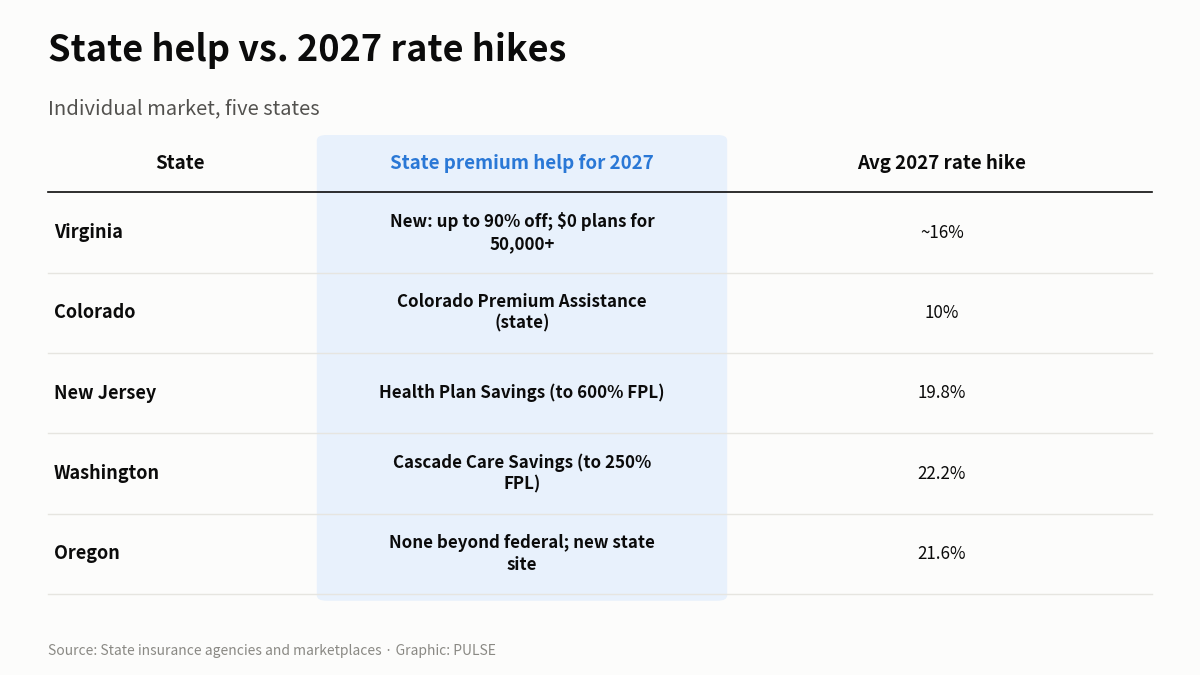
New Jersey layers its Health Plan Savings subsidy on top of federal credits for households up to 600 percent of the poverty level. Washington runs Cascade Care Savings for households at or below 250 percent of the poverty level, and it is open to residents regardless of immigration status.
| State | State premium help for 2027 | Avg 2027 individual rate hike |
|---|---|---|
| Virginia | New: up to 90% off; $0 plans for 50,000+ | ~16% |
| Colorado | Colorado Premium Assistance (state) | 10% |
| New Jersey | Health Plan Savings (to 600% FPL) | 19.8% |
| Washington | Cascade Care Savings (to 250% FPL) | 22.2% |
| Oregon | None beyond federal; new state site | 21.6% |
The pattern that emerges is uneven. A family just above the federal subsidy cutoff might still see a state check in Trenton or Richmond and nothing comparable elsewhere.
Oregon swapped the website, not the subsidy
Oregon's 2027 change is structural rather than financial. On November 1 the state launched Explore Health, a state-run marketplace that replaces HealthCare.gov for residents buying private coverage. The Oregon Health Authority says the platform will help shoppers check whether they qualify for financial assistance and enroll.
What it does not add is a new state premium subsidy on the scale of Virginia's or New Jersey's. Oregon's affordability lever remains its reinsurance program, which trimmed rates before shoppers ever logged in. For most residents the practical difference this year is the address they type, not an extra discount.
What to check before your deadline
Three steps matter more than the headline rate. First, confirm which door to use: Oregon shoppers now go to Explore Health, not HealthCare.gov, while Colorado, Washington, New Jersey, and Virginia each run their own sites. Second, re-run your eligibility this year even if nothing changed in your household, because the loss of enhanced federal credits reshuffled who qualifies and for how much. Third, if you live in a state with its own program, look for state savings applied on top of federal credits rather than instead of them.
Deadlines vary. Colorado and Oregon close January 15, 2027, Virginia closes January 29, and New Jersey closes January 31. Watch Congress, too: an extension of the enhanced federal credits would change the math in every state, and none has passed as of today.
How we checked this
We read primary releases and consumer pages from the Governor of Virginia, Connect for Health Colorado, the New Jersey Department of Banking and Insurance, the Washington Office of the Insurance Commissioner, Washington Healthplanfinder, the Oregon Health Authority, and the Oregon Division of Financial Regulation, all reviewed on November 2, 2026. Rate figures are the final approved 2027 individual-market averages published by each state. We could not load Virginia's consumer marketplace portal, which returned an access error, so Virginia program figures come from the Governor's office release. New Jersey's Health Plan Savings income threshold for 2027 is described by marketplace guidance; we confirmed the state's 19.8 percent rate average directly with the Department of Banking and Insurance. The federal enhanced premium tax credits expired December 31, 2025, and had not been restored as of our check date. Spot an error? Write to connect@blinkhub.net.
Cover photo: Leeloo The First / Pexels