If you live in a small town in West Virginia, you may have seen the headline: more than $19 million for rural health. Then you saw California's number, $233 million, and wondered what your state did wrong.
Nothing. The two figures do not measure the same thing. Lined up side by side, they give you the wrong answer about who got what.
Both come from the Rural Health Transformation Program, a $50 billion fund that the Centers for Medicare & Medicaid Services is paying out to all 50 states over five years, 2026 through 2030. CMS announced the awards for every state on December 29, 2025. Since then, states and CMS have been issuing a steady run of smaller press releases as the money reaches actual clinics and training programs. That is where the confusing numbers come from.
Why a $19 million headline and a $233 million headline describe the same thing
Read the fine print and the releases say so themselves. The California announcement states that the state "has committed its full fiscal year 2026 funding — more than $233 million," per CMS on October 29, 2026. That is the whole year's allocation, announced in one shot.
The West Virginia release is a different kind of number. Its $19 million went out through 11 awards on October 30, and the release says plainly that this "is one part of the larger overall funding amount awarded to West Virginia for fiscal year 2026." West Virginia's full-year total is $199,476,099.
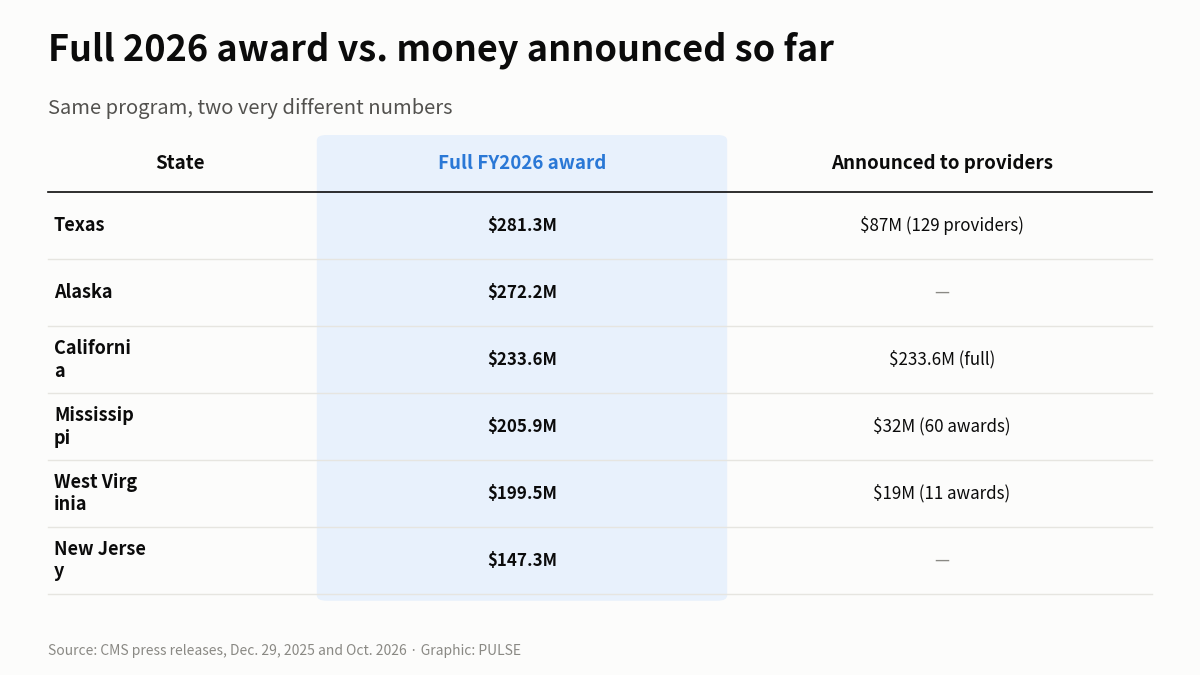
Texas is the clearest example of the gap. Its widely reported $87 million went to 129 rural providers. But Texas's full 2026 award is $281,319,361, the largest of any state. The $87 million is a first slice, not the pie.
What your state's full 2026 award actually is
The real apples-to-apples comparison is the full-year allocation, and those are published in the CMS table from December. Every state landed in a fairly narrow band. The awards average about $200 million, running from a high of $281.3 million in Texas to a low of $147.3 million in New Jersey.
So West Virginia's full share ($199.5 million) and California's ($233.6 million) are much closer than the stray press releases suggest. California simply chose to announce its entire allocation on one day. Other states are releasing the money provider by provider, so each individual headline looks small.
| State | Full FY2026 award | Announced to providers so far |
|---|---|---|
| Texas | $281.3M | $87M (129 providers) |
| Alaska | $272.2M | — |
| California | $233.6M | $233.6M (full allocation) |
| Mississippi | $205.9M | $32M (60 awards) |
| West Virginia | $199.5M | $19M (11 awards) |
| New Jersey | $147.3M | — |
The em dashes are honest ones. As of the check date I did not find a CMS provider-level release for Alaska or New Jersey, so those cells are blank rather than guessed. Their full-year totals come straight from the December CMS table.
Why no state fell below about $147 million
The formula explains the floor. CMS puts $10 billion on the table each year and splits it in two. Half is "distributed equally amongst all approved States." Half "is allocated by CMS based on a variety of factors including rural population" and the proportion of rural health facilities.
Do the arithmetic on the first half: $5 billion divided equally among 50 states is $100 million per state, guaranteed, before any state writes a word of its plan. The second $5 billion is where the spread comes from. States with more rural residents and more rural hospitals, and with plans CMS favored, pulled ahead. That is why Texas and Alaska sit near the top and densely populated New Jersey and Connecticut sit near the bottom, even though New Jersey still cleared $147 million.
Mississippi and Missouri show how the money reaches the ground
The provider releases are worth reading for what the dollars buy, not for ranking states. Mississippi's $32 million, spread across 60 awards on October 21, funds physician recruitment and three psychiatric emergency units next to hospital emergency departments. West Virginia's slice pays for mobile health units, drone delivery of time-critical supplies, remote eye care, and nursing apprenticeships. These are the kinds of line items a reader will actually encounter in a waiting room, and they vary by state because each state wrote its own plan.
What to watch, and where to find your state's number
If you want your state's real figure, look at the full-year allocation, not the latest press release. The authoritative list is the CMS December 29, 2025 announcement. Treat any new "$X million for rural [state]" headline as a progress update on money already counted in that total, not as fresh funding on top of it.
Two things to track going forward. First, this is year one of five; the $10 billion resets annually through 2030, and later-year amounts can shift because the discretionary half is re-decided each cycle. Second, watch your own state's office of rural health or governor's office for the provider-level awards, since that is where you learn which specific clinics, training programs, and services near you are being funded. Your state agency contact for program questions is listed as MAHARural@cms.hhs.gov on the Medicaid.gov rural health page.
How we checked this
We read the CMS press releases for California, Texas, West Virginia, and Mississippi, and the December 29, 2025 CMS announcement that lists every state's full fiscal year 2026 award, along with the Medicaid.gov rural health page describing the 50-50 funding split. All figures were confirmed on those CMS and Medicaid.gov pages on November 2, 2026. The full-year totals for Texas ($281,319,361), California ($233,639,308), Mississippi ($205,907,220), West Virginia ($199,476,099), Alaska ($272,174,856), and New Jersey ($147,250,806) come from the CMS state table. We could not reach the HHS.gov mirror of the national announcement, which returned a 403 error, so we relied on the identical CMS.gov release instead. We did not find CMS provider-level announcements for Alaska or New Jersey as of the check date, which is why those table cells are blank. Spot an error? Write to connect@blinkhub.net.
Cover photo: Atlantic Ambience / Pexels