
Two people can read the same headline about health insurance sign-ups and face deadlines more than six weeks apart. In Idaho, open enrollment for 2027 ends December 15. In California, New Jersey and Rhode Island, it runs to January 31. Anyone who assumes the national date applies to them could miss a window, or rush when they did not need to.
The federal date most people hear is January 15. That is the last day for the 2027 plan year on HealthCare.gov, according to a CMS fact sheet published October 30. But states that run their own marketplaces set their own calendars, and we checked those calendars one by one on the official sites.
The date that matters is usually not the last one
Each marketplace has two deadlines, and they are easy to confuse. The final deadline is the last day you can sign up without a qualifying life event. The earlier one decides whether coverage begins on January 1.
On HealthCare.gov, a plan picked by December 15 starts January 1, once the first premium is paid. A plan picked from December 16 through January 15 starts February 1. So someone whose job-based coverage ends December 31 and who enrolls on January 10 is inside the window, yet may still be uninsured for all of January.
What the official sites say, state by state
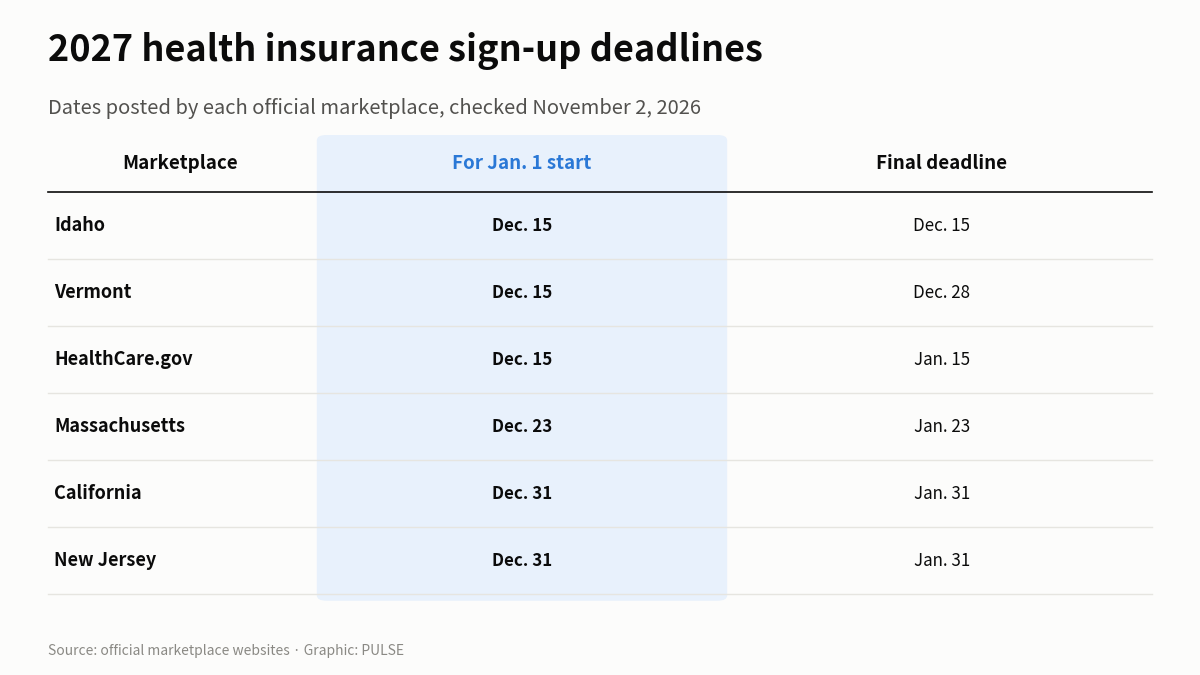
These are the deadlines posted by each marketplace, checked November 2, 2026. A dash means we could not confirm that date on an official page, not that no date exists.
| Marketplace | Sign up by, for Jan. 1 start | Final deadline |
|---|---|---|
| Idaho | Dec. 15 | Dec. 15 |
| Vermont | Dec. 15 | Dec. 28 |
| HealthCare.gov | Dec. 15 | Jan. 15 |
| Illinois | Dec. 15 | Jan. 15 |
| Maine | Dec. 15 | Jan. 15 |
| Nevada | — | Jan. 15 |
| Massachusetts | Dec. 23 | Jan. 23 |
| California | Dec. 31 | Jan. 31 |
| New Jersey | Dec. 31 | Jan. 31 |
| Rhode Island | — | Jan. 31 |
The spread is 47 days between the earliest and latest final deadlines in this table. The gap for a January 1 start is smaller, 16 days, which is why a reader in California and a reader in Illinois can follow the same advice and get different results.
Idaho and Vermont are the tightest
Idaho opened early, on October 15, and closes on the same day the federal cutoff for January coverage falls. There is no later window for a February start. Vermont offers one, but it is short: its marketplace lists November 1 through December 28, with December 15 as the cutoff for January 1.
A Vermont resident who follows national coverage and waits for mid-January would miss enrollment altogether. Outside open enrollment, marketplace coverage generally requires a qualifying life change, although Medicaid and CHIP applications are accepted year-round, according to HealthCare.gov.
Why the federal date stayed at January 15
A federal rule would have ended the HealthCare.gov window on December 15 this year. A federal court in Maryland vacated that provision in June in City of Columbus v. Kennedy, and the government has appealed to the Fourth Circuit. CMS's October 30 fact sheet lists January 15, and that is the date HealthCare.gov now shows.
Readers should not treat this calendar as permanent. Dates have moved before, and the case concerns future years as well.
What to do this week
Find out which marketplace serves your state, then write down its January 1 cutoff rather than its final deadline. If your current plan ends December 31, that earlier date is the one that protects you from a gap. People already enrolled should also look at their renewal notice, because staying in a plan automatically does not mean its 2027 price is the same.
How we checked this
We read each marketplace's own website on November 2, 2026, and linked it in the table. We left a dash where an official page did not state the date. We could not load the official sites for New York, Connecticut, Washington, Maryland, Virginia, Georgia, the District of Columbia or New Mexico, so those are not listed. Confirm your date on your marketplace's site before you rely on it. Spot an error? Write to connect@blinkhub.net.
Cover photo: SHVETS production / Pexels