It's 11 p.m. and you've just found a torn chocolate wrapper on the floor. Or your cat has been hiding under the bed all day and won't touch her food. Every pet owner knows the next question: does this need a vet tonight, or can it wait until morning?
PetCare AI is a web service built for exactly that moment. Owners describe what their dog or cat is doing, or upload a photo, a short video or a vet document, and get a first-step answer: what it could be, what to watch for, and whether it needs a vet today. It runs in English, Spanish and Korean.
Found through search in 41 countries, led by the U.S.
According to Google Search Console data for the last three months, people searching on Google reached PetCare AI from 41 countries. The United States accounted for 52% of those visits, followed by South Korea, India, Canada, Mexico and Spain. Over the same period, PetCare AI pages appeared in Google results in 171 countries, more than 78,000 times.
Paying users arrived from abroad first. Pet owners in Ireland and Spain bought consultation credits through PayPal, in both cases after finding the site through Google and going straight from the consultation screen to checkout. Payments are now also coming in from South Korea by bank transfer.
Built to answer "should I go to the vet?"
PetCare AI is clear that it does not replace a veterinarian. Every screen carries a notice that the service is informational, is not a veterinary diagnosis, and that medical decisions belong with a licensed vet. What it does instead is help owners organize what they're seeing and decide how urgent it is before they pick up the phone.
- AI consultation: owners can combine a description with photos, video, lab results or clinic paperwork. Answers are split into possible causes, what to watch at home, and red flags that mean go now. The AI does not give drug doses and is designed not to invent clinics, studies or statistics.
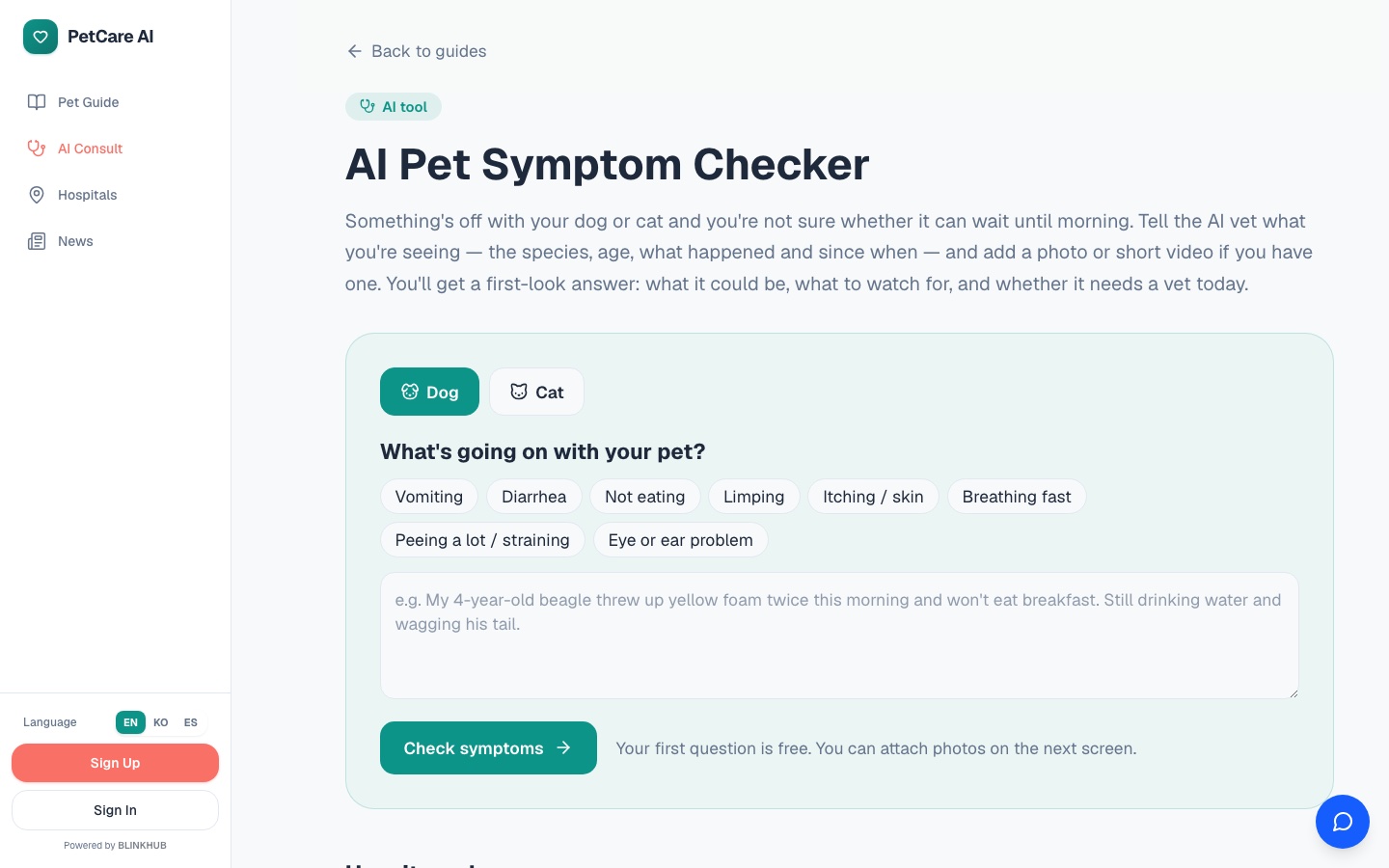
- Symptom checker: choose dog or cat, tap vomiting, diarrhea, not eating, limping, itching, fast breathing and more, and go straight into a consultation. The first question is free for new members.
- Vet clinic finder: 60,568 veterinary clinics in 195 countries, combining South Korea's official government licensing data with OpenStreetMap, searchable from your current location.
- Care calendar: keeps track of vaccinations and parasite prevention.
About 80 guides, written for real situations
The site's guides cover the moments owners actually face: a dog that ate chocolate, blood in the stool, a cat breathing fast. Emergency guides open with what to do, what not to do, and the signs that mean it's time for the ER.
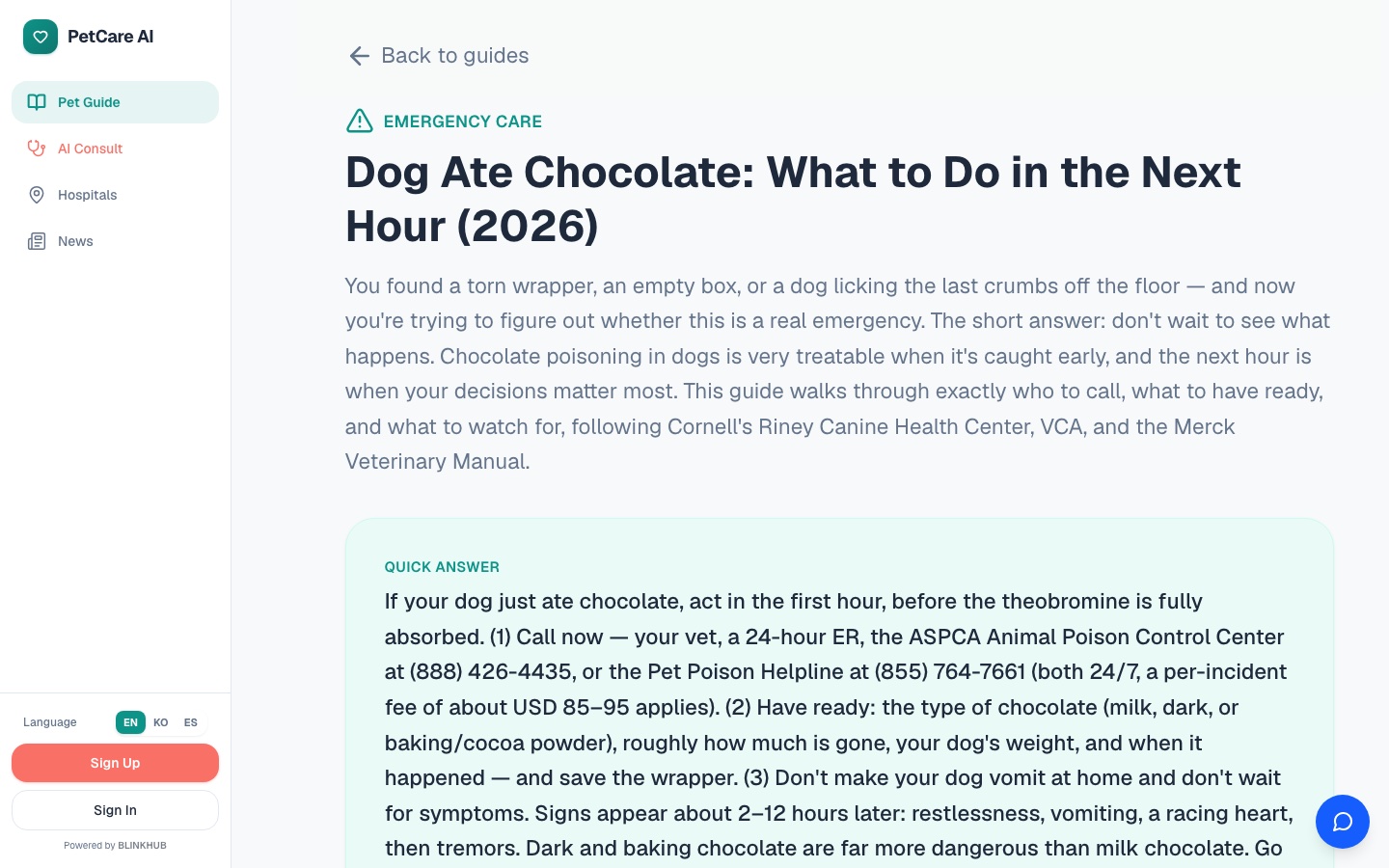
The guides aren't simply translated. The Korean edition has articles only Korean owners need, such as warning signs of SFTS, a tick-borne virus found in East Asia, and what to do when a dog eats ginkgo nuts on a walk. The Spanish edition covers diseases common around the Mediterranean, such as early signs of canine leishmaniosis. Country-specific guides are checked against primary sources such as national health authorities before they go live.
Coming next: a vet-only portal and global case sharing
Alongside the owner-facing service, PetCare AI is building a separate portal for veterinarians, open only after license verification. It brings together a weight-based drug dose calculator, species-specific lab reference ranges, AI-assisted differential diagnosis, emergency drug and CPR protocols, and a space where vets can share clinical cases.
For owners, the company is preparing Global Cases, a library where people can look up and share reference cases from veterinary clinics around the world, and a community where pet owners in different countries can swap experiences. The idea is to put how dogs and cats are treated in the U.S., Europe and Korea side by side in one place. These features will open as each one is ready.
Try it free, top up only when you need it
New members get their first question answered free. After that, consultations use credits that owners top up when they need them, with no monthly subscription. International users pay with PayPal, and owners in Korea can pay by bank transfer. Three days after a consultation, the service sends a short check-in email in the user's language asking how the pet is doing. The email does not repeat any symptoms.
"When a pet gets sick at midnight or on a weekend, the first thing owners do is search," a PetCare AI spokesperson said. "Our goal is to help them decide quickly whether it's an emergency or something they can watch, and then get them to the nearest clinic." The spokesperson added that because U.S. and European users responded first, the company plans to expand Spanish and other European-language guides and open the vet portal and global case sharing in stages.
PetCare AI is available at petcare-ai.com.