FAXTR, a fact-check aggregation site, has added two features to Scanner, its tool for checking social media posts and live streams: claim checks for a single screenshot of a news-style short video, and a "selling check" for live-shopping streams. The update comes a week after Scanner launched on Oct. 23.
The biggest change is that one phone screenshot is now enough to check the claims in a news-style post. Until now, a claim check needed a link to the post. Scanner now reads the on-screen text first, decides whether the post is news or advertising, and, if it is news, skips the face analysis and goes straight to the claims.
A screenshot of a TikTok short that circulated in South Korea on Oct. 29 shows how it works. In large captions, the video announced "nationwide emergency measures" in Britain and Japan, told viewers to "prepare three days of emergency food by Nov. 2," and said a disaster agency had issued an "urgent request" for a week of water and food. Scanner picked out three claims and compared them with 12 domestic and international reports.
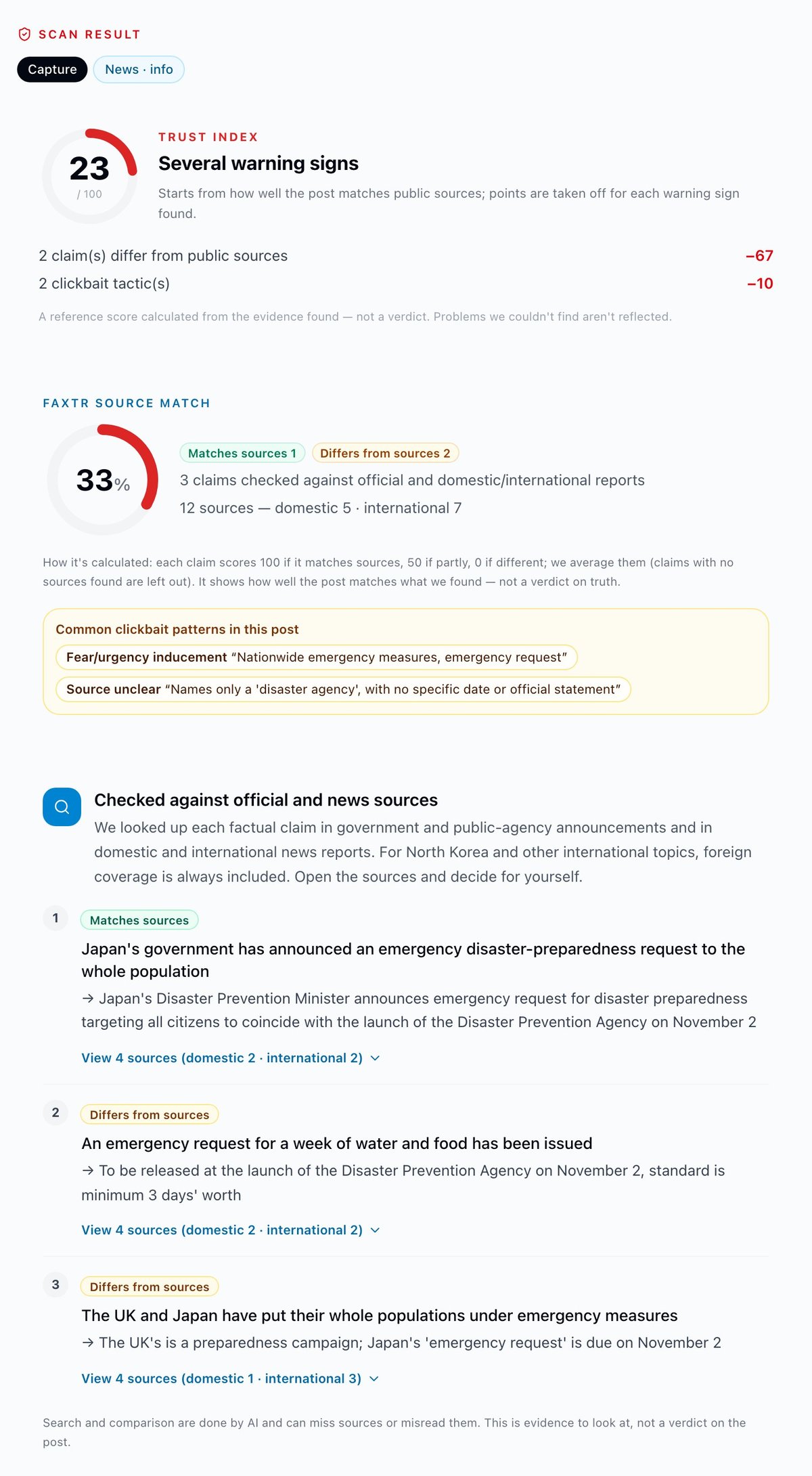
The claim that Japan's government had announced an emergency preparedness request to the whole population was marked as matching the sources. Scanner attached reports that Goshi Hosono, Japan's disaster-management minister, said he would issue the request on Nov. 2, when the country's new Disaster Prevention Agency is launched. The claim that a request for a week of supplies had already been issued was marked as differing from the sources: the request had not yet been made, and the stated baseline was at least three days. The claim that Britain and Japan had both put their populations under emergency measures was also marked as differing, citing reports that Britain's effort is a preparedness campaign.
Phrases such as "nationwide emergency measures" and "urgent request" were flagged separately as fear and urgency tactics, and the vague reference to an unnamed agency with no date was flagged as an unclear source. The post scored 23 out of 100 on Scanner's trust index, which starts from how well a post matches the sources found and subtracts points for each warning sign. The result page notes that the index is a reference score, not a verdict.
The selling check is aimed at live-shopping streams and social media group buys, where products are sold directly in a broadcast or post. Scanner looks at three things: how the product is being sold, how the price compares, and what is publicly known about the seller.
In a test on a Korean YouTube live-shopping stream selling red scallops, Scanner flagged seven risky selling methods, each quoted from what the host said or what appeared on screen. Three pushed viewers to order outside the platform, through KakaoTalk or another chat channel. Three pressured viewers to buy immediately, such as "after tomorrow the price goes up." One called the deal "the best price in the universe" without any evidence.
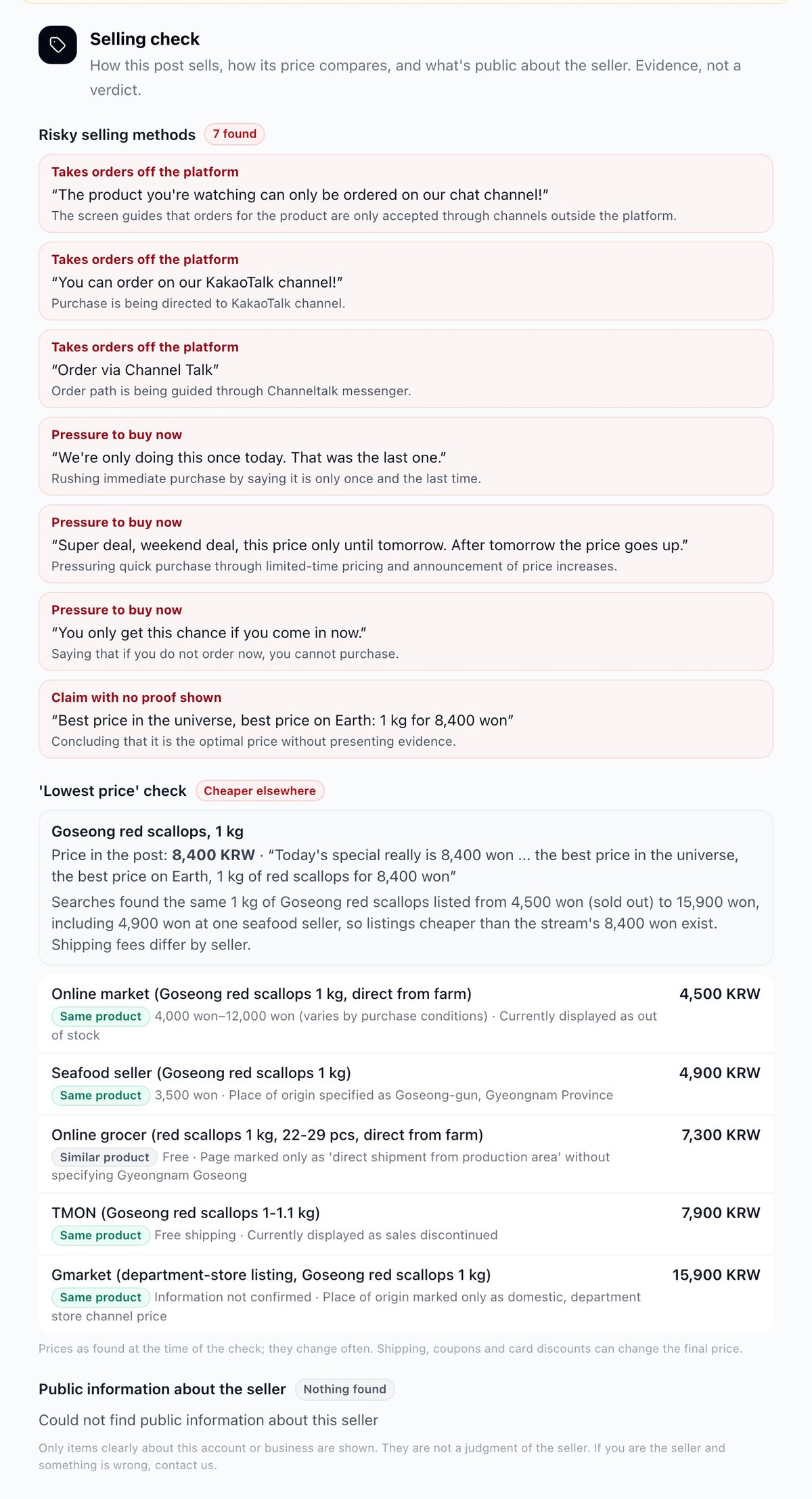
Scanner also checked the stream's "lowest price" claim. The host was selling 1 kilogram of scallops from Goseong, South Gyeongsang Province, for 8,400 won, about $6. Scanner found four sellers offering the same product and one offering a similar product, at prices from 4,500 won to 15,900 won, and showed shipping fees and whether each listing was sold out or discontinued. Some listings were cheaper before shipping but came close to the stream's price once shipping was added, so Scanner does not declare which offer is cheaper; it lays out the comparison. For the seller itself, it searches only for public information tied to the same account or business name, and found none in this case.
The new features respond to a growing number of complaints about selling on social media. According to Korea Consumer Agency data analyzed by a lawmaker on the National Assembly's National Policy Committee, consumer complaints about live commerce rose from 259 in 2022 to 510 in the first nine months of 2025. Figures that the Fair Trade Commission submitted to another lawmaker on the same committee show the regulator found 22,675 undisclosed paid-promotion posts on social media in 2025, and 108,709 over the past five years.
The update also makes Scanner easier to reach on phones. On Android, choosing FAXTR from the share menu in TikTok or Instagram starts a scan right away. On iPhone, FAXTR offers one shortcut for the share sheet and another that captures the current screen with a tap on the back of the phone. TikTok live streams restricted to viewers 18 and older can be scanned once users connect their own TikTok account. For news-style posts, Scanner also searches for the original press photos behind images that appear on screen.
"Information that spreads through one scene of a short or one line in a live stream tends to be consumed before anyone checks it," a FAXTR spokesperson said. "Scanner does not decide what is true or false for you. It helps viewers open the evidence and judge for themselves."
Each registered account gets one free scan. After that, Scanner runs on prepaid credits: a photo check costs 5 credits, a feed video 8 credits and a live stream 10 credits for every five minutes. The smallest pack is 40 credits for $9, and credits are refunded automatically if an analysis fails. The interface is available in 11 languages, including English, Korean, Japanese, Spanish and Arabic.
Scanner is available at faxtr.com/scanner.
Disclosure: FAXTR is part of BlinkHub, which also operates PULSE.