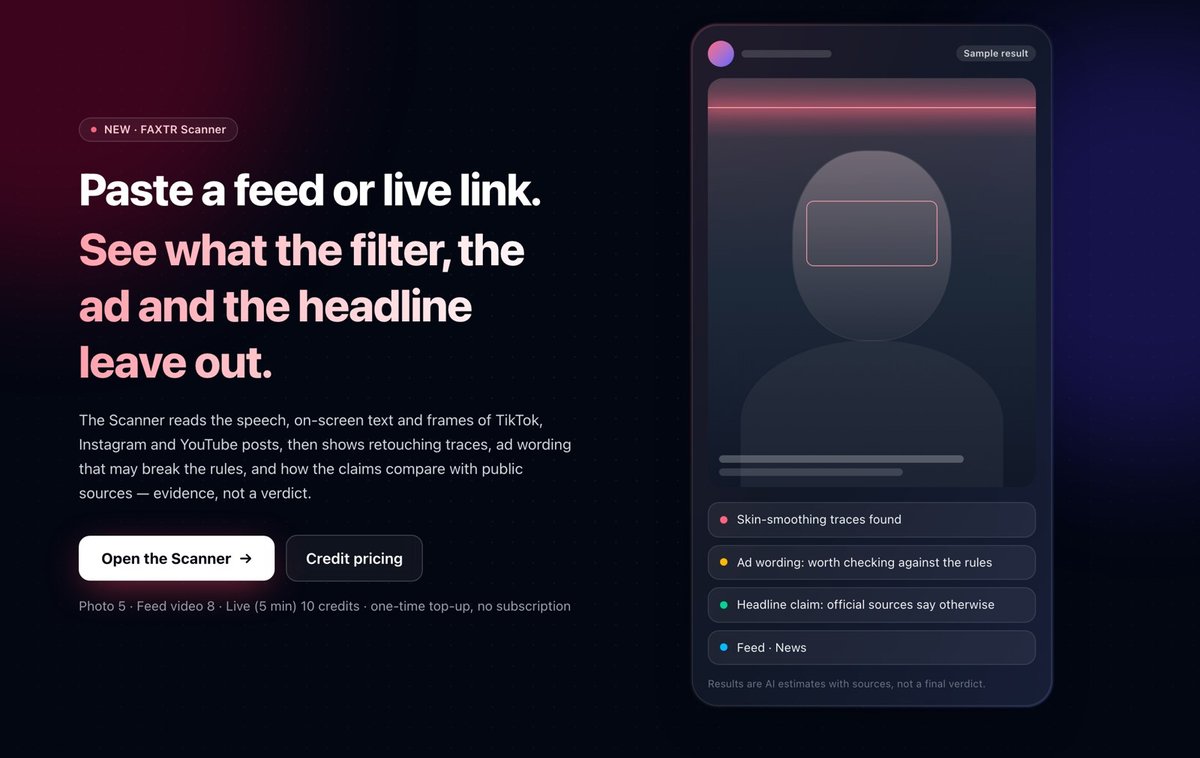
FAXTR, a fact-check aggregation site, this week launched a paid tool called Scanner that takes apart social media posts and live streams for signs of beauty filters, questionable advertising and misleading claims.
Users paste a link to a TikTok, Instagram or YouTube post or live stream. The Scanner transcribes what is said, reads the text on screen and samples the video frames. People can also upload up to five screenshots or a screen recording of up to 15 minutes.
The results come in three parts: traces of filters and retouching on faces and skin, advertising language that may run against the rules in different countries, and a comparison of the post's factual claims with government releases and news reports.
Retouching is broken down into skin smoothing, face reshaping, eye size and staged lighting. The tool also produces an estimate of how the person might look without the edits, but that image is stamped with the label "AI estimate · not the real face" so it cannot easily be passed off as a real photo.
Product claims for cosmetics, food and health are checked against advertising rules from 16 countries, including South Korea's Cosmetics Act. When a post uses wording that could make a cosmetic sound like a drug, or absolute terms such as "the best," the Scanner points to the relevant rule with a link to the source. It does not say whether a law was broken.
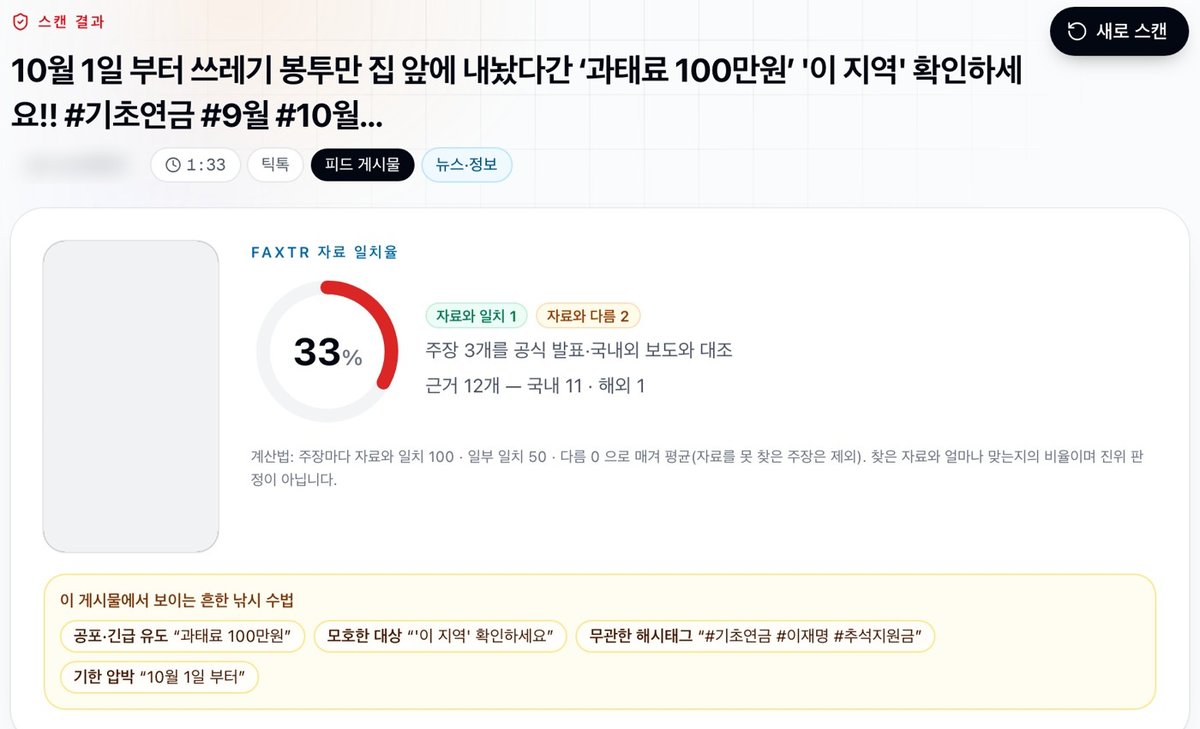
For news-style posts, the Scanner picks out the post's headline claim first and searches for public records that confirm or contradict it. In a test the company ran on a Korean TikTok video claiming that residents would be fined 1 million won, about $700, from Oct. 1 for putting out garbage bags in front of their homes, the Scanner flagged that line as the main claim and attached reports in which South Korea's environment ministry said the rumor of a fine crackdown was not true.

It handled the video's other claims one by one. A rule requiring food waste to be placed in dedicated bins turned out to apply only to the city of Donghae in Gangwon Province, not the whole country, while the timeline for mandatory separation of paper cartons matched the government's announcement. Phrases such as "1 million won fine" and "check if your area is affected" were marked separately as common clickbait tactics: fear and urgency, and a deliberately vague target.
Before analyzing anything, the Scanner sorts each post into feed or live, and news or advertising. News posts get a claim check rather than a face analysis, while ads are reviewed first for their wording.
"FAXTR does not label posts true or false. It shows the evidence," the company says on its service page. The result screen also explains that the match rate it displays measures how well a post lines up with the sources found, not whether the post is true.
The Scanner runs on prepaid credits rather than a subscription, and purchased credits do not expire. A photo check costs 5 credits, a feed video 8 credits and a live stream 10 credits for every five minutes. The smallest pack is 40 credits for $9. Credits are refunded automatically if an analysis fails.
Users who need a record for a dispute can also generate an evidence package that bundles the original video, file hashes and time stamps from outside certification authorities.
The Scanner is available at faxtr.com.
Disclosure: FAXTR is part of BlinkHub, which also operates PULSE.