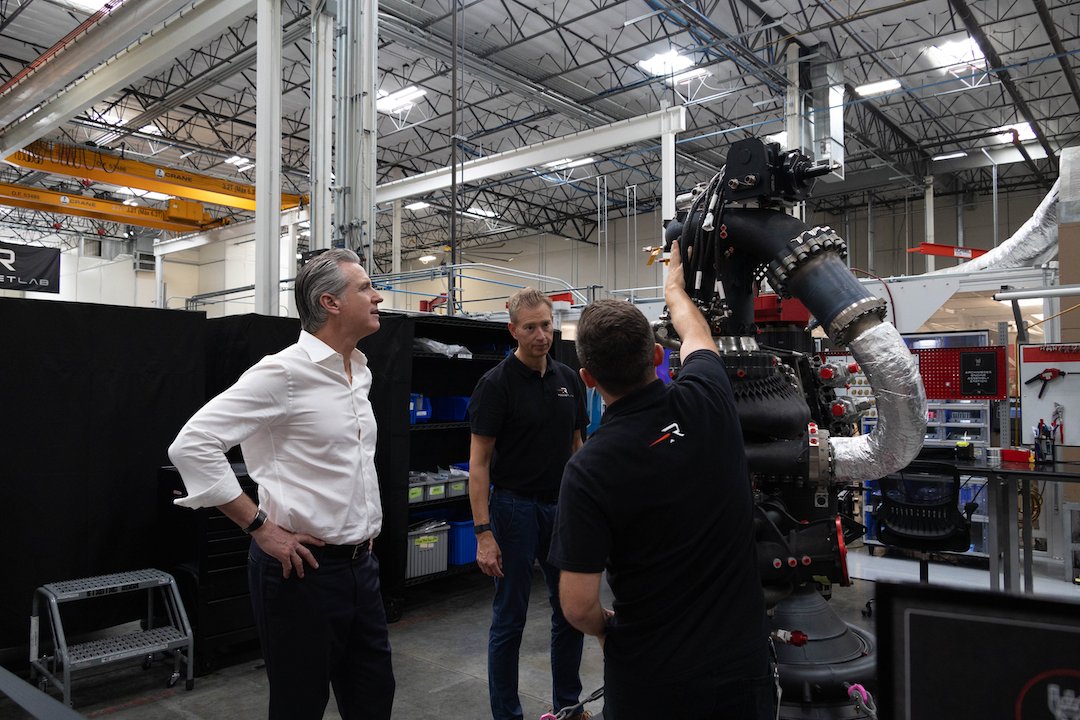
Governor Gavin Newsom toured Rocket Lab in Long Beach, a hub for aerospace manufacturing and innovation known locally as "Space Beach," highlighting California's dominant position in the nation's aerospace sector. The visit underscored the state's commitment to an industry that contributes an estimated $35 billion annually to California's economy.
California leads the nation in NASA science funding, receiving $2.72 billion in fiscal year 2025, according to state officials. The state is home to one-third of the nation's space technology companies, has more aerospace engineers and defense personnel than any other state, and ranks first in corporate aerospace research and development spending and space-technology venture capital investment.
Rocket Lab manufactures orbital rockets, spacecraft, and satellites. The company established its U.S. operations in Los Angeles in 2013 and moved its headquarters to Long Beach in 2020. Its Electron rocket has completed more than 90 missions, making it the second most frequently launched U.S. rocket. A larger, reusable Neutron rocket is expected to fly in 2027.
California has pursued targeted investments in the aerospace sector. The state awarded $16.95 million to two Central Coast projects in August 2025 and $19 million to seven projects in Kern County, the Southern Border region, and the Bay Area in August 2026. Multiple aerospace and defense companies received California Competes Tax Credits, including Mach Industries ($32.5 million for 1,057 jobs) and Vast, a Long Beach-based space station company ($87 million in private investment and 657-660 new jobs).
California's role in aerospace extends back to the nation's early space exploration. NASA facilities in the state include the Jet Propulsion Laboratory in Pasadena, which leads robotic space exploration, and Ames Research Center in Silicon Valley. The Goldstone Deep Space Communications Complex in San Bernardino County serves as the U.S. anchor for NASA's Deep Space Network.