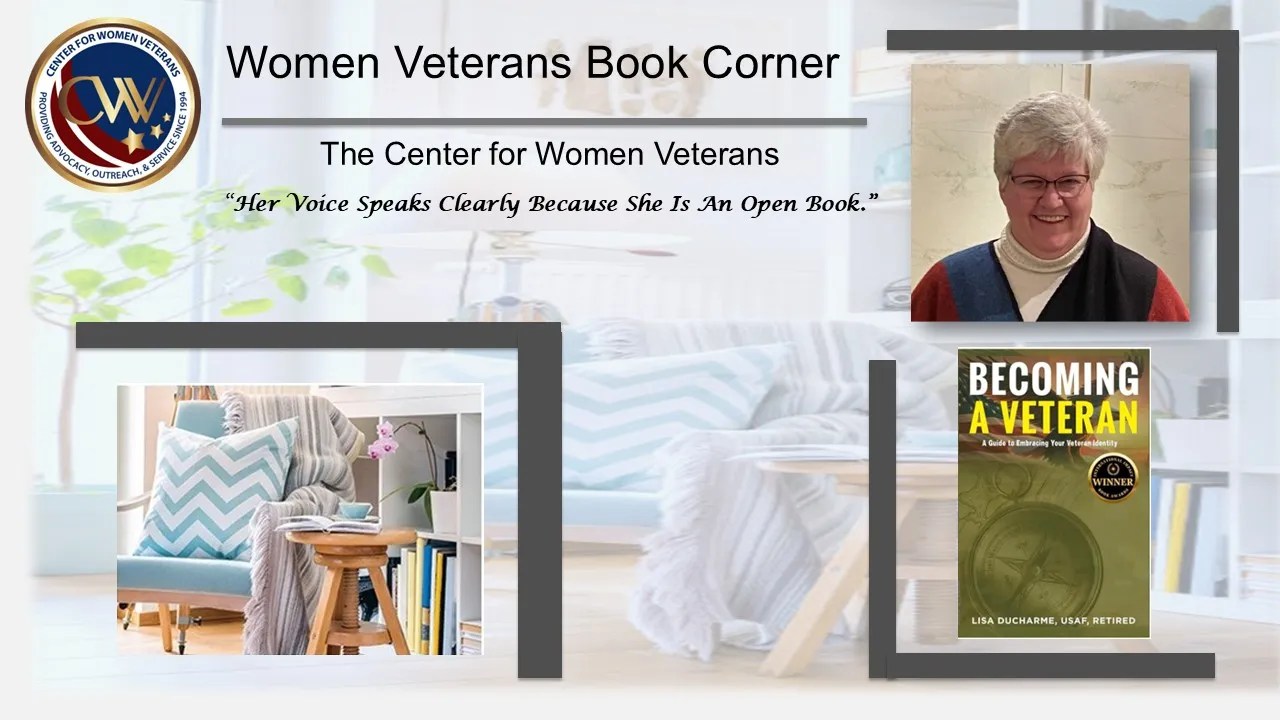
This month’s Center for Women Veterans Women Veterans Book Corner highlights Air Force Veteran and author Lisa Ducharme, whose military service, transition experience and Veteran advocacy inspired her book, “Becoming A Veteran: A Guide to Embracing Your Veteran Identity.”
Ducharme served in Personal Affairs and Personnel in the Air Force from 1986 to 2006.
During her 20-year career, she served in casualty-related roles and was the casualty representative on scene at the Pentagon on Sept. 11, 2001.
Although she never deployed, she was involved in the aftermath of three terrorist attacks during her military service.
These experiences shaped how she communicated about crisis, grief, survival, responsibility and the strength of the human spirit.
After retiring, Ducharme navigated the complex transition to civilian life and began learning how to access Veteran resources.
She spent almost 15 years participating in Veteran outreach and a decade working with Veteran businesses.
She owns LLR2000 and founded the Massachusetts Veterans Chamber of Commerce, where she serves as executive director.
Her book uses lessons from her own transition to help Veterans embrace their identity and recognize their military experience as a competitive advantage.
Ducharme credits both her father’s military service and her own Air Force career with shaping her voice as a storyteller.
Her father, Ronald Akins, is a retired Air Force Vietnam Veteran who served for 30 years.
Growing up in a military family during a time when service members and Veterans were often disrespected taught her resilience, respect and confidence in her own perspective.
Her Air Force experience deepened those lessons.
In the military, she learned that leadership requires honesty, clear communication and the ability to solve problems without always having complete information.
Working in casualty roles taught her to communicate with clarity, purpose and care.
While many of her earlier books emphasized facts, structure and instruction, this book required personal examples and language that could help Veterans recognize and understand feelings they may struggle to explain.
The central theme of Becoming A Veteran is that Veteran identity is a strategy rather than a liability.
She observed Veterans facing unemployment, underemployment and imposter syndrome while also being encouraged to leave their military identity behind and blend into civilian workplaces.
As the daughter of a Vietnam Veteran, the mother of an Army Veteran and a caregiver, she saw how these challenges could affect multiple generations.
Through almost 15 years of Veteran outreach and a decade of work with Veteran businesses, she came to understand that military experience should be transformed into a competitive advantage rather than erased. Her book explains how Veterans can embrace their identity, apply their adaptability, grit and mission focus, and learn to use available resources instead of navigating post-service life alone.
Ducharme encourages women Veterans to begin with the end in mind.
She suggests considering the intended audience, writing the final chapter first and capturing memories, lessons or frustrations before worrying about the finished product.
A journal or simple notebook can help writers preserve one memory or lesson at a time.
She also recommends identifying the purpose for writing, whether for healing, education or leaving a legacy.
A supportive community can make the process less isolating.
Most importantly, she reminds women Veterans that no one else experienced their service through the same lens, so no one else can tell their story in exactly the same way.
Ducharme has written more than 25 books.
For her, each had a specific purpose, and she treated scheduled writing time as non-negotiable.
She recommends creating a mind map or outline, setting aside dedicated writing time and limiting distractions.
Early in her writing career, she sometimes worked from a quiet corner at a local café so she could focus.
When self-doubt appeared, she relied on what she calls micro shifts: making small, manageable progress instead of focusing on the entire manuscript.
On difficult days, that could mean writing one paragraph, one sentence or a short checklist of ideas.
She also allows a project to change direction when the original format no longer supports the experience she wants readers to have.
Her most difficult writing journey involved “From Duty to Destiny,” the first book she began writing and her ninth published book.
She started the project in 2017, completed the core lessons by 2018 and struggled for years to find the right structure.
In 2022, she shifted her focus from publishing a book to creating a useful tool for Veterans.
She finished it in 2023 after deciding that the lessons mattered even if she ultimately gave the book away.
Women Veterans must tell their stories in their own words because their experiences have often been marginalized or generalized within the broader American Veteran narrative.
Writing their own stories allows women Veterans to preserve history, challenge stereotypes and show that their service is a foundational part of the nation’s strength.
She also sees storytelling as a way to provide guidance to younger servicewomen and Veterans who need to see what is possible.
Women may minimize their service by comparing deployments, rank or hardship, but each person’s experiences, struggles and achievements are valid.
A story can become a record for the writer, a legacy for family or a practical guide for someone facing a similar challenge.
VA has played a significant role in Ducharme’s post-service journey, although her first experience was discouraging.
After retiring in 2006, she applied for care through her local VA medical center and was denied. After that, she didn’t use any VA benefits or resources for years.
In 2008, she applied for the Post-9/11 G.I. Bill, and in 2009 she became part of the first group of Veterans to use it.
During a class, a VA representative reviewed her earlier denial, helped her enroll in VA healthcare and connected her with the primary care doctor she had originally requested.
After being laid off in 2012, she connected with Massachusetts Veteran representative Gary Howe, who introduced her to benefits and resources she hadn’t known were available.
In 2013, she joined Veterans Outreach Into Community Engagement and began learning from VA outreach professionals, Veteran service leaders and advocates.
That experience launched years of outreach and education focused on helping Veterans understand where to start.
In 2020, she was selected as the Massachusetts Dole Caregiver Fellow while caring for her father.
She helped him obtain VA disability compensation and healthcare in 2018, before his death in May 2024.
That experience made the importance of early connection to services even more personal.
Today, Ducharme encourages women Veterans not to allow pride, confusion, frustration or one difficult experience to prevent them from seeking earned benefits.
She recommends asking questions, working with a Veterans Service Officer, speaking with other Veterans and continuing until the available options are understood.
She encourages Veterans to embrace their Veteran identity and to use it as an advantage.
She also encourages Veterans to establish connections before a crisis so support is already in place for them and their families.
If you are a woman Veteran author interested in participating, learn more on the Center for Women Veterans website: https:department.va.gov/center-for-women-veterans/women-veterans-book-corner/.
Book Corner Center for Women Veterans