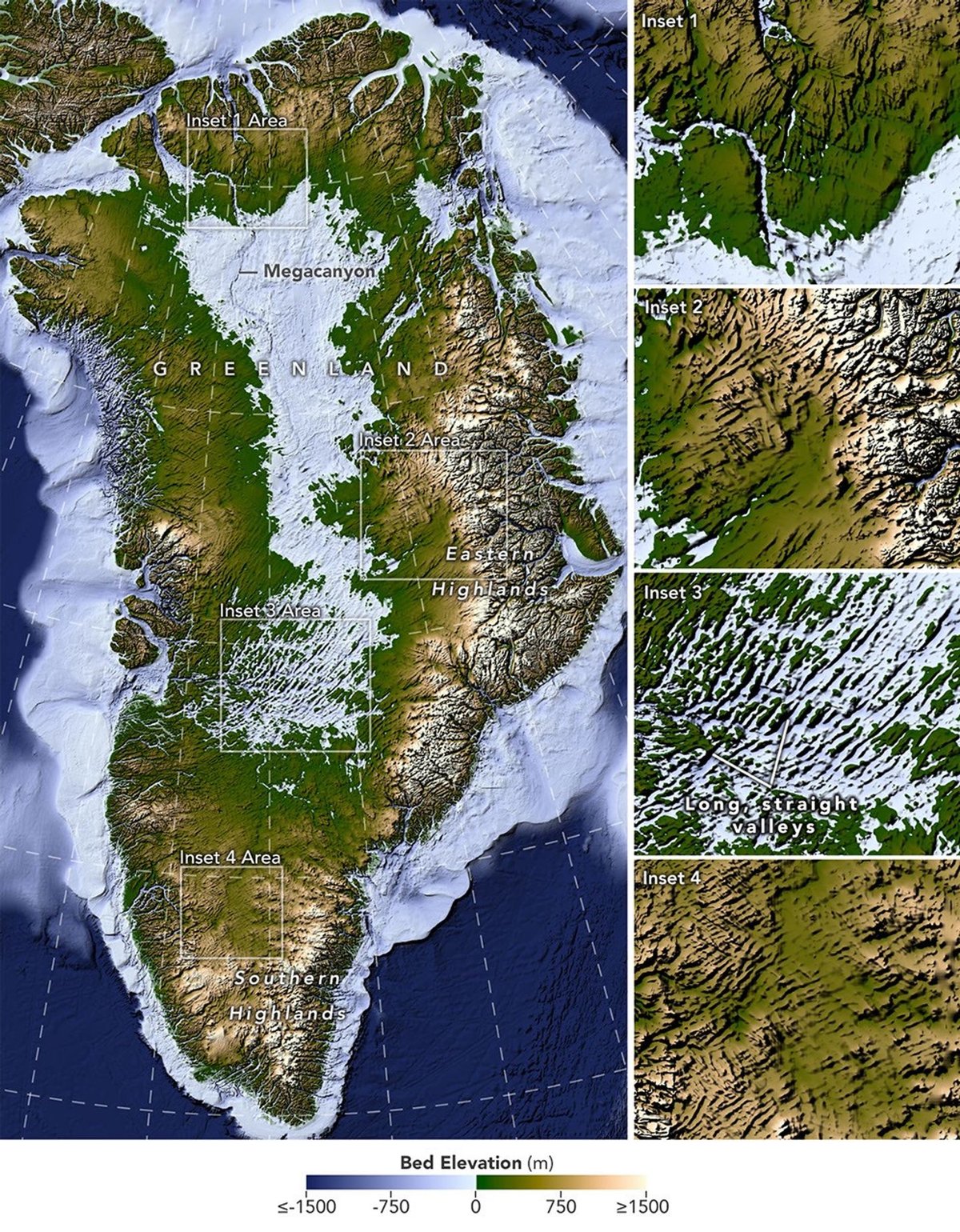
Researchers have mapped 1,943 valleys carved into the bedrock beneath the Greenland Ice Sheet using a new satellite-based technique, revealing an extensive landscape that had been hidden beneath more than 3 kilometers of ice, according to a NASA-led study published in Geophysical Research Letters.
The technique, called Ice Flow Perturbation Analysis, detects subtle features on the ice surface that indicate the shape of the terrain below. As ice flows over valleys and ridges, the topography leaves faint signatures that scientists can use to infer the shape of buried landforms.
About a third of the 1,943 valleys are newly identified. Many previously mapped valleys have been found to extend significantly farther inland than earlier datasets indicated, with some reaching hundreds of kilometers beyond their previously known extent.
Some valleys appear to have formed well before the ice sheet existed. Many seem to begin in the southern and eastern highlands, where scientists believe the ice sheet first formed, and some alpine-style landforms may have survived beneath the ice since at least the Pliocene epoch.
Other features remain puzzling. Numerous valleys in the west-central region are long, straight, and consistently aligned in a southwest-northeast direction, suggesting tectonic influences. The wide branching angles of the valleys suggest that a widespread groundwater network seeping upward, in addition to surface water, helped carve them before the ice sheet formed.
Understanding the valleys is key to predicting future ice sheet behavior. Ice flow concentrates in valleys, where it becomes thicker and flows faster, carving the valleys even deeper in a reinforcing cycle. As the ice sheet retreats, scientists expect this pattern to continue.
"The better we understand the topography now," said Joe MacGregor, a NASA cryospheric scientist and co-author of the study, "the better sense we'll have of what it will look like in the longer term—beyond the next decade or two—as faster ice flow propagates into Greenland's interior."