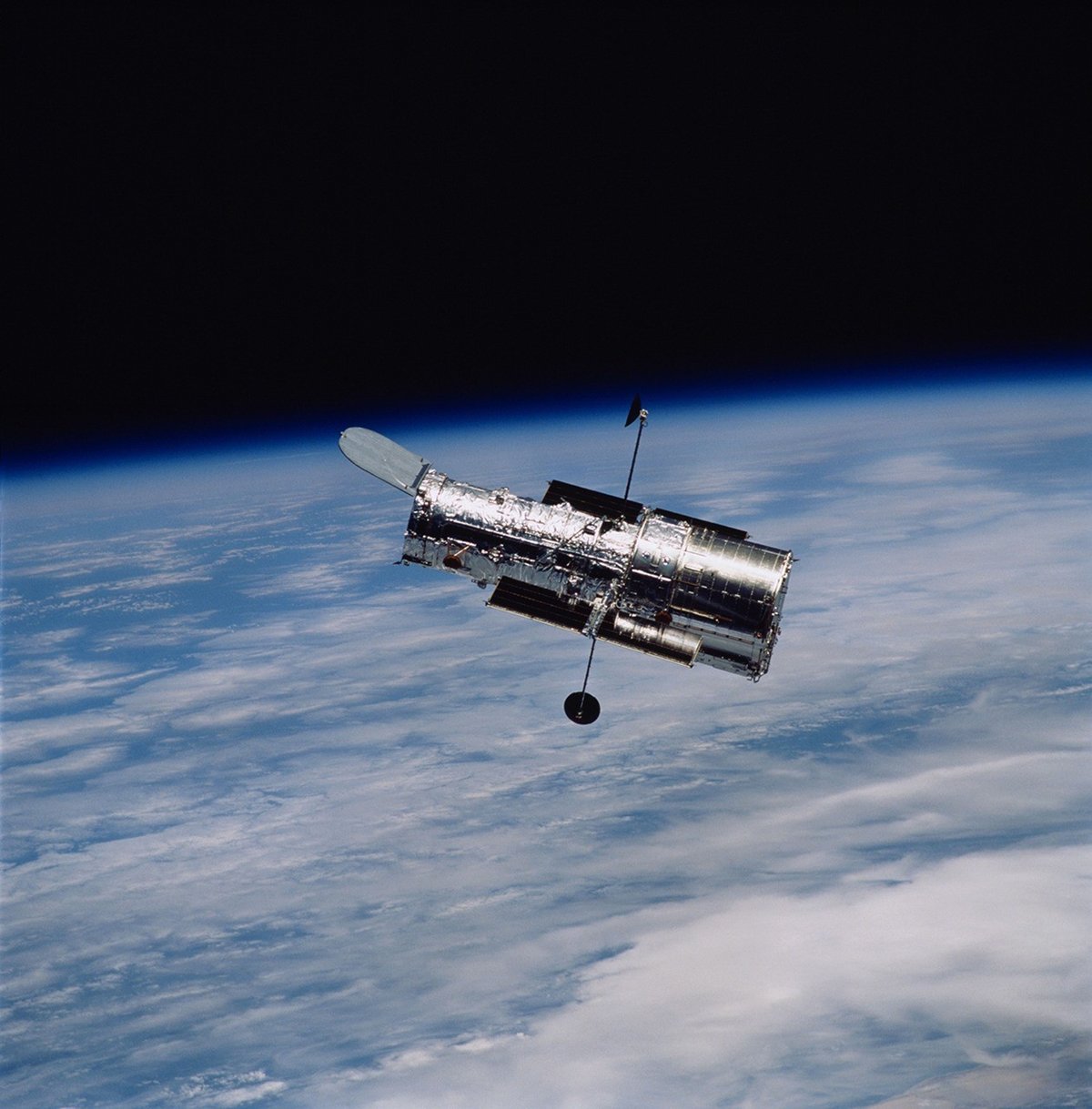
NASA's Hubble Space Telescope completed its 200,000th orbit around Earth on Sept. 19, marking a new milestone for the 36-year-old observatory. Hubble has traveled more than 5 billion miles over its lifetime and exceeded 1.7 million total observations, the space agency said.
On the day of the milestone orbit, Hubble conducted an observation related to one of its defining scientific legacies: measuring the Hubble Constant, or the expansion rate of the universe. The observation involved monitoring for the reappearance of a supernova called Athena, which is magnified by a massive galaxy cluster called MACS J0417 that acts as a gravitational lens.
Supernova Athena, discovered by NASA's James Webb Space Telescope in 2025, is predicted to reappear between now and early March 2027. Light from the supernova can reach Earth along multiple paths, causing the same stellar explosion to appear more than once at times separated by months or years. Measuring the timing of Athena's reappearances can help researchers map the mass of MACS J0417 and refine understanding of the universe's expansion rate.
Demand for Hubble observing time remains high despite the telescope's age. Astronomers request about seven times as much observing time as is available each year. Hubble continues to observe targets across all areas of astronomy around the clock.