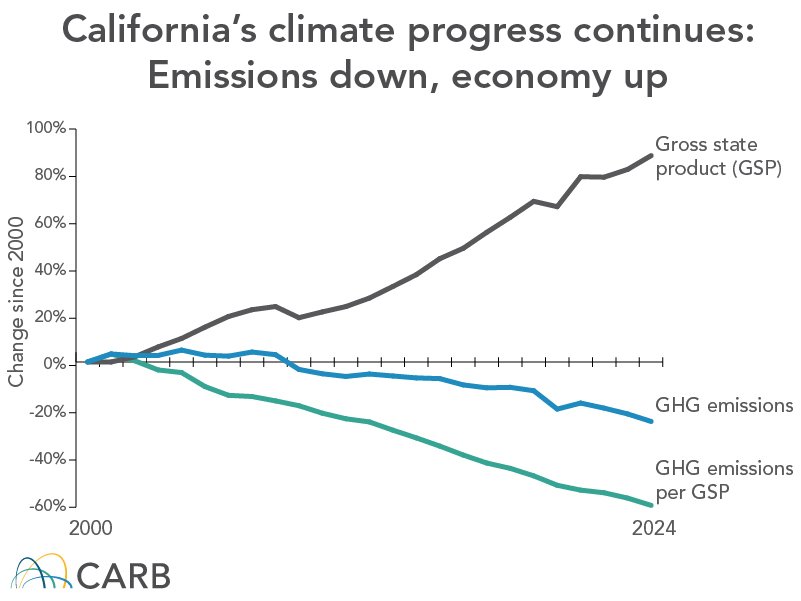
California cut statewide greenhouse gas emissions by 3.9% in 2024 while its economy grew 3.2%, extending a two-decade pattern of environmental progress alongside economic expansion, according to new data released by the California Air Resources Board.
The reduction is equivalent to removing more than 3.2 million gasoline-powered cars from California's roads for one year. Overall, emissions are now 28% below their 2004 peak, even as the state's economy has nearly doubled in size.
The emissions reductions came across multiple sectors. Transportation achieved the largest decrease, driven by increased use of renewable diesel and zero-emission vehicles. Power sector emissions fell despite an increase in total electricity generation, due to expansion of renewables and batteries. Industrial, agricultural, and commercial and residential emissions also decreased.
The progress reflects 20 years of climate policy beginning with AB 32, the Global Warming Solutions Act of 2006, which established a goal to return to 1990 emission levels by 2020. California met that target six years early in 2014. The law led to California's Cap-and-Invest Program, Low Carbon Fuel Standard, and clean car programs. In 2016, a subsequent law required 40% emissions reductions below 1990 levels by 2030. In 2022, the state established a goal of achieving net carbon neutrality by 2045.
California's clean energy workforce is now the largest in the nation, with 552,300 workers employed across clean energy technologies, nearly twice the number in Texas, the second-ranked state. The state has sold 2.7 million zero-emission vehicles, installed 216,445 public and shared EV chargers, and maintains 21,860 megawatts of battery storage capacity.