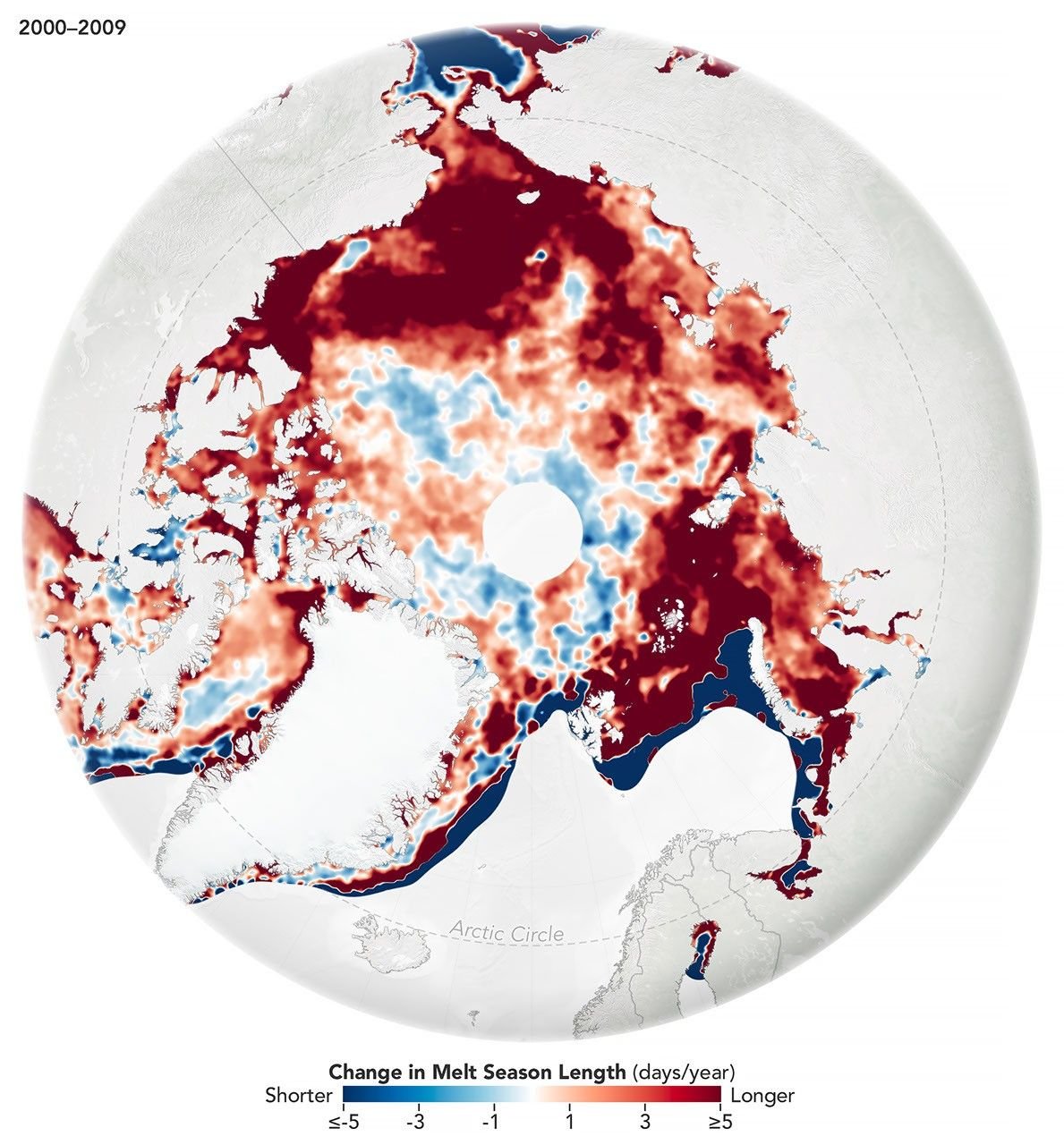
The Arctic sea ice melt season has lengthened by about 40 days since 1979, but that trend unexpectedly stabilized around 2010, according to a NASA-led study analyzing satellite observations from 1979 to 2023.
Most of the lengthening occurred before 2010. Since then, the average melt season length has remained relatively unchanged despite large year-to-year fluctuations, researchers found. The change was driven primarily by sea ice freezing later in the year rather than melting earlier in spring.
The team examined the Arctic's energy balance—the net difference between incoming heat from the Sun, atmosphere, and ocean and outgoing infrared radiation emitted back to space. During the 2000s, reduced ice cover exposed darker ocean water, which absorbed more sunlight and delayed freezing. Since 2010, changing cloud patterns have reduced the amount of sunlight reaching parts of the Arctic Ocean. "Melt season length is much more dependent on atmospheric effects. They seem to be playing a bigger role because the ice is generally thinner and more vulnerable to begin with," said Linette Boisvert, a co-author and ice scientist at NASA's Goddard Space Flight Center.
The Arctic remains substantially warmer than it was decades ago, and the remaining sea ice is thinner than several decades ago. Researchers cautioned that the apparent stabilization may be temporary. Thick Arctic ice still exists throughout the year north of Greenland and the Canadian Arctic Archipelago, and continued thinning in those regions could trigger another period of rapid sea ice loss.