Discover the cosmosEach day a different image or photograph of our fascinating universe is featured, along with a brief explanation written by a professional astronomer.
Explanation:If you went outside at the same time every day and took a picture that includedthe Sun, how would the Sun’s position change?
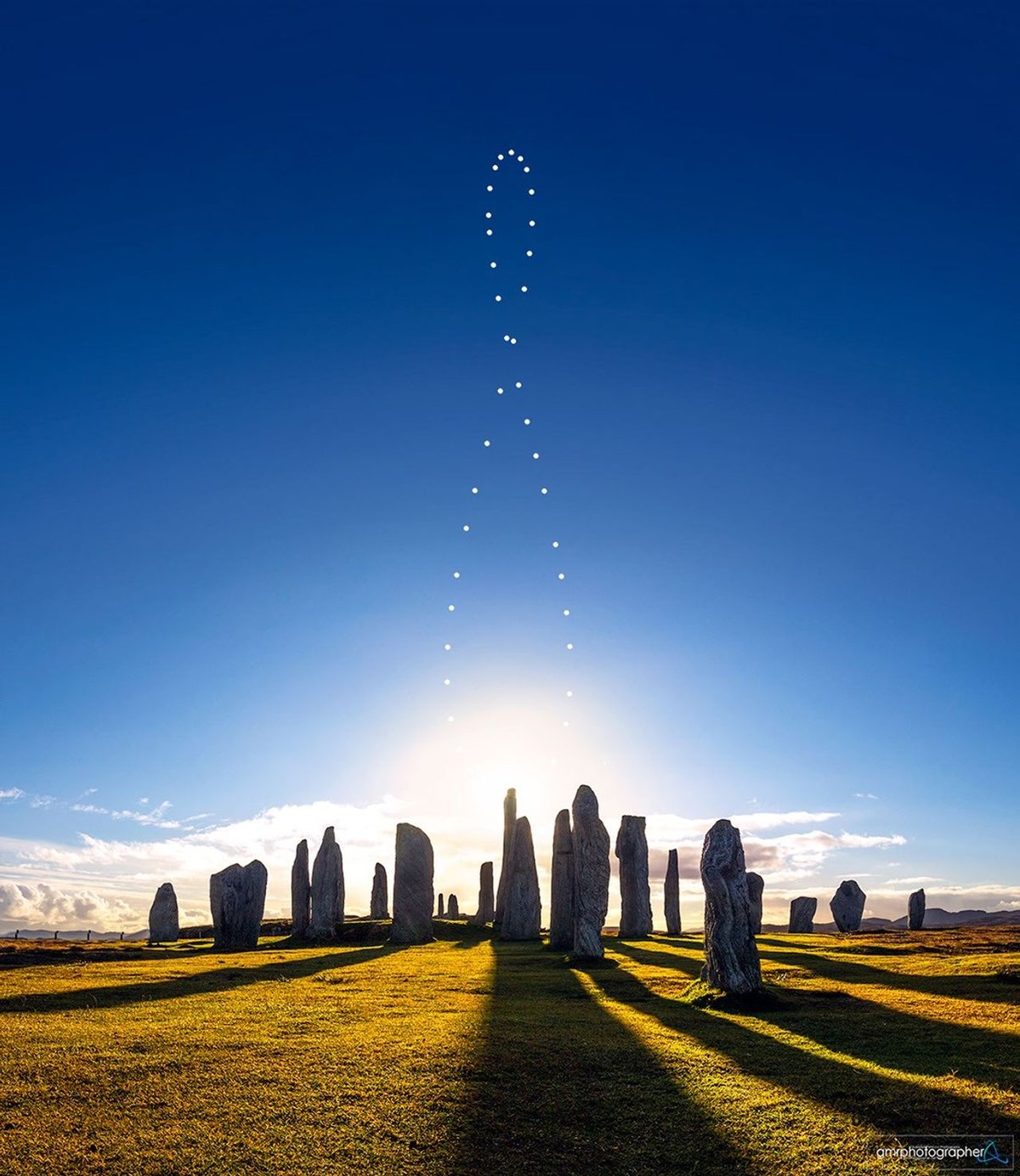
A visual answer to that question is ananalemma, a composite image taken from the same spot at the same time over the course of a year.
Thefeatured analemmawas composed from images taken every few days at noon near the village ofCallanishin the Outer HebridesinScotland,UK.
In the foreground are the CallanishStones, a stone circle built around 2700 BC during humanity’sBronze Age.
It is not known if the placement of the Callanish Stoneshas or had astronomical significance.
The ultimate causes for thefigure-8shape of this and all analemmas are thetilt of the Earth axisand theellipticityof the Earth’s orbitaround the Sun.
At thesolstices, the Sun will appear at the top or bottom of an analemma.
The featured image was taken near the December solstice and so the Sun appears near the bottom. Equinoxes, however, correspond to analemma middle points — not theintersection point.
In two days there will be anequinox, when day and night are equal over all of planet Earth.
Manycultures celebratea change of season at anequinox.
APOD’s main NASA site ismoving:Fromapod.nasa.govtoscience.nasa.gov/apod Tomorrow’s picture:open space