While the calendar indicated that astronomical summer was winding down, a swath of the south-central United States was sweltering under a heat dome in mid-September 2026.
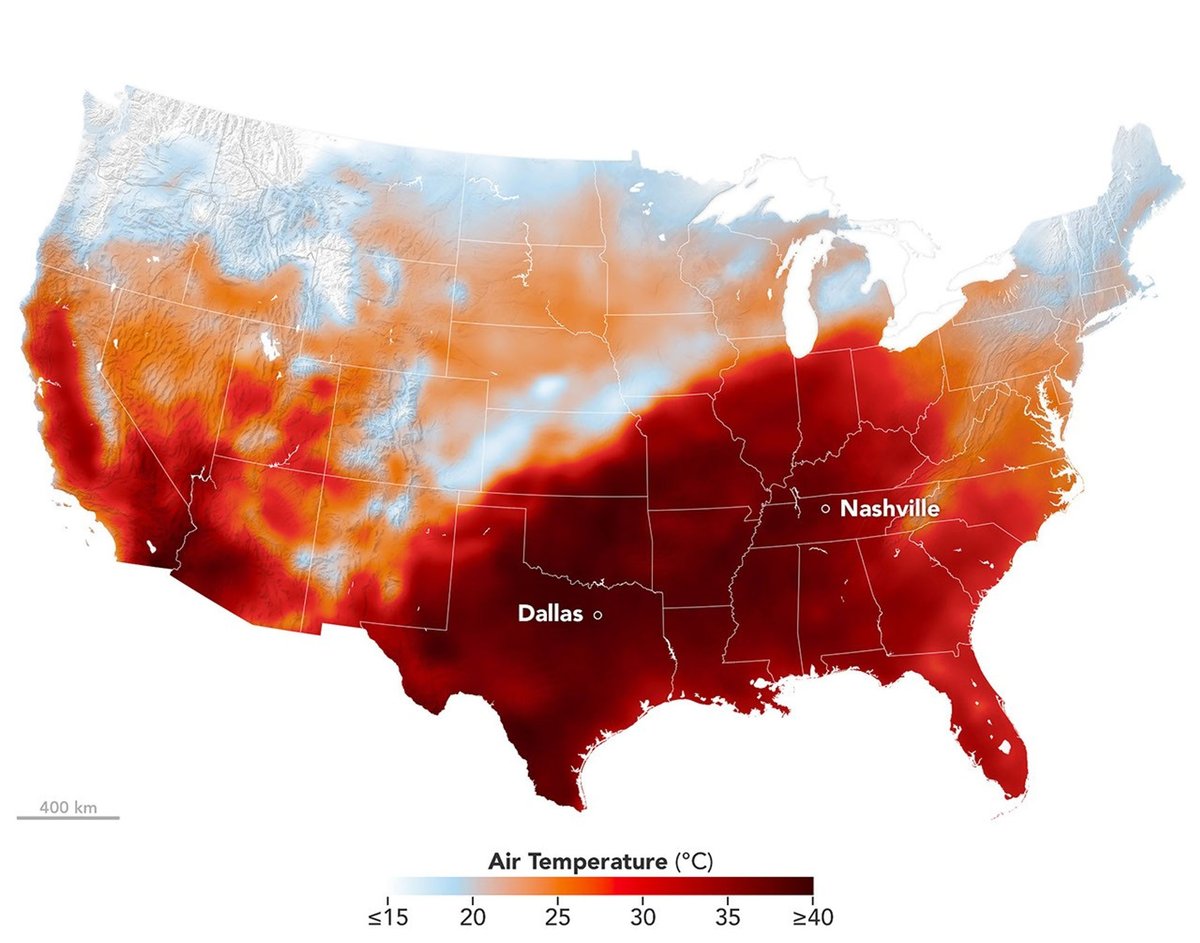
This map shows air temperatures in the contiguous U.S. on September 15, 2026, at 4 p.m. Central Time, modeled at 2 meters above the ground.
It was produced by combining satellite observations with temperatures predicted by a version of theGEOS model, which uses mathematical equations to represent physical processes in the atmosphere.
The darkest reds indicate areas where temperatures approached or exceeded 40 degrees Celsius.
More than41 million peoplein the U.S.—about 12 percent of the population—were under a National Weather Service extreme heat advisory, extreme heat watch, or extreme heat warning on September 15.
The high temperaturesspannedlarge portions of several states, such as Texas, Oklahoma, Arkansas, Missouri, and Tennessee.
Meteorologistswarnedthat high humidity, limited cloud cover, and light winds could make temperatures feel higher than thermometer readings and increase the risk ofheat-related illnesses.
Several locations set new daily high temperature records on September 15.
These included Dallas, Texas, at 101ºF, Memphis, Tennessee, at 99ºF, and Nashville, Tennessee, at 100ºF.
The cities were all at least 12ºF warmer than normal that day, with Nashville breaking its daily-high record from 1927.
The day before, Nashville also set a record-high minimum temperature of 75ºF.
A weather phenomenon meteorologists call aheat domewas responsible for driving temperatures up across the region.
A heat dome develops when an area of high pressure in the upper atmosphere pushes hot airtoward the surfaceand traps it there.
Heat domes put the brakes onconvectionand suppress clouds and precipitation.
This allows sunlight to reach Earth’s surface relatively unhindered and further elevate air temperatures.
The stretch of unseasonable temperatures follows the warmest June through August in the contiguous United States in a 132-year record, according to NOAA.
The three-month period in 2026 was 0.4ºF warmer than the previous records, set in 1936 and 2021.
NASA Earth Observatory image by Michala Garrison, usingGEOS-FPdata from the Global Modeling and Assimilation Officeat NASA GSFC. Story by Lindsey Doermann.
JPEG
AccuWeatherLatest heat dome to linger in south-central, southeastern US in mid-September. Accessed September 16, 2026.
Heat.govScience and Information to Reduce Heat Risk. Accessed September 16, 2026.
NOAA National Centers for Environmental InformationWarmest summer on record for the contiguous U.S. Accessed September 16, 2026.
The Washington PostIt’s almost fall, but this record heat dome didn’t get the memo. Accessed September 16, 2026.
Stay up-to-date with the latest content from NASA as we explore the universe and discover more about our home planet.
A ridge of high pressure fueled record-breaking temperatures in Montana, Utah, and Wyoming on July 12, 2026.
A series of heat waves in 2026 is breaking records and taking a toll in Europe.
New animations from NASA’s PREFIRE mission reveal two years of seasonal temperature swings at the Arctic and Antarctic.
Subscribe to the Earth Observatory and get the Earth in your inbox.
NASA’s Earth Observatory brings you the Earth, every day, with in-depth stories and stunning imagery.
Explore Earth Science
Open access to NASA’s archive of Earth science data