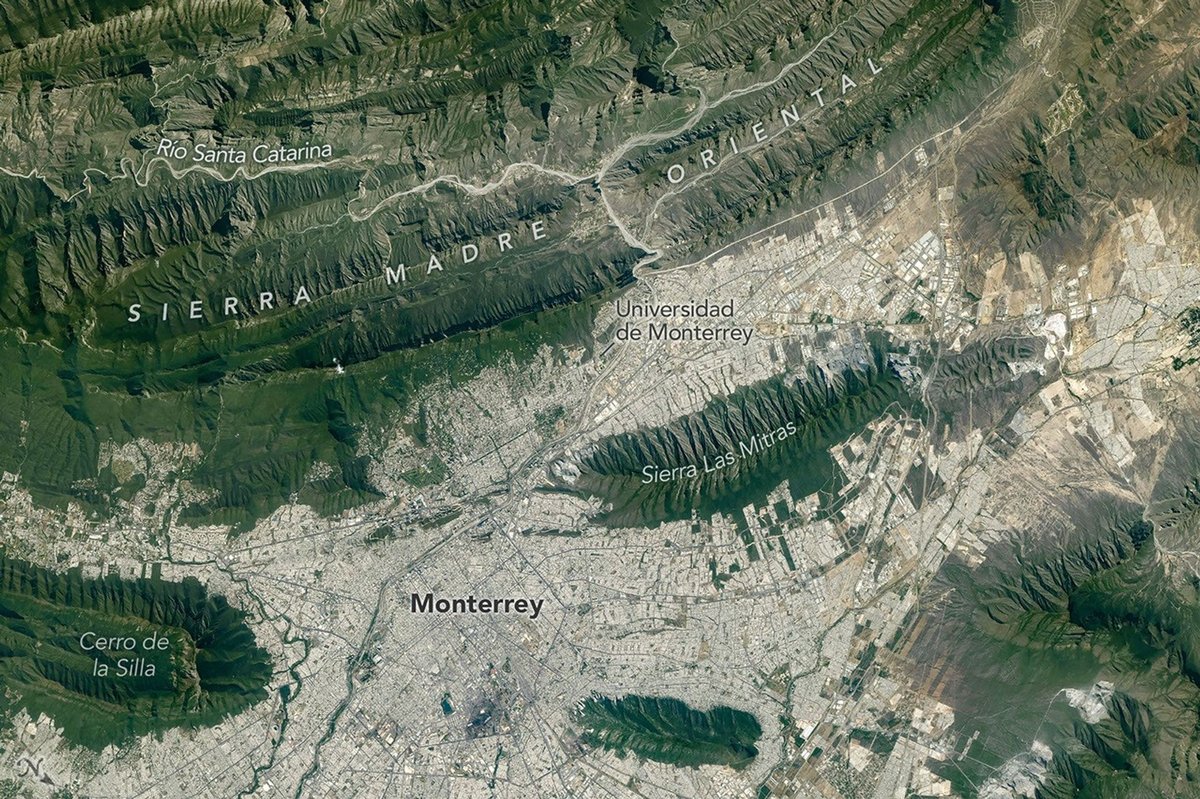
The curving, parallel mountain ridges of the Sierra Madre Orientalare an eye-catching feature of northeastern Mexico’s landscape.
The spot where these folds nestle up against Mexico’s second-largest metropolitan area captured the attention of an astronaut aboard the International Space Station, who took this photo on August 26, 2026.
Monterrey, the capital of the state of Nuevo León, is an industrial hub supporting heavy industries such as ironworks and steelworks, as well as manufacturing facilities for goods ranging from textiles to processed foods to glass and plastics.
The metropolitan area is home to 5.3 million people, according to the 2020 census.
And while the city has seen overall population growth since 1990, the number of people living within 5 kilometers of the city center has declined, researchers have found—a trajectory shared with many of Mexico’s metropolitan areas.
In Monterrey’s case, urban expansion runs up against some unforgiving terrain.
Along the city’s southern edge, layers of limestone, depositedin the late Mesozoic era and then folded between about 80 and 50 million years ago, form the Sierra Madre Oriental.
Over millions of years, weaker rock layers have eroded away, leaving behind the distinct ridgelines that bound Monterrey today.
TheRío Santa Catarinacarves through the mountains and onto the semiarid floodplain where the city lies.
Because of the dry environment, the river carries little to no water for much of the time.
But its channel is crucial for collecting runoff from summer rains and serves as an important natural area for plant and animal life within the city.
The river runs through Monterrey’s urban core and between several island-like protrusions of folded rock.
One of these is the Sierra Las Mitras, astate nature reserveestablished in 2000.
The mountain ridge rises approximately 1,500 meters over the city and provides a haven for wildlife.
As conditions become cooler and wetter with higher elevations, vegetation turns from cacti and thorny shrubs on lower rocky slopes to oak and pine forests higher on the ridge.
Cerro de la Silla is another prominent feature of the landscape, contrasting with the built environment.
Near the city’s border with the Sierra Madre Oriental sits Universidad de Monterrey, a host venue for theNASA Space Apps Challenge.
This annual hackathon will take place in November 2026 in person and virtually atsites around the world.
Participating teams use NASA and partner agency data to tackle challenges in fields such as software development, astrophysics, space exploration, and agriculture.
Astronaut photographISS075-E-70481was acquired on August 26, 2026, with a Nikon Z9 digital camera using a focal length of 400 millimeters.
It is provided by the ISS Crew Earth Observations Facility and the Earth Science and Remote Sensing Unit at NASA Johnson Space Center.
The image was taken by a member of the Expedition 75 crew.
The image has been cropped and enhanced to improve contrast, and lens artifacts have been removed.
TheInternational Space Station Programsupports the laboratory as part of theISS National Labto help astronauts take pictures of Earth that will be of the greatest value to scientists and the public, and to make those images freely available on the internet.
Additional images taken by astronauts and cosmonauts can be viewed at the NASA/JSCGateway to Astronaut Photography of Earth.
Story by Lindsey Doermann.
JPEG
International Parks, Sierra de las Mitras. Accessed September 10, 2026.
NASA Earth ObservatoryA Sliver of Mexico’s “Mother Mountain Range.”Accessed September 10, 2026.
NASA Earth ObservatoryMount Silla and Monterrey. Accessed September 10, 2026.
NASA Space Apps ChallengeMonterrey. Accessed September 10, 2026.
Universidad Autónoma de Nuevo León,La importancia ambiental del Río Santa Catarina. Accessed September 10, 2026.
Stay up-to-date with the latest content from NASA as we explore the universe and discover more about our home planet.
An astronaut on the International Space Station was surprised to photograph a shower of light streaking through the darkness while…
Over the years, astronauts aboard the International Space Station have photographed several of the cities hosting the 2026 FIFA World…
The hills and basins of Seattle, Washington, have been sculpted by glaciers and modified by humans.
Subscribe to the Earth Observatory and get the Earth in your inbox.
NASA’s Earth Observatory brings you the Earth, every day, with in-depth stories and stunning imagery.
Explore Earth Science
Open access to NASA’s archive of Earth science data