For twenty years, "can people find my website?" meant one thing: does it show up on Google. That question now has a second half. A growing share of people ask an AI assistant instead of typing into a search box, and the assistant decides which pages to quote. A page can rank perfectly well on Google and still be almost invisible to that second audience.
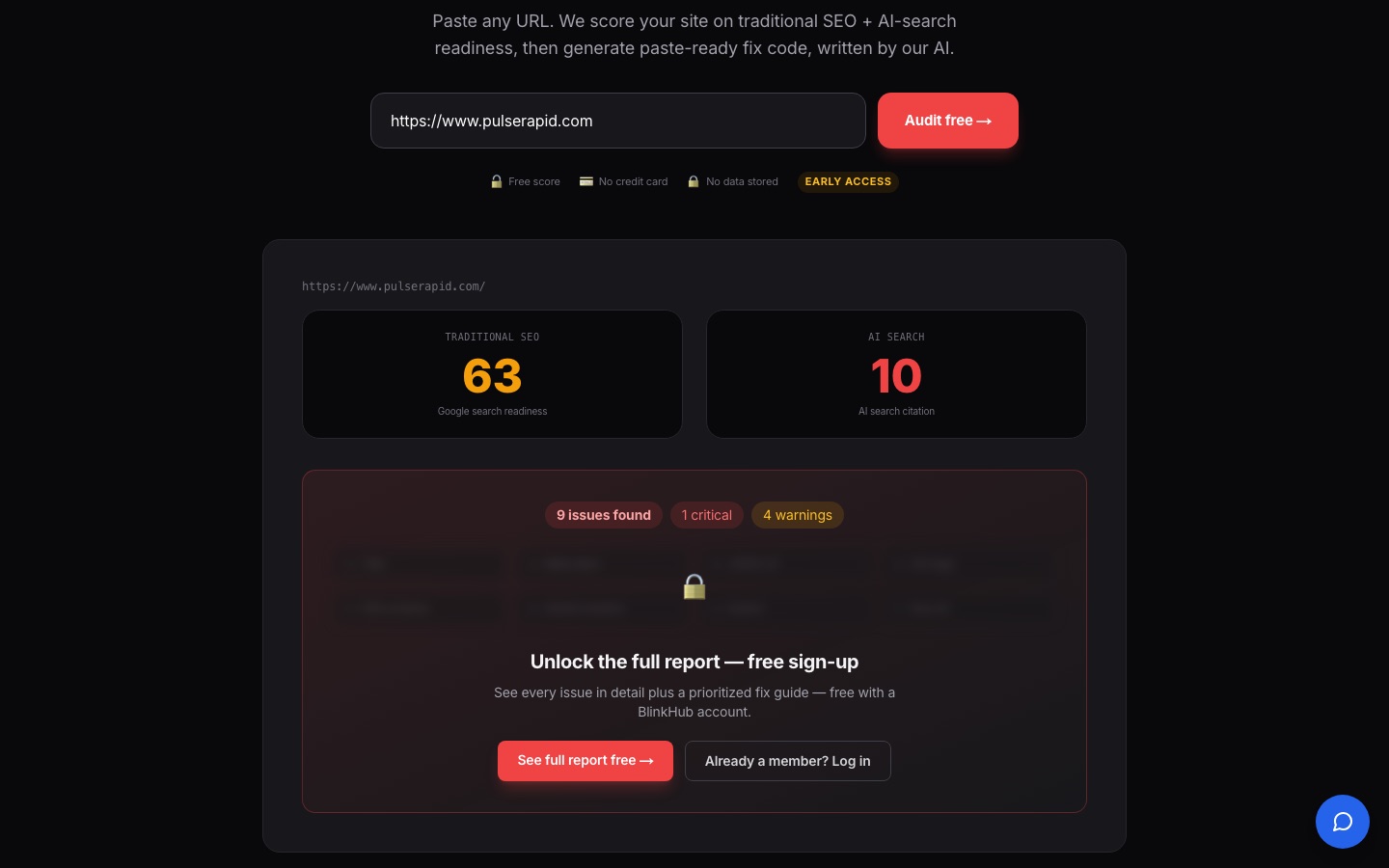
To see what that gap looks like in practice, we ran our own homepage through a free checker that scores both at once: the SEO + AI Search Audit from BlinkHub. The result was not flattering.
Two scores, measuring different things
The tool fetches a page the way a crawler would and returns two separate numbers out of 100.
The traditional SEO score covers the basics search engines have rewarded for years: a canonical tag that tells Google which address is the real one, robots and language settings, a mobile viewport, a title and meta description of sensible length, a single main headline, a clear structure of subheadings, social-sharing tags and image alt text. Critical problems cost the most points; minor ones cost a few.
The AI search score asks a different question: if an assistant landed on this page, would it find enough machine-readable structure to understand and quote it? It checks for:
- Structured data (JSON-LD), the hidden block of code that tells machines what a page is about
- FAQ markup and Article markup
- A named author and a publication date
- At least three subheadings that break the content into answerable sections
- An
llms.txtfile, a proposed plain-text guide to a site written for AI systems
Why our homepage scored 10
The free result showed the scores and the number of issues, but not the list itself; that requires an account. So we checked the homepage source ourselves. It has no canonical tag, no structured data of any kind, no social-sharing image and no llms.txt file. For a news site, missing structured data is a meaningful gap: it is the clearest way to tell a machine that a page is a news article, who wrote it and when.
That is the useful thing about a checker like this. It turns a vague worry ("are we visible to AI?") into a short list of concrete, fixable items.
What is free and what costs money
- No account: the two scores and a count of issues, split into critical items and warnings.
- Free account: the full list of issues. New accounts receive 200 trial credits.
- Fix code: for 100 credits, the tool writes a snippet for the page's
<head>section, including a rewritten title and description, a canonical tag, sharing tags and structured data filled in with the page's own details. You paste it in yourself; the tool does not change your site.
Credits are sold in packs, starting at $10 for 10,000 credits, according to BlinkHub's pricing page. The trial credits cover one fix.
What a checker cannot tell you
A few cautions apply to this tool and every tool like it.
- A high score is not a guarantee. Structured data helps machines understand a page, but no markup forces Google or an AI assistant to cite you. Content that answers a question clearly still does most of the work.
llms.txtis a proposal, not a standard. Adding one is cheap, but major AI companies have not committed to reading it.- Blocking AI crawlers has a cost. Some sites block AI bots in
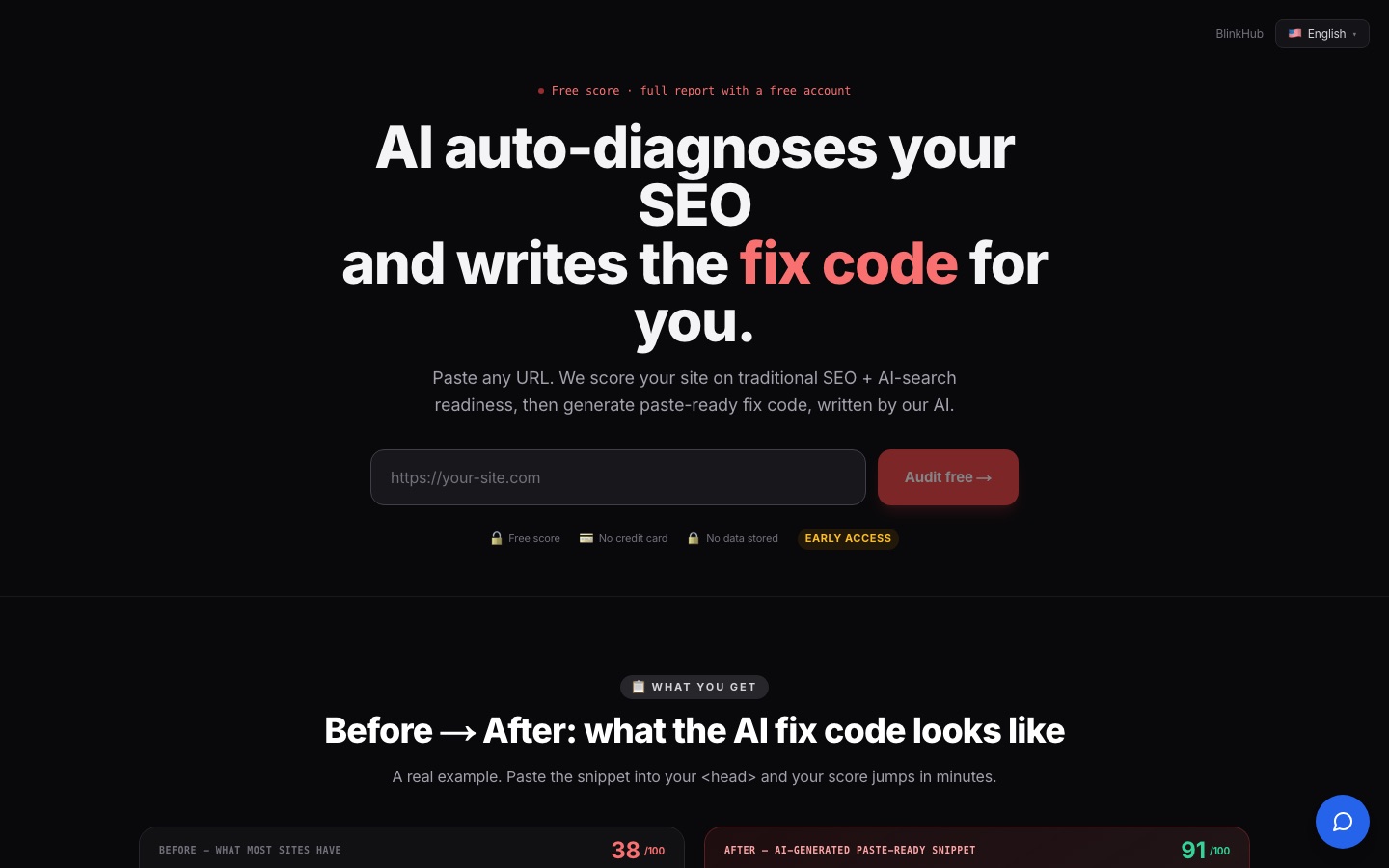
robots.txtto protect their content. That is a legitimate choice, but a page an assistant cannot read is a page it will not quote. - Before-and-after examples are illustrations. The tool's own landing page shows a sample site jumping from 38 to 91. That example is fictional; your result depends on your page.
Who makes it
BlinkHub sells the audit as one piece of a pay-as-you-go toolkit for small communications teams, alongside press-release distribution, card-style social posts and short videos. There is no monthly subscription; features draw down prepaid credits. Those paid features were not tested for this article.
The bottom line
If you run a small business site, a blog or a newsroom, the free score takes under a minute and needs nothing but a web address. The most likely finding is the one we got: a site built for search engines, but not yet for the assistants that increasingly sit in front of them. The good news is that most of the fixes are a few lines of code.