Ask a new TikTok LIVE creator what 10,000 diamonds is worth and you will usually get one of two answers: "about $100" or "about $50, then TikTok takes half." Both are wrong, and the gap between them is the difference between a realistic budget and a disappointing first payout.
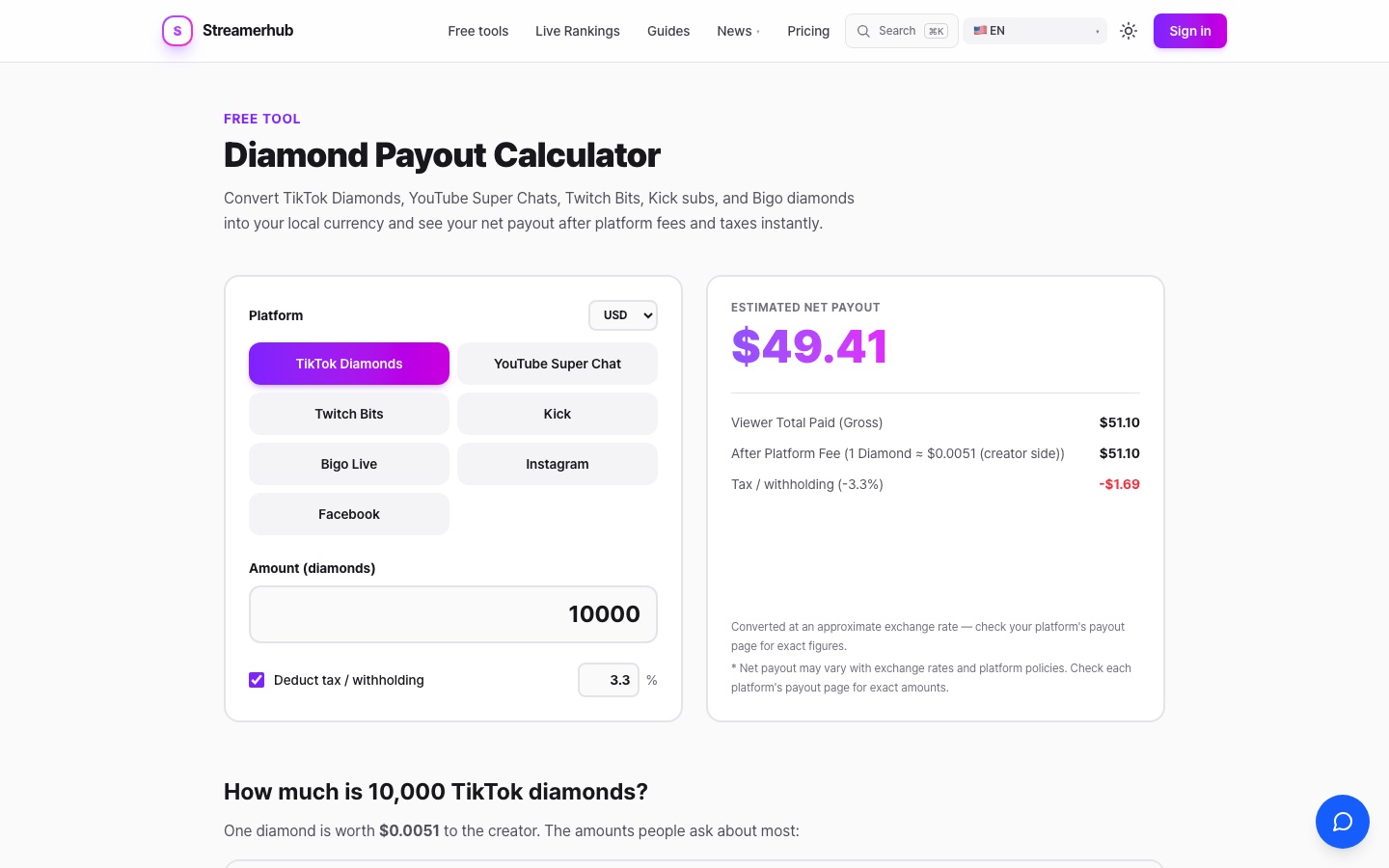
The short answer is that 10,000 diamonds is worth roughly $51 before tax. That is the figure produced by the free Diamond Payout Calculator on StreamerHub, a site that builds tools and guides for live streamers. The calculator runs entirely in the browser and does not require an account.
Where the $51 comes from
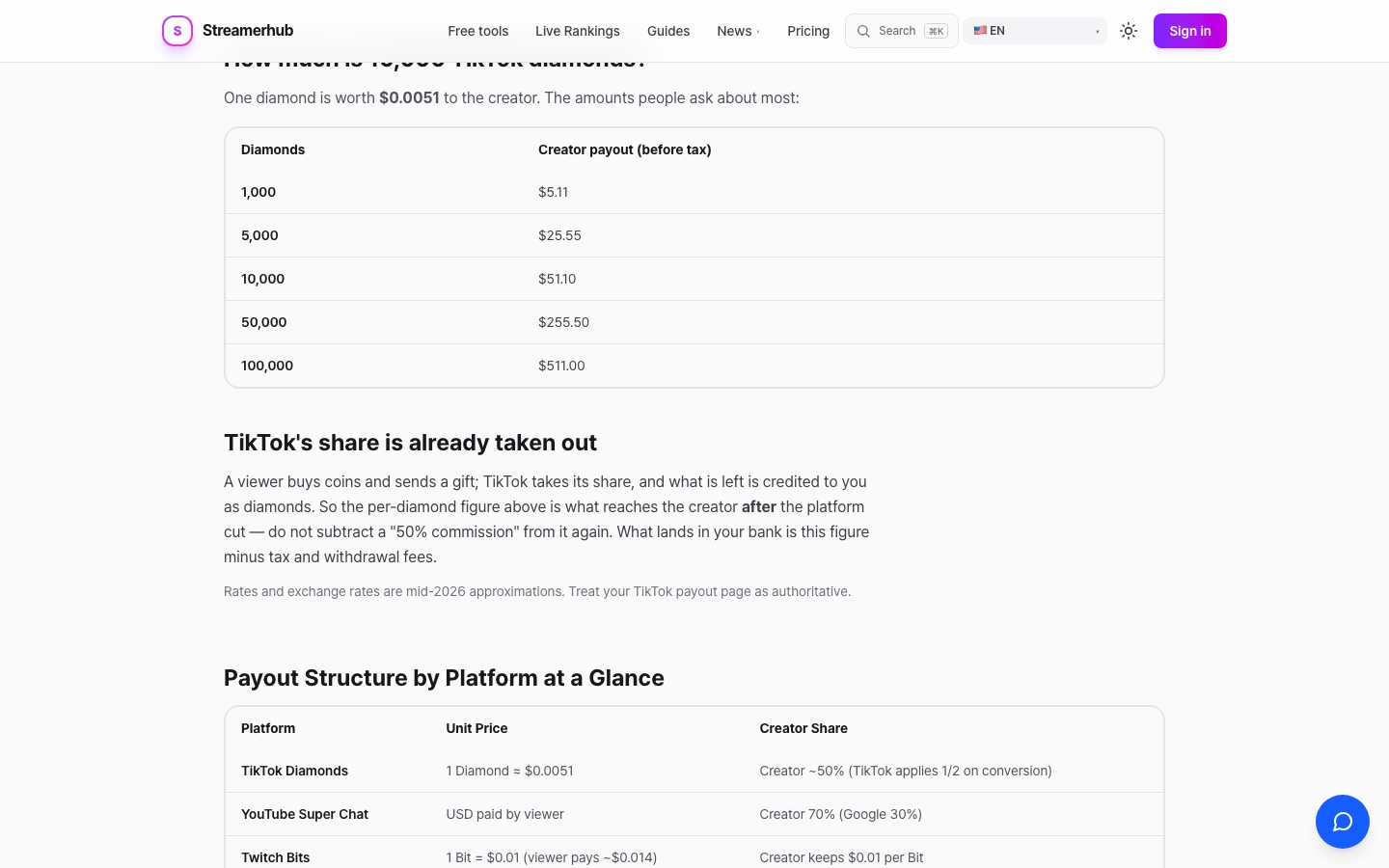
Gifting on TikTok LIVE works in two currencies. Viewers buy coins and spend them on virtual gifts during a stream. The creator receives those gifts as diamonds, which can be cashed out. The calculator values one diamond at about $0.0051 to the creator, which gives these amounts before tax:
| Diamonds | Creator payout, before tax |
|---|---|
| 1,000 | $5.11 |
| 5,000 | $25.55 |
| 10,000 | $51.10 |
| 50,000 | $255.50 |
| 100,000 | $511.00 |
The tool labels these as mid-2026 approximations that depend on exchange rates, and tells creators to treat the payout page inside their own TikTok account as the authoritative number. That caveat matters: the rate is set by the platform, not by any third-party calculator, and it can change.
The most common mistake: subtracting TikTok's cut twice
The "TikTok takes half" answer comes from a real fact applied in the wrong place. The platform does keep a large share of what viewers spend on gifts. But that share is taken before the gift is credited to the creator as diamonds. The per-diamond value already reflects it.
StreamerHub's own explanation puts it plainly: "do not subtract a '50% commission' from it again." What actually lands in a creator's bank account is the diamond value minus income tax and any withdrawal fees charged by the payment method.
A note for U.S. creators on the tax field
The calculator deducts 3.3% by default. That number is a withholding rate used in South Korea, where the tool was first built, and it does not describe U.S. taxes. American creators should untick the box or type in their own estimated rate. In the United States, creator income is generally taxable, and the right rate depends on the individual's situation, so a tax professional is the right person to ask.
How TikTok compares with other platforms
The same page converts other platforms' tipping systems using these assumptions, which are useful for creators who stream in more than one place:
- YouTube Super Chat: the creator keeps about 70% of what the viewer pays.
- Twitch Bits: the streamer receives $0.01 per Bit. Viewers pay slightly more than a cent per Bit when they buy them.
- Kick: subscriptions are split 95/5 in the creator's favor, at about $4.99 per sub.
- TikTok: about $0.0051 per diamond, after the platform's share.
These are the tool's stated assumptions rather than figures published by each platform, and each platform's creator dashboard remains the final word.
Other free pages worth a look

Two other StreamerHub pages work without an account:
- Platform Events & Programs lists creator monetization programs for TikTok, YouTube, Twitch, Kick, Bigo, Instagram and Facebook, with the stated requirements and a link to each official page. Each card shows the date it was last verified, and readers should check that date before relying on a requirement.
- Live Stream Rankings shows the channels that are live right now, ranked by concurrent viewers. It currently covers Twitch and YouTube; TikTok LIVE is not included.
The site's AI tools, such as a live-title scorer and a troubleshooting assistant called Live SOS, require a free account. New accounts receive 750 credits, enough for about three runs, according to the pricing page.
The bottom line
If you are planning around gifts, count on roughly half a cent per diamond, not a full cent and not a quarter-cent. Ten thousand diamonds is about $51 before tax, and the platform's share is already gone by the time you see that number. Check the figure against your own payout page, adjust the tax for where you live, and plan from there.