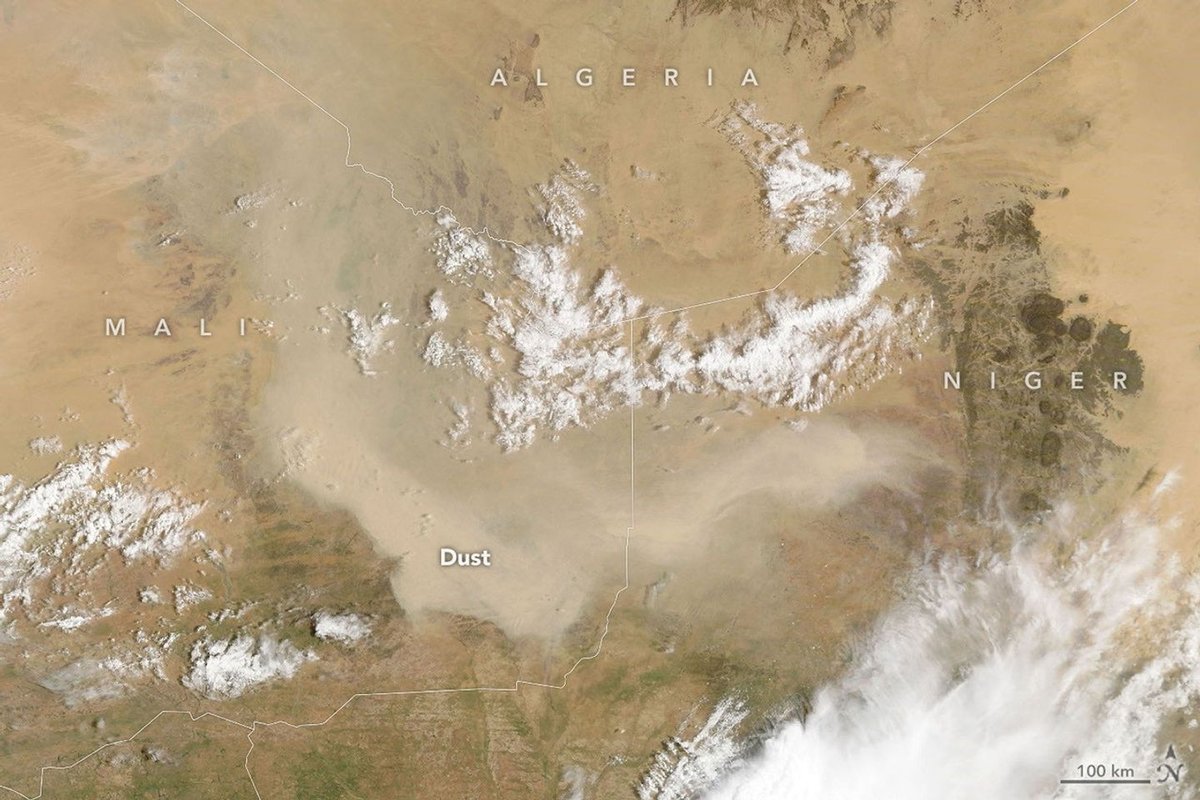
Dust storms can still occur, though, as one did in early September 2026, when a plume covered parts of Mali and neighboring countries.
TheMODIS on NASA’sTerrasatellite captured this image on September 5, 2026.
According to Tianle Yuan, an atmospheric scientist at NASA’s Goddard Space Flight Center, storms like this one are often associated withhaboobs—powerful dust storms driven by strong convective winds.
In the days after this image was acquired, awider satellite viewshowed aerosols from the region moving westward and spilling over the Atlantic Ocean.
However, a full transatlantic crossing is unlikely.
Such crossings are more common from late spring through summer, when the Saharan Air Layer—a dry, dusty mass of air—can carry dust thousands of miles westward from Africa, riding high in the atmosphere.
Looking ahead, the developingEl Niñocould reshape these patterns.
For instance, Yuan noted that the phenomenon can affect dust over the Sahel and Mali by shifting the Intertropical Convergence Zoneand altering convection patterns, though the influence cuts both ways.
Drier conditions can leave more loose sediment available for winds to lift, but less convective activity also means fewer intense storms to kick up large dust plumes in the first place. “The connection can be real,” Yuan said, “but hard to pin down for individual events.”
NASA Earth Observatory image by Lauren Dauphin, using MODIS data from NASAEOSDIS LANCEandGIBS/Worldview. Story by Kathryn Hansen.
JPEG
NASA EarthdataSaharan Dust Versus Atlantic Hurricanes. Accessed September 9, 2026.
NASA Earth ObservatoryAfrica Sheds Some Dust. Accessed September 9, 2026.
NASA Earth ObservatoryA Dusty Journey. Accessed September 9, 2026.
NASA Earth ObservatoryFrom the Dust Bowl to the Sahel. Accessed September 9, 2026.
Stay up-to-date with the latest content from NASA as we explore the universe and discover more about our home planet.
An astronaut’s photo, taken en route to the Moon, reveals our planet and its place in space in a novel…
Your challenge is to tell us the location of the satellite image and why it is interesting.
The Pacific was buzzing with storms while the Atlantic was notably quiet.
Subscribe to the Earth Observatory and get the Earth in your inbox.
NASA’s Earth Observatory brings you the Earth, every day, with in-depth stories and stunning imagery.
Explore Earth Science
Open access to NASA’s archive of Earth science data