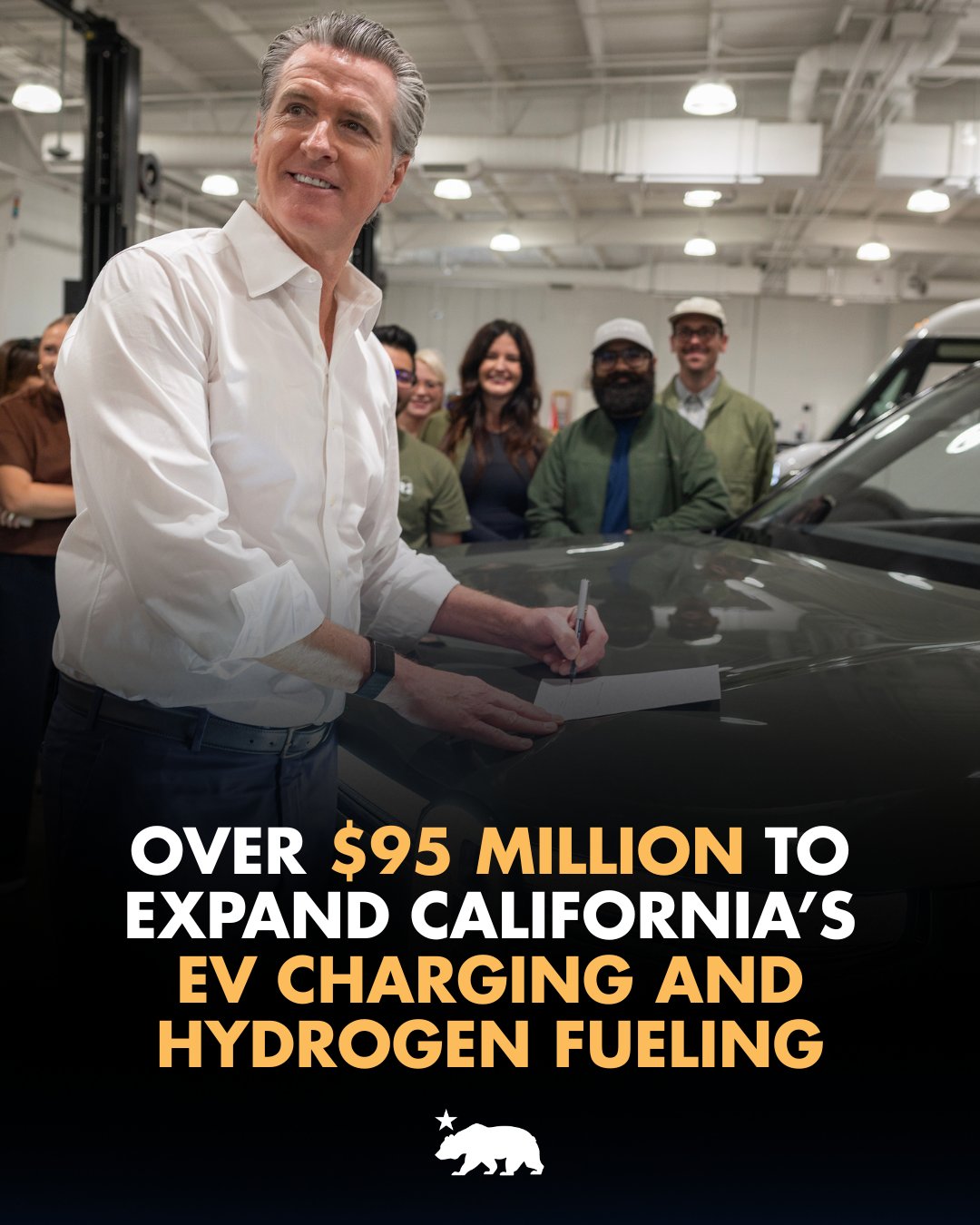
Governor Gavin Newsom announced $95.2 million in state funding for zero-emission vehicle (ZEV) infrastructure across California, including electric vehicle charging stations and hydrogen refueling facilities.
The California Energy Commission approved the investment on Monday. The funding prioritizes charging infrastructure close to where Californians live, work, and drive, while supporting light-, medium-, and heavy-duty ZEVs.
The allocation breaks down as follows: $48 million for light-duty EV charging infrastructure, emphasizing direct current fast charging and at-home or near-home charging; $30.2 million for medium- and heavy-duty ZEV infrastructure focused on freight, port, public fleet, and school bus operations; $15 million for hydrogen refueling; and $2 million for ZEV workforce training and development.
At least 50 percent of program funds must benefit low-income Californians and residents of low-income and disadvantaged communities. As of March 2026, more than 62 percent of Clean Transportation Program funds have gone to projects in disadvantaged or low-income communities.
The investment builds on California's Clean Transportation Program, which has allocated more than $2.7 billion since 2008 for ZEV infrastructure development. The program has installed or planned more than 52,000 EV chargers statewide, including about 41,000 lower-power chargers and more than 11,000 DC fast chargers, and helped build the nation's largest network of hydrogen refueling stations with more than 100 stations for light-, medium-, and heavy-duty fuel cell electric vehicles.
According to the state, California now has 216,445 publicly available and shared EV charging ports across the state. The state surpassed 20,000 DC fast chargers earlier this year. Public chargers are located at fully accessible sites like grocery stores, park-and-ride lots, and gas stations, while shared chargers are found at workplaces, doctors' offices, and sports facilities with some level of restricted access. An estimated 800,000 EV chargers have been installed at residential homes.
California Energy Commissioner Nancy Skinner said the program's expansion accelerates the state's clean transportation goals. "The faster California can build out ZEV infrastructure, giving drivers the confidence they need to get off of gas-powered vehicles, the quicker we can clean the air and improve public health," she said.