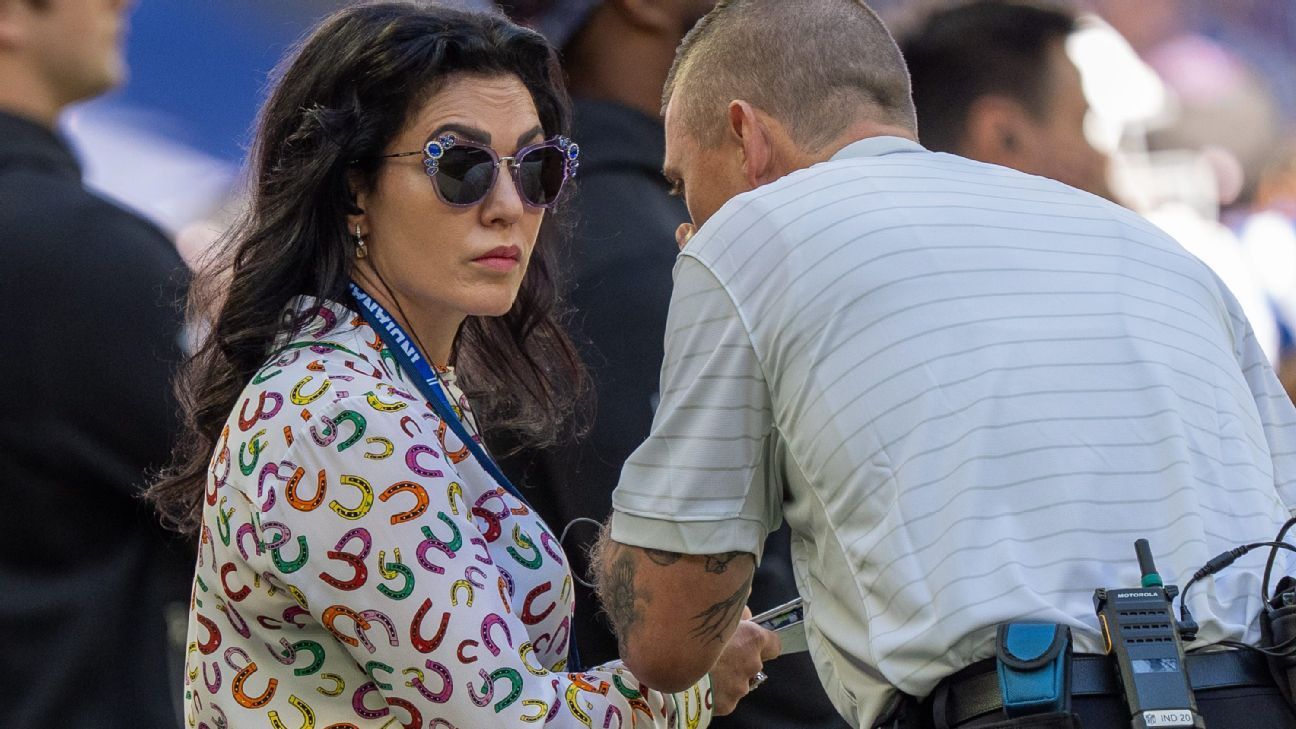
INDIANAPOLIS -- One of the most instructive moments in Carlie Irsay-Gordon's life came before she was old enough to perform long division.
She was in the third grade, but the girl who would grow up to become principal owner of the Indianapolis Colts learned then about the realities of leading a major sports franchise.
A classmate she considered her best friend was in the school restroom criticizing Colts leadership for the team's consistent lack of success at the time.
Irsay-Gordon was in a nearby stall, within earshot of it all.
“If you're old enough to remember, the ‘80s were not so great around here,” Irsay-Gordon said, referencing a period when her grandfather, Bob Irsay, was the team's owner and her father, Jim Irsay, was its general manager.
The Colts had just two winning seasons between 1980 and 1989.
“I was in third grade,” she continued. “It was probably 1987.
And I'll never forget it ..
I thought she was my best friend.
I hear her talking to this other girl.
And this other girl was saying, ’The Irsays should just get the hell out of here.
What are they even doing?
My dad says they're losers.' And [my friend] was like, ‘Yeah, maybe they are.'
”And I just remember thinking, ’Oh my gosh.' This was my best friend“
It was Irsay-Gordon's earliest memory of being on the wrong end of fan sentiment. In the decades since, that lesson has been reinforced in myriad ways:
On talk radio, where fans bemoan the Colts' lack of a playoff berth for the past five seasons.
On social media, where every word is analyzed and critiqued.
And in media coverage, as she is now the person who ultimately must answer for successes and failures after taking over as principal owner last year.
Learning to absorb sometimes harsh assessments has been a lifelong lesson for Irsay-Gordon.
And it all began on that day back in third grade.
When her father came home late that evening, Irsay-Gordon had some difficult questions for him.
”I said, ‘Why do we suck so much?'“ she recalled. ”'People are getting mad, and they're saying all these mean things about you and Grandpa.'“
Her dad, who died one year ago this week , looked at her and offered two hard truths.
First, he said that her friend probably wasn't a real friend after all.
Then, he said of criticism generally, ”It's just part of the job.“
Jim Irsay's words resonate every day for Irsay-Gordon and her sisters and co-owners, Casey Foyt and Kalen Jackson.
It is up to them to guide the Colts through another rough patch as they enter the 2026 season trying to overcome a brutal end to 2025: an injured quarterback, seven straight losses and a free fall from the best record in the NFL at midseason to out of the playoffs by January.
Daniel Jones ’ torn Achilles played a big role in the stunning losing streak, a tailspin that dropped the Colts from 8-2 to 8-9.
Irsay-Gordon's understanding of being the subject of debate has grown since her father's death. In previous years, she rarely put herself out there and happily worked in the background.
Meanwhile, Jim Irsay was one of the NFL's best-known owners.
He had a huge persona, was consistently available to reporters and was not afraid to be candid -- he was one of the owners most willing to publicly push for former Washington owner Dan Snyder's ouster, for example.
His daughters, meanwhile, worked mostly in anonymity from the perspective of those outside the franchise. But Irsay-Gordon is often reminded she is no longer in the shadows.
Case in point: She recalled a recent trip to the grocery store -- her oldest daughter wanted snacks -- when something unfamiliar happened. Irsay-Gordon was in an aisle looking at items on the shelves when she noticed a woman staring at her.
”I thought I was in her way,“ Irsay-Gordon said. ”And she's like, ‘No. Are you her?' And I'm like, ’Who?'“